The Legacy of the Koekkoek Lineage
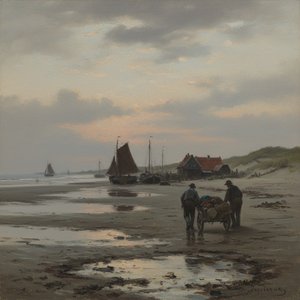
To understand the artistry of Hendrik Barend Koekkoek, one must first understand the profound weight of his heritage. He was born into a veritable dynasty of painters, part of the illustrious Koek koek family—a lineage so prolific that it produced eighteen artists across five generations, making it perhaps the most expansive family of painters in global history. Growing up within this vibrant creative ecosystem, Hendrik’s early life was steeped in the traditions of Dutch landscape and marine art. His father, Hermanus Koekkoek, a celebrated marine artist, served as his primary mentor, imparting not only the technical nuances of capturing the sea's majesty but also a deep-seated reverence for the natural world. This familial foundation ensured that Hendrik’s brushstrokes were imbued with a sense of continuity, connecting him to the Romantic traditions that had defined his ancestors.
The early works of Koekkoek reflect this profound influence, characterized by an emotive expression and a fascination with the dramatic, sweeping vistas typical of the Romantic movement. His brothers, including Johannes Herman and Willem, were fellow travelers in this artistic journey, creating a collaborative atmosphere where innovation was nurtured by shared technique. In these formative years, Hendrik’s work mirrored his father's focus on the power of nature, often prioritizing the atmospheric tension and the sublime beauty found in the Dutch coastline and untamed forests.
A Transformation from Romanticism to Realism
As Koekkoek’s career matured, he underwent a significant stylistic evolution that would ultimately define his unique contribution to 19th-century art. While his roots remained firmly planted in the Romantic ideals of his youth, he began to feel the limitations of purely emotive representation. Seeking a deeper connection to the tangible world, he turned his gaze toward the principles of the Hague School. This transition marked a shift from the idealized and dramatic toward a commitment to scientific accuracy and nuanced tonal gradations. He moved away from the theatricality of the past to embrace a more disciplined observation of light, shadow, and texture.
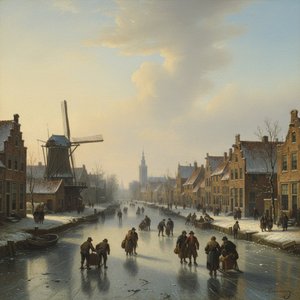
This metamorphosis resulted in a breathtaking synthesis of two seemingly opposing movements: the Romantic idealism of his heritage and the realist precision of the Hague School. In works such as "Beech tree Sun," one can witness this delicate balance. The painting captures a serene, almost spiritual moment in nature, yet it is executed with a meticulous attention to detail that honors the physical reality of the bark, the translucency of the leaves, and the subtle interplay of sunlight filtering through the canopy. His ability to capture these fleeting atmospheric effects—the way light dances across a forest floor or settles upon a winter landscape—became his artistic hallmark.
Artistic Mastery and Historical Significance
The significance of Hendrik Barend Koekkoek lies in his role as a bridge between eras. He did not merely abandon the Romanticism of his ancestors; rather, he refined it through the lens of modern realism. His landscapes are more than mere depictions of scenery; they are studies in light and life. Whether portraying the quiet solitude of a "Winterlandscap with ruin" or the pastoral warmth of a "Farmers couple on forest hill," his work possesses an enduring vitality that speaks to the universal beauty of the natural landscape.
Throughout his life, Koekkoek’s dedication to his craft allowed him to leave an indelible mark on Dutch art. His mastery of the medium ensured that the Koekkoek name remained synonymous with excellence in landscape painting well into the turn of the century. Today, his works serve as a vital historical record of a period of profound transition in European art, reminding us of a time when the pursuit of scientific truth and the celebration of poetic emotion could exist in perfect, luminous harmony.
질의응답
Hendrik Barend Koekkoek의 작품 전체 목록을 볼 수 있는 곳이 있나요?
본 웹사이트에 등록된 Hendrik Barend Koekkoek의 모든 작품은 작가의 모든 작품 보기 페이지에서 확인하실 수 있습니다.
Hendrik Barend Koekkoek 작가 작품에 대한 통계 정보는 어디에서 확인할 수 있나요?
Hendrik Barend Koekkoek의 작품에 관한 통계를 보여주는 통계 페이지가 본 웹사이트에 마련되어 있습니다.
Hendrik Barend Koekkoek 작가의 출신 국가는 어디인가요?
Hendrik Barend Koekkoek은(는) Netherlands에서 태어났습니다.