A Life Shaped by Light and Landscape
Born in Scarborough, North Yorkshire, on 13 June 1871, Harry Watson moved through the world with a keen eye for the subtle shifts of natural light. His early years were marked by a brief residence in Winnipeg, Canada, between 1881 and 1883, before returning to the English coast to begin his formal studies. He gathered his technical foundation at the Scarborough School of Art, followed by periods of study at the Lambeth School of Art and the Royal College of Art. It was during these years, from 1889 to 1894, that he earned various medals and a travelling scholarship to Italy, an experience that likely deepened his understanding of classical form.
Watson’s approach to the canvas was defined by a commitment to painting en plein air. He sought to capture the way sunlight interacted with its surroundings, a pursuit evident in works such as Sunlight Reflected Upon a Wide Riverscape and Reflected Light. His method often leaned toward an impressionistic style, utilizing loose brushwork to translate atmospheric conditions onto the surface of his oils and watercolours. This focus on the ephemeral qualities of light allowed him to bridge the gap between traditional representation and the more fluid techniques emerging in the early twentieth century.
The Quietude of the English Scene
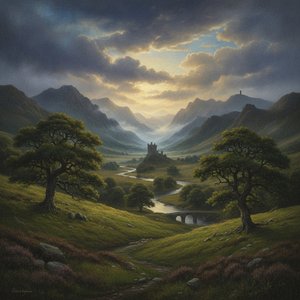
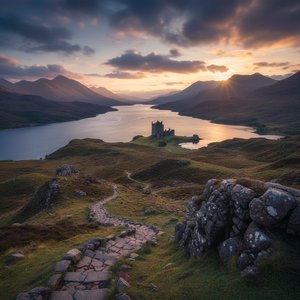
While his training provided a rigorous structure, Watson’s subject matter often drifted toward the tranquil and the domestic. He possessed a particular affinity for the Scottish Highlands, where he documented the stillness of places like Loch Rannoch. In The Edge of Loch Rannoch, the artist employs subtle tonal variations to convey a sense of peace. His landscapes were rarely dramatic in a theatrical sense; instead, they offered a quiet observation of the natural world.
This sensitivity extended to his portraiture and depictions of social life. He captured members of the upper middle class in moments of leisure, imbuing these scenes with a psychological depth that moved beyond mere likeness. In A Tale by the Way, he presents a window into the customs of the Victorian and Edwardian eras. His ability to render textures—seen clearly in the impasto of Study Of A Young Girl In A Pink Dress—complemented his skill in portraying the soft, unhurried rhythms of daily life.
Professional Standing and Later Years
Watson’s career was marked by steady recognition within the British art establishment. He began exhibiting at the Royal Academy in 1896 and maintained active memberships in several prestigious organizations:
- The Royal Watercolour Society (R.W.S.) from 1915
- The Royal West of England Academy (R.W.A.) from 1927
- The Royal Institute of Oil Painters (R.O.I.) from 1932
Beyond the easel, he contributed to the instruction of others, teaching life drawing at the Regent Street Polytechnic starting in 1913. His technical knowledge was also codified in his 1930 publication, Figure Drawing. Even as he participated in broader cultural events, such as the painting competition at the 1932 Summer Olympics, his work remained rooted in the observation of light and form. He passed away on 17 September 1936, leaving behind a body of work held in collections ranging from the Tate Gallery to the Scarborough Art Gallery.
Q&A
Harry Watson의 다른 이름이나 별칭에는 무엇이 있나요?
Harry Watson은(는) Гарри Уотсон라는 이름으로도 활동하고 있습니다.
Harry Watson은(는) 어느 시대의 작품을 남겼나요?
Harry Watson은(는) Modern 시대에 활동했습니다. 이 시기는 역사적 맥락 속에서 작가의 예술적 위치를 보여줍니다.
Harry Watson의 작품 중 몇 점을 둘러보실 수 있나요?
전체 작품 보기 페이지에서 Harry Watson의 작품 작품 13점점을 만나보실 수 있습니다.
Harry Watson의 모든 작품을 어디에서 볼 수 있나요?
이 사이트에 등록된 Harry Watson의 모든 작품은 작가의 전체 작품 보기 페이지에서 만나보실 수 있습니다.