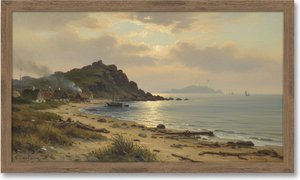
A Life Rooted in the Danish Soil
Born in Fredericia to a customs clerk and a mother named Vilhelmine Sophie, Harald Foss began his path far from the easel. Before he ever held a brush with intent, he served as a disciple at a pharmacy following his confirmation. This early period of quiet service eventually gave way to a profound calling toward the natural world. In 1861, he moved to Copenhagen to seek formal training at the Academy of Fine Arts, where he became a pupil of P.C. Skovgaard. Under this guidance, Foss began to develop a deep connection to the landscapes of his homeland.
His education was further shaped by the tutelage of V. Kyhn, whose influence proved vital to his growth as a landscape painter. This training instilled in him a romantic approach to the scenery of Denmark. He possessed a particular devotion to the hilly terrains and rural life found within Jutland. His eye for nature was so singular that he was known to intentionally omit buildings from his compositions if they threatened to spoil the purity of the view. To Foss, the landscape was a sanctuary of untouched beauty.
The Pursuit of Light and Landscape
As his skills matured, Foss sought inspiration beyond the borders of Denmark. In 1879, he undertook a significant foreign trip that carried him through Germany, Austria, Italy, and France. These travels expanded his understanding of light and form, yet his heart remained tethered to the Danish countryside. He found his most profound subjects in the undulating hills and quiet forests of his native land, capturing the essence of places like Sæby forest and the hills at Ry.
His dedication to his craft earned him several honors during his career. In 1867, he received the Southern Ringian Encouragement Prize, and later, he was awarded annual medals at exhibitions in 1888 and 1889. His professional standing grew steadily, leading to his membership in the plenary session of the Academy in 1889 and his appointment as a titular professor in 1901. Even as he achieved academic distinction, he remained a man of the outdoors, often staying with local residents during his painting excursions to better understand the rural life he depicted.
A Legacy of Teaching and Nature
In the later years of his life, Foss found a new way to share his passion for the natural world. He settled in Virkland, where he established a summer painting school. This institution became a successful endeavor, attracting students who sought the same freedom found in the environment that had shaped him. Through this school, he passed on his techniques and his reverence for the landscape to a new generation of artists.
The works he left behind continue to reside in important collections, such as the Royal Painting Collection, which holds his depiction of the hills at Ry. His paintings, including scenes of boys fishing in the Ladegaardsaa or the morning light over autumn hills, remain focused on the quiet dignity of the Danish landscape. He passed away in Frederiksberg, leaving behind a body of work that celebrates the unadorned beauty of the Jutland terrain.
Q&A
Harald Foss의 작품 중 몇 점을 둘러보실 수 있나요?
전체 작품 보기 페이지에서 Harald Foss의 작품 작품 6점점을 만나보실 수 있습니다.
Harald Foss의 작품을 사조별로 둘러볼 수 있나요?
Harald Foss 작가의 작품을 예술 사조별로 모아둔 모든 미술 사조 페이지에서 해당 작가가 활동했던 사조를 확인하실 수 있습니다.
Harald Foss 작가의 작품을 연도별로 어떻게 확인할 수 있나요?
Harald Foss의 작품을 연도별로 정리하여 보여주는 작품 연대기 페이지입니다.