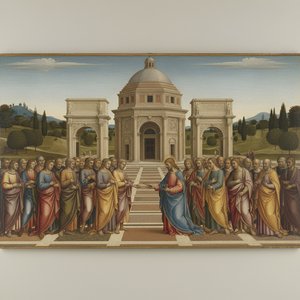
The Florentine Legacy of Gregorio Pagani
In the vibrant, sun-drenched landscape of late 16th-century Florence, a period where the structured elegance of the High Renaissance began to yield to the restless, emotive energy of Mannerism, Gregorio Pagani emerged as a vital custodian of spiritual narrative. Born around 1558 into an artistic lineage that already breathed the air of creativity, Pagani was the son of the painter Francesco Pagani. This early immersion in the workshop traditions of Florence provided him with more than just technical foundations; it offered him a profound connection to the Florentine disegno—the disciplined art of drawing and structural integrity that would define his entire career.
Pagani’s artistic evolution was shaped by a sophisticated synthesis of styles, nurtured under the tutelage of two of the era's most influential masters. Through his studies with Santi di Tito, he inherited a commitment to meticulous realism and clarity, a quality that prevented his religious compositions from dissolving into mere abstraction. However, it was his subsequent time in the studio of Ludovico Cigoli that infused his work with a burgeoning sense of drama and expressive dynamism. This unique duality—the marriage of precise anatomical truth with a theatrical use of light and color—allowed Pagani to create works that were both intellectually grounded and emotionally resonant.
Mastery of the Sacred and the Lost Grandeur
The true essence of Pagani’s oeuvre lies in his ability to transform altarpieces and devotional scenes into windows of profound spiritual experience. He possessed a rare talent for capturing the quiet, luminous moments of the divine, most notably seen in his breathtaking nativity scenes. His work for the cathedral of Santa Maria del Fiore stands as a testament to his ability to utilize intricate detail and a radiant color palette to evoke the awe of the Nativity, drawing the viewer into a state of contemplative grace.
Yet, much of Pagani’s most ambitious legacy remains shrouded in the tragedy of history. His monumental painting for Santa Maria del Carmine, titled St. Helena Finding the Cross, was celebrated as a pinnacle of his creative power, showcasing a masterful command of composition and narrative tension. Tragically, this masterpiece was lost forever in the devastating fire that consumed the church in 1771. Today, we are left to reconstruct the grandeur of his vision through fragmentary sketches and preparatory drawings, which serve as hauntingly beautiful echoes of a lost Florentine splendor.
A Bridge Between Eras and Generations
Beyond his individual canvases, Pagani’s historical significance is cemented by his role as a pivotal educator and a bridge between the late Mannerist tradition and the approaching Baroque era. His studio became a crucible for the next generation of Florentine masters, most notably Cristofano Allori and Matteo Rosselli. In teaching Allori, Pagani passed on the essential tools of tonal gradation and emotional depth, helping to shape an artist who would eventually blend Florentine precision with the lushness of Venetian color.
The influence of Pagani can be traced through several key artistic developments:
- Technical Lineage: The transmission of disegno from the tradition of Santi di Tito to the burgeoning Baroque style.
- Stylistic Synthesis: The integration of Cigoli’s dramatic light with a more grounded, realistic approach to religious subjects.
- Pedagogical Impact: The mentorship of Cristofano Allori, whose work would carry Pagani's lessons into the new century.
Though his life was relatively short, ending in 1605, Gregorio Pagani left an indelible mark on the Florentine school. His ability to navigate the transition from the calculated elegance of Mannerism to a more palpable, psychological intensity ensures that he remains a figure of immense importance for anyone seeking to understand the soul of late Renaissance Italy.
Q&A
Gregorio Pagani 작가의 작품을 감상할 수 있는 3D 가상 투어가 있나요?
Gregorio Pagani의 작품은 작가의 3D 갤러리 페이지 내 3D 갤러리에서 감상하실 수 있습니다.
Gregorio Pagani의 예술 세계는 시간이 흐름에 따라 어떻게 진화했나요?
Gregorio Pagani의 예술적 여정은 연대기 페이지에서 시기별로 펼쳐집니다. 이곳에서는 작가의 활동 시기를 장(chapter)으로 나누어 작품들을 연대순 타임라인 형태로 한눈에 확인할 수 있습니다.
Gregorio Pagani의 작품을 분위기별로 모아둔 곳은 어디인가요?
아티스트의 무드 룸 페이지에서는 Gregorio Pagani의 작품들을 분위기에 따라 큐레이션된 형태로 만나보실 수 있습니다.