A Life Shaped by Color and Line
In the quiet town of Randalstown, County Antrim, a young girl named Gladys Moore Maccabe began to see the world through a lens of fine detail and design. She was born into a household where art was woven into the very fabric of daily life; her mother, Elizabeth, worked as a designer in the linen industry, while her father, George Chalmers, brought the disciplined beauty of calligraphy and illumination to their home. This early immersion in craftsmanship meant that by the age of thirteen, her talent was already finding its way into national publications. The precision required for such work stayed with her as she moved to Belfast to study sculpture and commercial art at the Belfast School of Art.
Her path was deeply intertwined with that of Max Maccabe, a fellow artist and musician whom she married in 1941. Together, they shared more than a home; they shared a creative pulse, exhibiting their works side by side in galleries from Belfast to London. They were part of a circle of painters known as The Contemporary Ulster Group, finding companionship in the shared experimentation of their era. Even as she navigated the complexities of her personal life, such as the loss of her father which led her to remain in Ulster rather than pursuing studies in London, her commitment to the local art scene never waed.
The Pulse of Everyday Life
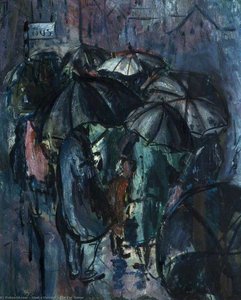
Gladys possessed a particular eye for the movement of crowds and the quiet energy of communal spaces. Her canvases often focused on the simple, shared moments of Northern Irish life: the bustle of a market, the excitement of a race meeting, or the calm of a beach. She had a way of capturing people in their natural elements, whether they were waiting for a bus on a rainy day or gathered at a local fair. This interest in the human element extended to her still lifes and floral studies, where she applied the same careful observation she used for larger social scenes.
As the years progressed, the atmosphere around her changed. During the height of The Troubles in 1969, the peace of her earlier subjects was interrupted by the harsh realities of conflict. She turned her brush toward the streets of Belfast, documenting the presence of barricades and the heavy shadows cast by civil unrest. Works such as Barricades and Petrol Bomb Sequel reflected a landscape transformed by tension, showing that her art could hold both the charm of a summer market and the gravity of a changing society.
A Legacy of Advocacy and Recognition
Beyond her own brushwork, Gladys was a driving force for others. In 1957, moved by the lack of opportunities for her female peers, she founded the Ulster Society of Women Artists. She served as its first President, beginning with just ten members, to ensure that the talent of women in Northern Ireland would no longer go unnoticed. Her work as a journalist and arts correspondent further allowed her to shape the cultural conversation, bringing news of fashion and fine art to newspapers and television audiences alike.
Her many honors reflected a lifetime of dedication to the arts. She was appointed an MBE for her services to the community and held fellowships in several prestigious societies. Her paintings found permanent homes in significant collections, including:
- The Ulster Museum
- The Royal Ulster Academy
- The Arts Council of Ireland Collection
- The Imperial War Museum
Through her dual roles as a creator and an advocate, she left behind a record of a century defined by both beauty and struggle.
질의응답
Gladys Maccabe의 작품 중 조회수가 가장 높은 것은 무엇인가요?
Gladys Maccabe 작가 작품에 관한 통계 정보는 작가의 통계 페이지에서 확인하실 수 있습니다.
Gladys Maccabe 작가는 어떤 색상을 가장 자주 사용했나요?
Gladys Maccabe 작가 작품의 컬러 프로필은 작가의 팔레트 지놈 페이지에서 확인하실 수 있습니다.
Gladys Maccabe의 작품을 색상별로 정렬해서 볼 수 있나요?
Gladys Maccabe의 작품은 작가의 색상별 인덱스 페이지에서 색상별로 살펴보실 수 있습니다.