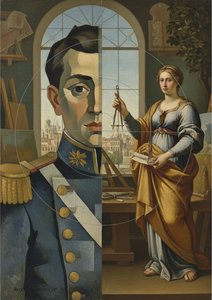
The Life and Art of Georges Maroniez
Born in Douai, France, Georges Maroniez was a man of diverse pursuits, serving as a magistrate in Boulogne-sur-Mer, Avesnes-sur-Helpe, and Cambrai before devoting himself entirely to art. His formal training began at the École des Beaux-Arts of Douai under Pierre Billet, where he met Adrien Demont. This connection led him to the coastal scenery of Wissant and the "École de Wissant." While his early career was tied to the judiciary, his passion for the canvas eventually led him to resign from the magistracy in 1905.
His artistic output focused on landscapes with figures, often characterized by Flemish realism. He was known for capturing:
Technical Innovations and Later Years
Beyond the easel, Maroniez was an inventor with a profound interest in photography. He patented the "Sphynx," a simplified hand-held camera, in 1891, utilizing film invented by his relative, Victor Planchon. His travels through North Africa, the Middle East, and the Mediterranean resulted in over 1,600 images. Additionally, he patented a method in 1899 to suppress vibrations in cinematographs.
During the German occupation of north-east France, his studio was looted and his wife was deported to an internment camp in Lower Saxony. Following the ceasefire, the family relocated to Paris in 1919. Maroniez, who had been created a Knight of the Légion d'honneur in 1918, died in Paris and was interred in the family vault at Cambrai.
Q&A
Georges Maroniez 작가의 국적은 어디인가요?
Georges Maroniez은(는) France 출신입니다.
Georges Maroniez의 활동 시기는 어떻게 구분되어 있나요?
Georges Maroniez의 연대기는 작가의 활동 시기별로 분류된 작품들을 연대순으로 보여주는 스크롤 방식의 타임라인입니다.
미술 사조별로 분류된 Georges Maroniez의 작품은 어디에서 볼 수 있나요?
Georges Maroniez의 작품은 작가의 모든 미술 사조 페이지에서 사조별로 만나보실 수 있습니다.
Georges Maroniez의 작품 중 몇 점을 둘러보실 수 있나요?
전체 작품 보기 페이지에서 Georges Maroniez의 작품 작품 11점점을 만나보실 수 있습니다.