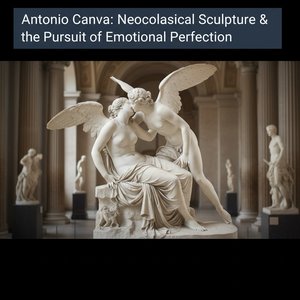
Early Life and Artistic Foundations
Gaetano Matteo Monti, born in the historic city of Ravenna on March 13th, 1776, emerged into a world steeped in artistic tradition. His upbringing within a family already connected to the sculpting arts provided an early immersion into the beauty and discipline of form. While Ravenna itself boasted a rich Byzantine past—evident in its stunning mosaics—the burgeoning Neoclassical movement would ultimately shape Monti’s aesthetic trajectory. He initially honed his skills at the Accademia di Belle Arti in Bologna, laying the groundwork for his future endeavors. However, it was his subsequent studies in Rome, at the prestigious Accademia di San Luca, that truly ignited his passion and instilled within him a deep reverence for classical antiquity. This period proved pivotal; Monti absorbed the ideals of harmony, balance, and idealized representation that defined Neoclassicism, principles which would become hallmarks of his mature work.
Milanese Flourishing and Collaborative Projects
Around the early 19th century, Monti relocated to Milan, a city undergoing significant transformation during both the Napoleonic era and its aftermath. He quickly established himself as a prominent figure within the artistic community, contributing significantly to several ambitious architectural projects. A particularly noteworthy collaboration occurred with another sculptor named Gaetano Monti (1750–1827), highlighting the vibrant artistic exchange of the time. Together, they worked on the iconic Duomo di Milano—Milan Cathedral—where Monti sculpted numerous statues destined for its soaring spires. His contribution to this monumental structure, including the exquisite statue of Saint Esichius the Martyr (1835) and a preserved gesso model within the Duomo Museum, cemented his reputation as a skilled craftsman capable of both grand scale and intricate detail. He also participated in the creation of sculptures for the Arco della Pace, further solidifying his presence in Milan’s artistic landscape.
A Legacy in Marble: Key Works and Artistic Style
Monti's oeuvre is characterized by a refined Neoclassical style—a deliberate departure from the more flamboyant Baroque traditions. His sculptures exude elegance, proportion, and an almost ethereal quality. Beyond his contributions to larger architectural endeavors, Monti excelled in creating individual monuments and busts that captured the essence of their subjects. The Tomb of Count Paolo Tosio in Brescia’s Vantiniano Cemetery (1842) stands as a testament to his ability to convey both solemnity and artistic grace. Similarly, his commemorative busts honoring literary figures like Giuseppe Parini and Giuseppe Zanoja—now housed within the Pinacoteca di Brera—demonstrate his skill in portraiture and his appreciation for intellectual pursuits. The Moses Fountain at Sacro Monte in Varese further showcases his versatility and mastery of marble.
Influences, Family Connections, and Artistic Lineage
Monti’s artistic development was profoundly influenced by the rediscovery of classical sculpture during the 18th and early 19th centuries. Artists like Antonio Canova served as key inspirations, shaping his understanding of idealized form and technical precision. His commitment to Neoclassical principles wasn't merely stylistic; it reflected a broader cultural movement that sought to emulate the perceived virtues of ancient Greece and Rome. Interestingly, Monti’s artistic lineage extended beyond his immediate family—his son, Raffaelle Monti, also became a respected sculptor, carrying forward his father’s legacy and contributing to the continuation of Neoclassical traditions in Lombardy.
Historical Significance and Enduring Impact
Gaetano Matteo Monti occupies an important position within the history of Italian sculpture. His work embodies the spirit of the Neoclassical era, characterized by a renewed interest in classical forms and ideals. While not as widely celebrated as some of his contemporaries, Monti’s contributions to major architectural projects—particularly his sculptures for the Duomo di Milano—ensure his lasting legacy. He played a crucial role in shaping the artistic landscape of Milan during a period of significant political and cultural change. His influence extended beyond his immediate circle, inspiring a generation of Lombard artists and contributing to the region's rich sculptural heritage. Monti’s sculptures continue to captivate viewers with their elegance, precision, and enduring beauty—a testament to the power of classical ideals and the skill of a dedicated artist.
질의응답
Gaetano Matteo Monti 작가의 작품을 3D 갤러리에서 어디서 볼 수 있나요?
Gaetano Matteo Monti의 작품은 작가의 3D 뮤지엄 페이지에 마련된 3D 갤러리에서 감상하실 수 있습니다.
Gaetano Matteo Monti의 작품을 색상 스펙트럼별로 살펴볼 수 있나요?
Gaetano Matteo Monti의 작품은 작가의 색상별 인덱스 페이지에서 색상별로 살펴보실 수 있습니다.
Gaetano Matteo Monti의 작품은 얼마나 인기가 있나요?
Gaetano Matteo Monti 작가 작품에 관한 통계 정보는 작가의 통계 페이지에서 확인하실 수 있습니다.