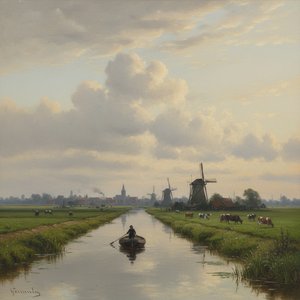
A Legacy Carved in Light and Landscape
Born into a lineage of profound artistic devotion, Friedrich Preller the Younger emerged from the cultural heart of Weimar as a master of the German landscape. The son of the esteemed painter and professor Friedrich Preller the Elder, his very beginnings were steeped in the scent of oil paints and the disciplined atmosphere of his father’s studio. From the tender age of thirteen, he was not merely an observer but an active participant in the creative process, absorbing the technical rigors of etching and painting through hands-on apprenticeship. This early immersion provided him with a foundational mastery that would later allow him to capture the ephemeral qualities of light and atmosphere with unparalleled sensitivity.
His artistic journey was profoundly shaped by a romantic yearning for the classical worlds described in ancient literature. Driven by a desire to witness the landscapes that had once inspired the Odyssey, Preller undertook transformative travels through Italy, Sicily, and Naples. These excursions were more than mere sightseeing; they were spiritual pilgrimages that allowed him to translate the mythic grandeur of the Mediterranean into the language of seascape and land painting. By wandering the rugged coasts and sun-drenched vistas of the south, he developed a unique ability to marry the topographical accuracy of a draftsman with the poetic soul of a romanticist.
The Mastery of Atmosphere and Form
As his career matured, Preller established himself as a formidable presence in the German art scene, eventually ascending to a professorship at the Dresden Academy of Fine Arts in 1880. His work during this period reflects a sophisticated command over both the terrestrial and the maritime. Whether depicting the windswept shores of Rügen or the dramatic cliffs of the Greek coast, his canvases resonate with a palpable sense of place. He possessed a rare talent for capturing the subtle shifts in weather—the heavy humidity before a storm, the crystalline clarity of a Mediterranean noon, or the soft, melancholic mist of a northern morning.
The technical brilliance of Preller’s work lies in his ability to balance structural permanence with atmospheric fluidity. His landscapes are never static; they breathe with the movement of water and the rustle of foliage. While much of his monumental work—including grand murals depicting Greek mythological themes such as Oedipus and Achilles for the Semperoper—was tragically lost to the firebombing of Dresden in 1945, the surviving remnants of his oeuvre continue to speak of a period when art sought to bridge the gap between the physical world and the realm of myth.
Historical Significance and Artistic Heritage
The significance of Friedrich Preller the Younger extends beyond his individual canvases; he represents a vital link in the evolution of German landscape painting. His life’s work serves as a testament to the enduring power of the plein air tradition and the profound impact of classical influence on nineteenth-century European art. Through his meticulous study of nature and his deep reverence for historical narrative, he helped elevate the landscape genre from mere topographical documentation to a medium of high emotional and intellectual expression.
Though much of his larger-scale legacy was consumed by the flames of war, Preller’s influence persists through the enduring beauty of his compositions and the academic lineage he helped foster. He remains a celebrated figure for those who seek to understand the intersection of naturalism and romanticism, leaving behind a body of work that continues to evoke the timeless majesty of the earth and sea.
Q&A
키워드별로 분류된 Friedrich Preller the Younger의 작품은 어디에서 볼 수 있나요?
특정 주제의 Friedrich Preller the Younger 작품을 찾으려면 키워드별로 작품이 분류된 작가의 키워드별 탐색 페이지를 이용해 보세요.
Friedrich Preller the Younger의 출생 도시와 국가는 어디인가요?
Friedrich Preller the Younger은(는) Germany Weimar에서 태어났습니다.
Friedrich Preller the Younger 작품의 연도별 타임라인이 있나요?
Friedrich Preller the Younger의 작품을 연도별로 정리하여 보여주는 작품 연대기 페이지입니다.