A Life of Art and Adversity
The story of Franz De Paula Ferg, also known by his anglicized name Francis Paul Ferg, is one of profound talent intertwined with a tragic, uncertain fate. Born in Vienna, Austria, he was the son of the history painter Adam Pankraz Ferg, who provided his initial artistic foundation. This early immersion in the world of fine art set the stage for a career defined by meticulous detail and a mastery of small-scale compositions. His education was far from singular; after beginning his training under his father, he spent four years working under a painter known as Baschueber, later refining his skills under the guidance of landscape specialists such as Johann Graf and Josef Orient. These formative years in Vienna allowed him to develop a unique ability to breathe life into landscapes through the addition of delicate figures, a technique often referred to as staffage.
As his artistry matured, Ferg’s journey took him across the European continent, from the German territories of Bamberg, Leipzig, and Dresden to the bustling streets of London. In Dresden, working alongside Johann Alexander Thiele, he established a reputation for considerable merit. His travels were not merely geographical but stylistic, as he absorbed the nuances of various masters. He found great inspiration in the engravings of Callot and Le Clerc, whose intricate line work left an indelible mark on his approach to printmaking. By the time he settled in London around 1724, he had become a versatile creator, capable of producing oil paintings, etchings, and engravings that captured both the grandeur of nature and the intimacy of human interaction.
Mastery of Genre and Landscape
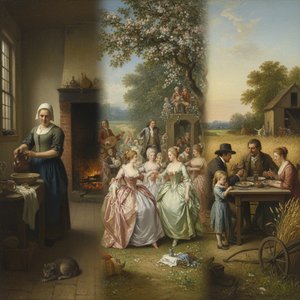
Ferg’s oeuvre is characterized by an exquisite attention to minutiae and a sophisticated command of color. He was particularly renowned for his genre paintings—scenes of daily life that depicted markets, village festivities, and the lively interactions of common folk. His works often featured a distinctive palette, frequently utilizing blueish-green landscapes contrasted with figures rendered in warm ochre, light blue, and tinted vermillion. This careful application of color, often executed on small sheets of copper, gave his pieces a jewel-like quality that appealed to the refined tastes of his era.
Beyond the bustling village squares, Ferg excelled in creating idealized Italianate landscapes, which were highly sought after by young aristocrats returning from their Grand Tours. His ability to blend the ruggedness of nature with the charm of classical ruins or tranquil canals demonstrated a remarkable range. Whether he was depicting the energetic movement of A Village Dance or the quiet stillness of a Village on a Canal, his work possessed a sense of realism and vitality reminiscent of the great Dutch masters. His technical prowess extended into printmaking, where he taught himself to etch, allowing him to offer intricate landscapes and sea-pieces that showcased his skill as both a draughtsman and a colorist.
A Tragic Conclusion
Despite his evident artistic success and the presence of his works in prestigious collections, the final chapters of Ferg’s life were shrouded in hardship. His later years in London were marked by significant financial and personal struggles. Historical accounts of his decline vary widely, adding a layer of mystery to his legacy. Some contemporary writers, such as George Virtue, attributed his destitution to an unhappy and extravagant marriage that exhausted his resources. Conversely, others, like the art dealer Noël Desenfans, suggested that a physical injury—a blow from a falling roof tile—had left him unable to continue his beloved craft.
The end of his life was as stark as it was somber. Found dead in the street near his lodgings in a state of great poverty, he was granted a pauper's burial at Saint Giles in the Fields. Though he died in obscurity and lack, the enduring legacy of his talent remains preserved in the halls of the world's greatest institutions. His works continue to be celebrated for their technical brilliance and their ability to capture the fleeting beauty of life, ensuring that the name of Franz De Paula Ferg is never truly lost to time.
- Notable collections holding his work include The British Museum, the V&A Museum, and The Met Museum in New York.
- His artistic influences included masters such as Ostade, Berchem, Poelenburg, Callot, and Le Clerc.
- He was a multi-talented artist, working as a painter, draughtsman, printmaker, and etcher.
Q&A
특정 주제별로 Franz De Paula Ferg의 작품을 어떻게 찾아볼 수 있나요?
특정 주제의 Franz De Paula Ferg 작품을 찾으려면 키워드별로 작품이 분류된 작가의 키워드별 탐색 페이지를 이용해 보세요.
Franz De Paula Ferg의 작품 중 몇 점을 둘러보실 수 있나요?
전체 작품 보기 페이지에서 Franz De Paula Ferg의 작품 작품 25점점을 만나보실 수 있습니다.
주제별로 분류된 Franz De Paula Ferg의 작품들은 어디에서 확인할 수 있나요?
Franz De Paula Ferg의 작품은 작가의 주제별 작품 모음 페이지에서 주제별로 찾아보실 수 있습니다.
Franz De Paula Ferg의 출생지와 출생 연도는 어떻게 되나요?
Franz De Paula Ferg은(는) 1689년 Vienna에서 태어났습니다.