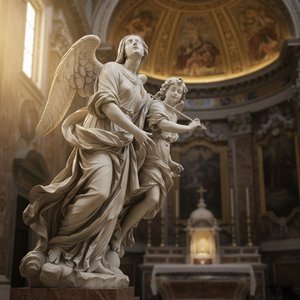
A Legacy of Light and Shadow: The Life of Felice Torelli
In the heart of the Italian Baroque era, a period defined by dramatic tension and theatrical grandeur, the name Felice Torelli resonates as a testament to the enduring power of the Bolognese school. Born in the historic city of Verona in 1667, Torelli was not merely an individual artist but a member of a profound artistic lineage. His very existence was woven into a tapestry of creativity; his father and brother were celebrated figures in the musical and artistic realms, providing him with an upbringing where melody and pigment were as natural as breath. This early immersion in the arts allowed him to develop a sensitivity to rhythm and composition that would later define his brushwork, imbuing his canvases with a certain lyrical movement characteristic of the late Baroque period.
Torelli’s journey from the banks of the Adige to the prestigious studios of Bologna marked the true beginning of his stylistic evolution. His initial training under Santi Prunati in Verona provided him with the essential technical foundations, yet it was his move to Bologna that would ignite his creative spirit. Seeking the intellectual and artistic pulse of the Papal States, he followed his brother, the renowned violinist Giuseppe Torelli, to a city teeming with masters. It was here, within the vibrant atmosphere of Bologna, that he began to frequent the studio of Giovanni Gioseffo dal Sole. This mentorship was transformative, guiding Torelli toward a style that embraced the emotional intensity and monumental scale required for the great altarpieces and frescoes of the age.
Mastery of the Bolognese Baroque
The work of Felice Torelli is characterized by a profound command over the dramatic interplay of light and shadow, a technique designed to draw the viewer into the sacred or mythological narratives he depicted. His artistic output was remarkably diverse, ranging from intimate studies to sweeping religious compositions. As a founding member of the Accademia Clementina, Torelli stood at the center of Bologna's intellectual life, engaging in a continuous dialogue with his contemporaries, such as the gifted Giuseppe Maria Crespi. This period of his life was marked by a pursuit of excellence that sought to balance the classical elegance of the Carracci tradition with the burgeoning emotionalism of the Baroque.
His repertoire often focused on themes of martyrdom, divinity, and classical myth, executed with a precision that captured both the physical weight of figures and the ethereal quality of divine light. Some of his notable thematic explorations include:
- Religious Devotion: His altarpieces served as focal points for liturgical splendor, utilizing dramatic compositions to inspire awe in the faithful.
- Mythological Grandeur: Works such as Diana and Nymphs showcase his ability to render the grace and movement of classical legends.
- Heroic Narratives: His depictions of figures like the Warrior with Helmet reflect the era's fascination with strength, nobility, and the epic scale of human struggle.
Influence and Enduring Significance
Beyond his individual canvases, Torelli’s historical significance lies in his role as a bridge between generations. His studio was a place of transmission, where the techniques of the masters were passed down to the next wave of Italian talent. His pupils, including the talented Ubaldo Gandolfi and Gaetano Gandolfi, carried forward the stylistic nuances he had refined, ensuring that his influence would permeate the Bolognese landscape well into the following century. This pedagogical legacy is a crucial component of his biography, marking him not just as a creator of images, but as an architect of artistic tradition.
The personal life of Torelli was also deeply intertwined with the art of his time. His marriage to Lucia Casalini, a painter in her own right, created a domestic sphere of intense artistic production. Together with their son, Stefano Torelli, they formed a family unit that contributed significantly to the visual culture of Bologna. As we look back upon the life of Felice Torelli, we see more than just a painter; we see a master who captured the very soul of the Baroque—a period where every stroke of the brush was an attempt to touch the infinite and every shadow held a story waiting to be told.
Q&A
Felice Torelli의 작품을 사조별로 둘러볼 수 있나요?
Felice Torelli 작가의 작품을 예술 사조별로 모아둔 모든 미술 사조 페이지에서 해당 작가가 활동했던 사조를 확인하실 수 있습니다.
Felice Torelli의 모든 작품을 어디에서 볼 수 있나요?
이 사이트에 등록된 Felice Torelli의 모든 작품은 작가의 전체 작품 보기 페이지에서 만나보실 수 있습니다.
특정 매체로 분류된 Felice Torelli의 모든 작품을 어떻게 찾을 수 있나요?
모든 매체별 페이지에서는 Felice Torelli의 작품을 기법별로 모아볼 수 있습니다.
Felice Torelli의 작품들은 어떤 분위기를 담고 있나요?
Felice Torelli의 작품은 각 작품이 지닌 분위기에 따라 분류된 무드 룸 페이지에서 무드별로 감상하실 수 있습니다.