A Life Etched in Light: The Serene World of Ernest Stamp
Ernest Stamp, born in Sowerby, Yorkshire in 1869 and passing away in Shoreham-by-Sea in 1942, was a British artist whose work beautifully captured the essence of Victorian and Edwardian England. While not a household name today, his meticulous watercolors and particularly his masterful mezzotints offer a poignant glimpse into a world on the cusp of change—a world steeped in atmospheric detail and quiet beauty. Stamp’s artistic journey began with studies at Hubert von Herkomer's renowned art school at Bushey around 1890-92, an environment that fostered both technical skill and a deep appreciation for landscape painting. This early training laid the foundation for his lifelong dedication to depicting scenes of rural England and the burgeoning urban landscapes of London. He exhibited regularly at prestigious venues like the Royal Academy, Manchester Academy of Fine Arts, and Walker Art Gallery in Liverpool, establishing himself as a respected artist within the British art community.The Allure of Reproduction: Mezzotints and Artistic Skill
Stamp’s reputation largely rests on his exceptional skill as a mezzotinter—a demanding printmaking technique that allowed him to recreate the delicate nuances of paintings with remarkable fidelity. He specialized in reproducing works by celebrated masters such as Gainsborough, Reynolds, Raeburn, and Lawrence, bringing their artistry to a wider audience through finely crafted prints. However, Stamp was not merely a copyist; he infused his reproductions with his own artistic sensibility, subtly enhancing the tonal qualities and atmospheric depth of the originals. This ability to interpret and elevate existing works demonstrated a profound understanding of light, shadow, and composition. Beyond reproduction, Stamp also created original mezzotints based on his own watercolor paintings, showcasing scenes from Hampstead and Cookham, which reveal his unique vision as an artist. His address history—from Prospect Studio in Bushey to 44 Willoughby Road in Hampstead—reflects a life deeply connected to artistic communities and the landscapes that inspired him.Hampstead Landscapes and Victorian Sensibility
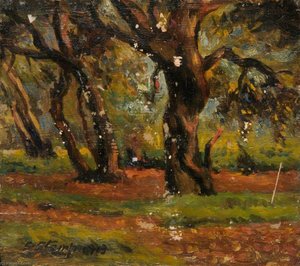
Stamp’s paintings often depict serene landscapes, particularly those around Hampstead, London. These works are characterized by their delicate watercolor washes, soft palettes, and meticulous attention to detail. He captured the quiet beauty of the English countryside—rolling hills, winding roads, and picturesque villages bathed in gentle light. His scenes evoke a sense of tranquility and nostalgia, reflecting the Victorian sensibility that valued harmony, order, and natural beauty. A prime example is “A Rainy Day, Cookham” (1894), originally based on a watercolor by Frederick Walker, which Stamp masterfully transformed into an evocative etching. The print beautifully conveys the misty dampness and muted tonality of the subject, capturing the feeling of a quiet afternoon in the Berkshire village. This work exemplifies his ability to manipulate his medium to create a powerful atmospheric effect.Recognition and Legacy
Elected as an Associate of the Royal Etching Society (ARE) in 1894, Stamp’s artistic achievements were formally acknowledged by his peers. His works are now held in esteemed collections such as the Fitzwilliam Museum, Cambridge; Ashmolean Museum, Oxford; Museum of London; Victoria and Albert Museum; and Worthing Art Gallery—testaments to their enduring quality and historical significance. While he may not be a widely celebrated figure, Stamp’s contribution to British art lies in his exceptional technical skill, his ability to capture the beauty of Victorian England, and his dedication to preserving the legacy of earlier masters through his meticulous reproductions. His work offers a valuable window into a bygone era—a time when artistry was valued for its precision, detail, and emotional resonance.A Quiet Enduring Presence
Ernest Stamp’s life, though relatively undocumented in broad biographical terms, speaks volumes through his art. He settled in Worthing later in life, passing away there in 1942, leaving behind a body of work that continues to captivate viewers with its serene beauty and technical brilliance. His prints and paintings serve as a reminder of the enduring power of observation, the importance of artistic skill, and the quiet charm of Victorian England. Stamp’s legacy is not one of grand innovation but rather of refined execution and heartfelt representation, qualities that continue to resonate with art lovers today. He remains an important figure for those interested in the history of British printmaking and the aesthetic sensibilities of a transformative era. His work invites us to slow down, appreciate the subtle nuances of light and shadow, and find beauty in the everyday moments of life.질의응답
Ernest Stamp의 작품은 얼마나 인기가 있나요?
Ernest Stamp 작가 작품에 관한 통계 정보는 작가의 통계 페이지에서 확인하실 수 있습니다.
Ernest Stamp의 작품을 사조별로 둘러볼 수 있나요?
Ernest Stamp 작가가 활동했던 예술 사조는 작품을 사조별로 분류하여 보여주는 작가의 모든 사조 페이지에서 확인하실 수 있습니다.
특정 팔레트의 Ernest Stamp 작품은 어떻게 찾을 수 있나요?
Ernest Stamp의 작품은 작가의 컬러 팔레트별 페이지에서 컬러 팔레트별로 둘러보실 수 있습니다.