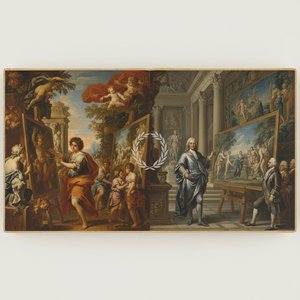
The Legacy of Ercole Graziani the Younger
In the vibrant landscape of the Italian Baroque, few painters captured the transition from late seventeenth-century classicism to the burgeoning monumentalism of the eighteenth century as gracefully as Ercole Graziani the Younger. Born in Bologna in 1688, Graziani emerged from a rich artistic lineage, shaped by the rigorous training of his mentors, Donato Creti and Marcantonio Franceschini. His early years were steeped in the traditions of the Bolognese school, a period where the echoes of the Carracci masters still resonated through every brushstroke. As he matured, his work began to shed the delicate intricacies of his predecessors, moving instead toward a profound sense of weight and presence that hinted at the approaching dawn of Neoclassicism.
The evolution of Graziani’s style is a fascinating study in artistic metamorphosis. While his early output occasionally displayed a variable quality, it served as a crucible for the refinement seen in his later masterpieces. Influenced heavily by the works of Monti and Pasinelli, he maintained a steadfast allegiance to the native classicism of Bologna. However, by the 1740s, a palpable shift occurred; his figures grew more monumental, possessing a sculptural dignity that commanded the viewer's attention. This stylistic journey—from the fluid grace of the Baroque to a more structured, imposing form—marks him as a pivotal figure in the bridge between two eras of Italian art.
Mastery and Devotion in Paint
Graziani’s technical prowess was most profoundly realized in his religious commissions, where he utilized light and composition to evoke deep spiritual reverence. His ability to weave complex theological narratives into single, breathtaking canvases earned him the patronage of the highest echelines of the Church. One of his most celebrated achievements was the creation of St. Peter consecrating St. Apollinaire. The impact of this work was so significant that Pope Benedict XIV himself requested a copy for the church of Sant'Apollinare in Rome, a testament to the artist's ability to communicate divine majesty through earthly medium.
Beyond his grand altarpieces, Graziani’s repertoire extended into intimate devotional scenes and historical subjects. His skill was not limited to large-scale oil paintings; his mastery of black chalk and white highlights on paper, as seen in works like Adoration of the Magi, reveals a sensitive hand capable of immense nuance and shadow. Whether depicting the dramatic tension of Judith with the Head of Holofernes or the quiet sanctity of a saint receiving a scapular, his work consistently sought to balance emotional intensity with formal elegance.
Artistic Influence and Historical Significance
The significance of Ercole Graziani the Younger extends far beyond his own completed canvases. As an educator, he played a vital role in sustaining the Bolognese tradition by mentoring a new generation of painters, including Giuseppe Becchetti, Antonio Concioli, and Carlo Bianconi. Through these pupils, his approach to composition and his pursuit of monumental form were disseminated throughout the region, ensuring that the lessons of the Baroque continued to evolve well into the next century.
Today, Graziani is remembered as a painter who successfully navigated the shifting tides of Italian art history. His legacy resides in the tension between the decorative elegance of his youth and the structural strength of his maturity. By looking back at the traditions of Annibale Carracci while simultaneously looking forward to the clarity of Neoclassicism, he created a body of work that remains a vital chapter in the story of Italian painting, embodying the enduring power of the Bolognese spirit.
Q&A
Ercole Graziani the Younger의 예술 세계는 시간이 흐름에 따라 어떻게 진화했나요?
Ercole Graziani the Younger의 작품 세계를 시간순으로 정리한 기록은 아티스트 연대기 페이지에서 확인하실 수 있으며, 이곳에서는 각 시기별로 분류된 챕터를 따라 작품들을 제작 순서대로 만나보실 수 있습니다.
Ercole Graziani the Younger은(는) 어느 시대의 작품을 남겼나요?
Ercole Graziani the Younger은(는) Early Modern 시대에 활동했습니다. 이 시기는 역사적 맥락 속에서 작가의 예술적 위치를 보여줍니다.
미술 사조별로 분류된 Ercole Graziani the Younger의 작품은 어디에서 볼 수 있나요?
Ercole Graziani the Younger 작가의 작품을 예술 사조별로 모아둔 모든 미술 사조 페이지에서 해당 작가가 활동했던 사조를 확인하실 수 있습니다.