Edward Burra: A Life in Surreal Visions
Early Life and Education
- Born: South Kensington, United Kingdom, 1905.
- Edward Burra demonstrated artistic talent early on, particularly as a draughtsman.
- He received his formal training at the Royal College of Art from 1923 to 1925, honing his skills in drawing and painting.
Early Travels and Influences (1920s)
- During the latter half of the 1920s, Burra travelled extensively throughout France.
- He focused on depicting detailed urban scenes, often portraying the harsh realities of life in cities like Toulon and Marseille.
- These early works reveal a keen observational eye and a sensitivity to social conditions.
- A pivotal moment came in 1927 when he met Paul Nash, who introduced him to avant-garde periodicals.
- Exposure to artists like George Grosz through these publications profoundly influenced Burra, inspiring him to experiment with collage and drawing within a Dadaist spirit.
Artistic Development & Key Themes (1930s-1940s)
- The Jungle (1931) exemplifies Burra’s fascination with the exotic and forbidden. The painting depicts a lavish dinner party set in a fantastical tropical world, blending sensuality with premonitions of death.
- Burra was among the first British artists to embrace Surrealism, creating a distinctive universe populated by extravagantly dressed women, workers, sailors, and soldiers—often situated in imaginary locales.
- His physical health, compromised from childhood, led him to favor watercolor as his primary medium due to its relative ease of use compared to oil paints.
- He held his first solo exhibition at the Leicester Galleries in 1930.
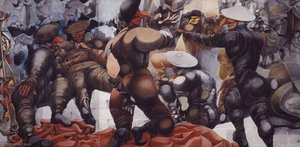
- The impact of Picasso’s Guernica was significant, prompting a shift in Burra's artistic style.
World War II and Later Life (1940s-1976)
- During World War II, travel restrictions led Burra to work as a stage designer for theatrical productions and ballets, achieving some recognition in this field.
- He declined an invitation to become a Royal Academician in 1963 but accepted the Order of the British Empire in 1971.
- A major retrospective of his work was organized by the Tate Gallery in 1973, solidifying his place within British art history.
- He died in Hastings on March 22, 1976, as a result of complications from a fractured iliac bone.
Artistic Style and Historical Significance
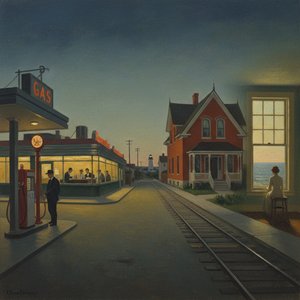
- Burra’s style is characterized by its unsettling atmosphere, vivid colors, and distorted figures.
- He masterfully blended elements of Dadaism and Surrealism with a uniquely British sensibility.
- His work offers a critical commentary on social issues, exploring themes of alienation, decadence, and the darker aspects of human nature.
- Though not always widely recognized during his lifetime, Edward Burra is now considered a pioneering figure in 20th-century British art, influencing subsequent generations of artists with his distinctive vision.
질의응답
Edward Burra 작가의 작품을 감상할 수 있는 3D 가상 투어가 있나요?
가상 방문이 가능합니다: Edward Burra의 3D 뮤지엄 페이지에서 작가의 작품들을 3D 갤러리를 통해 만나보실 수 있습니다.
Edward Burra의 작품 세계는 시간이 흐름에 따라 어떻게 변화했나요?
Edward Burra의 작품 세계를 시간순으로 정리한 기록은 아티스트 연대기 페이지에서 확인하실 수 있으며, 이곳에서는 각 시기별로 분류된 챕터를 따라 작품들을 제작 순서대로 만나보실 수 있습니다.
특정 팔레트의 Edward Burra 작품은 어떻게 찾을 수 있나요?
Edward Burra의 작품은 작가의 컬러 팔레트별 페이지에서 컬러 팔레트별로 둘러보실 수 있습니다.