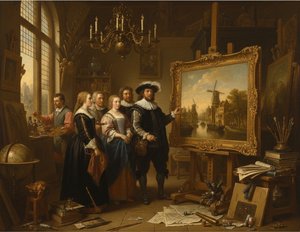
A Life Immersed in Delft: The Evocative Townscapes of Daniel Vosmaer
Daniel Vosmaer, a name perhaps less immediately recognizable than his celebrated Dutch Golden Age contemporaries like Vermeer or Rembrandt, nevertheless occupies a significant and fascinating niche within the artistic landscape of 17th-century Netherlands. Born in Delft around 1622 into a family deeply rooted in the city’s artisanal traditions – his father was a goldsmith – Vosmaer's life unfolded against a backdrop of burgeoning prosperity, civic pride, and a remarkable flourishing of painting. While details surrounding his early training remain somewhat elusive, it is widely believed that he received initial instruction from his uncle, Jacob Woutersz. Vosmaer, a respected flower painter. This familial connection undoubtedly instilled in him an appreciation for meticulous detail and observation, qualities that would become hallmarks of his mature style.
Initially, Vosmaer’s artistic endeavors focused on landscapes, but following the devastating explosion of 1654 that rocked Delft, he shifted his attention towards townscapes. This transition wasn't merely a change in subject matter; it reflected a broader cultural shift. The disaster had profoundly impacted Delft, and the depiction of its rebuilding and resilient spirit became a powerful theme for artists. The popularity of these scenes likely spurred Vosmaer’s focus on capturing the architectural beauty and bustling life of his hometown.
From Landscapes to City Views: A Developing Artistic Voice
In 1650, Vosmaer joined the Delft Guild of Saint Luke, a crucial step in establishing himself as a professional painter. This affiliation provided access to commissions, networks, and the broader artistic community. His early townscapes reveal a developing talent for perspective and an emerging ability to render light with increasing sophistication. However, it was his later works that truly distinguished him. He didn’t simply record Delft; he *reimagined* it.
Vosmaer's paintings often incorporate architectural elements not actually present in the city—grand loggias and imposing facades—creating a sense of idealized beauty and civic grandeur. This blending of reality and imagination is particularly evident in works like A View of Delft through an Imaginary Loggia, where he frames the familiar cityscape within a classical structure, elevating the scene to a more monumental scale. This technique wasn’t about deception; it was about celebrating the potential and inherent beauty of Delft, presenting a vision of what it *could* be.
The Harbour as a Microcosm: Themes and Techniques
Works such as The Harbour of Delft exemplify Vosmaer’s mastery. The painting is not merely a topographical depiction; it's a vibrant snapshot of 17th-century Dutch life, teeming with activity – merchants conducting business, boats unloading cargo, and citizens going about their daily routines. His attention to detail is remarkable: the textures of fabrics, the reflections on the water, the intricate rigging of ships—all are rendered with painstaking accuracy.
Vosmaer’s palette typically features warm earth tones, punctuated by subtle blues and grays, creating a harmonious and atmospheric effect. He skillfully employed light to create depth and volume, drawing the viewer into the scene and inviting them to explore its intricacies. His compositions are carefully balanced, often utilizing strong horizontal lines to convey stability and order.
Later Life and Legacy: A Connection to Den Briel
In 1661, Vosmaer married Annetje Eduwards de Neeff, a widow from the town of Den Briel, and relocated there. Despite this move, he maintained his ties to Delft, continuing to be considered a citizen of the city. His relocation was likely influenced by family connections; his brother Abraham had already established himself in Den Briel. Vosmaer’s life in Den Briel appears to have been comfortable, supplemented by income from local ventures, including leasing rights to tax beer and wine.
Although he continued to paint after moving to Den Briel, the number of documented works from this period is relatively small. He died there around 1670, leaving behind a modest but significant body of work. While Vosmaer may not have achieved the widespread fame of some of his contemporaries, his paintings offer a captivating glimpse into the life and atmosphere of 17th-century Netherlands. His evocative townscapes—blending realism with imagination—continue to resonate with viewers today, offering a unique perspective on a pivotal period in art history.
질의응답
Daniel Vosmaer의 작품을 기법별로 모아볼 수 있는 곳은 어디인가요?
특정 매체로 제작된 Daniel Vosmaer의 모든 작품을 확인하시려면, 작가의 모든 매체 페이지를 이용해 주세요.
Daniel Vosmaer의 작품을 컬러 팔레트별로 둘러볼 수 있나요?
특정 색상 팔레트의 Daniel Vosmaer 작품을 찾으시려면, 작가의 컬러 팔레트별 페이지를 이용해 보세요.
Daniel Vosmaer의 작품은 얼마나 인기가 있나요?
Daniel Vosmaer의 통계 페이지에서는 본 웹사이트에 등록된 작가의 작품들을 바탕으로 산출된 통계 정보를 제공합니다.