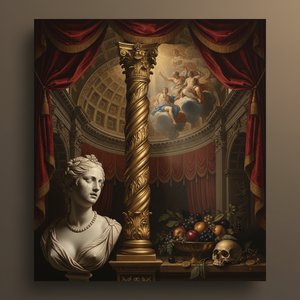
Daniel Gran: Life and Legacy
Daniel Gran (1694-1757) was a prominent Austrian Baroque painter who played a crucial role in the transition towards Classicism. His career spanned a period of significant artistic change, and he is remembered for his masterful frescoes, religious scenes, and illusionistic style.
Early Life and Training
Born in Vienna, Italy in 1694, Daniel Gran came from a family that valued its noble lineage. Successfully asserting his claim to this title was important during his time, as improper use of such distinctions could have severe social consequences. Details regarding his early artistic training remain somewhat scarce, but it is known he developed considerable skill and ambition.
Artistic Development & Influences
Gran’s initial work firmly rooted in the Baroque tradition, characterized by dramatic compositions, rich colors, and a sense of movement. However, towards the end of his career, his paintings began to exhibit a shift away from purely Baroque aesthetics – particularly in terms of figural dimensions and illusionism. This evolution suggests an increasing interest in the emerging principles of Classicism, emphasizing clarity, balance, and restraint.
While specific influences are not extensively documented, it’s reasonable to assume Gran was impacted by contemporary Italian and Austrian Baroque masters. His later stylistic changes suggest a growing awareness of early Classical art and its emphasis on form and proportion.
Major Achievements & Notable Works
- Frescoes: Gran is particularly celebrated for his large-scale fresco cycles, adorning the ceilings and walls of numerous churches and palaces in Austria.
- St. Elizabeth Distributing Alms (1736): A compelling depiction of a charitable act, showcasing Gran’s skill in portraying human emotion and narrative detail.
- Christ and the Roman Captain (1736): Another significant religious work demonstrating his mastery of composition and dramatic lighting.
- Paradise (Sketch for a ceiling fresco in Sonntagberg Basilica, Austria) (1736): A preparatory sketch revealing Gran’s meticulous planning process for complex fresco projects.
- Glory of the House of Austria (Ceiling fresco in Marble Hall of Klosterneuburg Monastery) (1749): Considered one of his most ambitious and impressive works, showcasing his ability to create grand illusionistic spaces.
- Allegory of Four Seasons (1757): A late work reflecting a more refined and classical approach.
Historical Significance
Daniel Gran’s significance lies in his role as a bridge between the Baroque and Classical periods. He wasn't merely an imitator of earlier styles but actively contributed to the evolving artistic landscape of 18th-century Austria. His work demonstrates a conscious effort to move beyond the exuberance of the High Baroque towards a more restrained and balanced aesthetic.
Gran’s influence can be seen in the subsequent development of Austrian painting, paving the way for later Classicist artists. In 1894, Vienna honored his legacy by naming the Grangasse street in Rudolfsheim-Fünfhaus (the 15th district) after him. His self-portrait remains a treasured piece within the monastery of Herzogenburg.
Gran’s frescoes continue to captivate viewers with their beauty, technical skill, and historical importance, solidifying his place as a notable figure in Austrian art history.
Q&A
Daniel Gran의 작품을 기법별로 모아볼 수 있는 곳은 어디인가요?
모든 매체별 페이지에서는 Daniel Gran의 작품을 기법별로 모아볼 수 있습니다.
Daniel Gran의 작품을 색상별로 정렬해서 볼 수 있나요?
Daniel Gran의 작품은 작가의 컬러 인덱스 페이지에서 색상별로 감상하실 수 있습니다.
Daniel Gran 작가의 작품을 연도별로 어떻게 확인할 수 있나요?
Daniel Gran의 작품은 작품 연대기 페이지에서 연도순으로 확인하실 수 있습니다.
Daniel Gran의 작품을 컬러 팔레트별로 둘러볼 수 있나요?
특정 색상 팔레트의 Daniel Gran 작품을 찾으시려면, 작가의 컬러 팔레트별로 보기 페이지를 이용해 보세요.