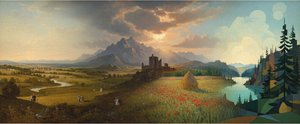
Cornelis Huysmans: A Flemish Landscape Master
- Born: Antwerp, Belgium (1648)
- Died: 1727
Early Life and Training
- Cornelis Huysmans was baptized on April 2, 1648, in Antwerp. His parents were Hendrik Huysmans and Catharina van der Meyden.
- His father's profession is described as either a master builder or a craftsman in the mint.
- Following his parent’s early death, he was sent to study under the landscape painter Gaspar de Witte.
- He later moved to Brussels to further his studies and may have worked as an assistant in the studio of Jacques d'Arthois.
- Around 1675, he collaborated with Adam Frans van der Meulen in Maastricht.
Career and Artistic Development
- In 1675, Huysmans became an independent master of the Guild of Saint Luke in Brussels.
- He spent time in London from approximately 1686 to 1688, creating landscapes for prominent members of society.
- Around 1688, he settled in Mechelen and married Maria Anna Scheppers.
- In 1690, he created a significant altarpiece, "The Road to Emmaus," for the Onze-Lieve-Vrouw-over-de-Dijle church in Mechelen.
- He returned to Antwerp in 1706 and was admitted as a master in the local guild of Saint Luke.
- Huysmans eventually returned to Mechelen, where he continued working until his death in 1727.
Artistic Style and Influences
- Huysmans is primarily known for his landscape paintings, though he also created religious and history works.
- His style is characterized by detailed observations of nature, particularly forests and trees.
- He was significantly influenced by Jacques d'Arthois, evident in the decorative compositions depicting forest edges with sandy banks.
- Huysmans incorporated a "pseudo-Italianate" aesthetic, featuring mountains and vegetation reminiscent of Italy.
- His use of dramatic light contrasts between roads and tree shadows created a striking visual effect.
- He often employed diagonal lines within his compositions to create depth and perspective.
Legacy and Historical Significance
- Cornelis Huysmans held a prominent position in Flemish landscape painting during the late 17th and early 18th centuries.
- His works demonstrate a transition from earlier, more detailed styles towards a more decorative and atmospheric approach to landscape art.
- He influenced younger artists, including his son Pieter Balthasar Huysmans and his brother Jan Baptiste Huysmans.
- Huysmans's paintings are represented in numerous museum collections worldwide, including the Louvre, the Hermitage Museum, and various museums in Belgium and elsewhere.
- His ability to capture both the realism of nature and a sense of idealized beauty contributed to his lasting reputation as a significant Flemish landscape painter.
Q&A
특정 색상 팔레트의 Cornelis Huysmans 작품은 어디에서 찾아볼 수 있나요?
특정 색상 팔레트의 Cornelis Huysmans 작품을 찾으시려면, 작가의 컬러 팔레트별로 보기 페이지를 이용해 보세요.
특정 매체로 분류된 Cornelis Huysmans의 모든 작품을 어떻게 찾을 수 있나요?
모든 매체별 페이지에서는 Cornelis Huysmans의 작품을 기법별로 모아볼 수 있습니다.
Cornelis Huysmans 작가의 다른 활동명이나 알려진 이름이 있나요?
Cornelis Huysmans은(는) Cornelis Hausmann, Cornelis Huysman, Cornelis Huijsman, Cornelisz Huysmans, Cornelis Huysmann라는 이름으로도 활동하고 있습니다.