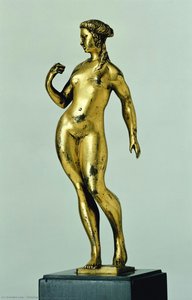
The Master of the Metal Disc: The Life and Legacy of Christoph Weiditz
In the vibrant, transformative landscape of the German Renaissance, few artists possessed the ability to condense the grandeur of human character into the small, intimate circumference of a bronze medal as masterfully as Christoph Weiditz. Born around 1500 in Freiburg im Breisgau, Weiditz emerged from a lineage deeply embedded in the artistic fabric of Europe. He was the son of the sculptor Hans Weiditz the elder and the brother of the renowned woodcut artist Hans Weiditz the Younger. This rich familial heritage provided him with a foundational understanding of form, texture, and the burgeoning humanist ideals that were sweeping through the Holy Roman Empire. As his career progressed, moving eventually to the influential artistic hub of Augsburg, Weiditz would distinguish himself as one of the four preeminent German medallists of his era, standing alongside luminaries such as Hans Schwarz, Friedrich Hagenauer, and Matthes Gebel.
The artistry of Weiditz is defined by a fascinating stylistic journey, a metamorphosis that mirrors the broader shifts in European art history. His early works are often characterized by a naïve German aesthetic, possessing a charming simplicity and a sincere, almost folk-like devotion to detail. During this period, his compositions reflected the serene and idealized beauty championed by Renaissance humanism. However, as he matured, Weidict’s hand grew more complex, embracing the sophisticated, elongated, and intellectually dense language of Mannerism. This evolution allowed him to move beyond mere physical likeness, imbuing his portraits with a psychological depth and a subtle tension that captured the very essence of his subjects' status and spirit.
A Vision in Bronze and Gold
Weiditz was far more than a simple engraver; he was a polymath of the decorative arts, working with the precision of a goldsmith and the vision of a painter. His mastery extended across various media, including sculpture and painting, yet it is in his portrait medals that his true genius resides. These small, precious objects served as much more than commemorative tokens; they were profound vehicles for symbolism and identity. Through meticulous craftsmanship, he could render the intricate textures of a velvet doublet or the noble sternness of a diplomat's gaze with breathtaking clarity.
His notable achievements include works that captured the likenesses of the era's most influential figures, such as:
- The Portrait Medal of Francisco de los Cobos y Molina: A stunning bronze masterpiece that showcases his ability to blend intricate detail with the dignified weight of Renaissance portraiture.
- The Portrait of Charles de Solier, Sire de Morette: An exquisite boxwood medallion that immortalizes a French diplomat through a lens of remarkable symbolic richness and delicate precision.
Beyond the formal portraits of the elite, Weiditz’s travels also left an indelible mark on his repertoire. During his time in Spain between 1528 and 1529, he engaged deeply with the local culture, producing drawings of the vibrant folk costumes of the Iberian Peninsula. This ethnographic eye added a layer of observational realism to his work, bridging the gap between high-court portraiture and the lived reality of the people.
Historical Significance and Enduring Influence
The historical importance of Christoph Weiditz lies in his role as a bridge between eras. He stood at the crossroads of the late Middle Ages and the sophisticated complexity of the Mannerist period, capturing the transition from a world of idealized types to one of individualistic, psychological exploration. His ability to infuse metal with expressive power helped elevate the medium of the medal from a craft-based tradition to a high art form capable of profound communication.
Though his name may not always command the same immediate recognition as Dürer, Weiditz’s contribution to the German Renaissance is indispensable. He provided the visual vocabulary for an age of discovery and self-reflection, leaving behind a legacy of works that continue to fascinate collectors and historians alike. Through his delicate touch and technical brilliance, he ensured that the fleeting moments of human dignity and the intricate details of cultural identity were preserved in the enduring permanence of bronze and gold.
Q&A
Christoph Weiditz의 다른 이름이나 별칭에는 무엇이 있나요?
Christoph Weiditz은(는) Hans Weiditz라는 이름으로도 활동하고 있습니다.
미술 사조별로 분류된 Christoph Weiditz의 작품은 어디에서 볼 수 있나요?
Christoph Weiditz 작가의 작품을 예술 사조별로 모아둔 모든 미술 사조 페이지에서 해당 작가가 활동했던 사조를 확인하실 수 있습니다.
Christoph Weiditz 작가의 작품을 감상할 수 있는 가상 박물관에 방문할 수 있나요?
Christoph Weiditz의 작품은 작가의 3D 갤러리 페이지 내 3D 갤러리에서 감상하실 수 있습니다.
키워드로 Christoph Weiditz의 작품을 찾아볼 수 있나요?
Christoph Weiditz의 작품은 아티스트의 키워드별 탐색 페이지에서 키워드별로 찾아보실 수 있습니다. 각 키워드를 통해 관련 작품들을 모아 감상하실 수 있습니다.