The Architect of Disillusionment: The Life and Vision of Christian Schad
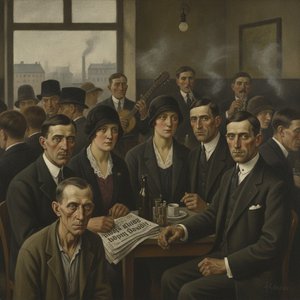
In the fractured landscape of post-World War I Europe, few artists captured the shimmering decadence and underlying psychological tension of the era as piercingly as Christian Schad. Born in 1894 in Miesbach, Bavaria, to a prosperous lawyer, Schad possessed a unique vantage point that allowed him to navigate the turbulent currents of the early twentieth century with both intimacy and detachment. His journey was one of profound stylistic evolution, moving from the raw emotionality of Expressionism toward the sharp, clinical precision of New Objectivity and the experimental frontiers of Dada. While his contemporaries often sought to scream against the chaos of a broken world, Schad’s work frequently whispered of its secrets, using a meticulous, almost surgical technique to expose the hollowed-out glamour of Vienna and Berlin.
The Great War served as a pivotal, albeit indirect, catalyst for his artistic trajectory. Avoiding military service through a self-inflicted heart defect, Schad found himself in Switzerland, a sanctuary where he encountered the radical energies of the Cabaret Voltaire. It was here, amidst the avant-garde ferment of Zurich, that he engaged with figures like Hans Arp and Hugo Ball. During this period, he pioneered his celebrated Schadographs—innovative photograms created by placing objects directly onto light-sensitive paper. These works, characterized by their ghostly, fragmented silhouettes, embodied the Dadaist rejection of traditional representation and captured the ephemeral, fractured essence of a world in flux.
From Neapolitan Light to Berlin’s Cold Precision
As the 1920s dawned, Schad’s artistic gaze shifted southward. His time in Italy, particularly his immersion in the art academies of Naples and Rome, introduced a new layer of refinement to his practice. Influenced by the classical mastery he encountered there, his style began to transition toward Magic Realism. This period was marked by an increasing preoccupation with detail and a subtle, uncanny clarity that would become his hallmark. The warmth of Mediterranean light met a growing interest in psychological depth, creating a tension between the beautiful surface of his subjects and the profound isolation they seemed to inhabit.
By 1927, the relocation to Vienna and the subsequent return to Berlin placed Schad at the very heart of the New Objectivity movement. It was in these urban centers that he achieved his most enduring fame. His portraits became emblematic of the era's social climate—capturing the polished, often artificial elegance of the upper classes while simultaneously hinting at the moral and economic decay lurking beneath the surface. Through works like Amourette and St. Genois d’Anneaucourt, Schad utilized a smooth, almost porcelain-like finish to render skin and fabric, creating an aesthetic that was both alluring and unsettlingly sterile.
Legacy and the Shadow of History
The trajectory of Schad’s career was irrevocly altered by the global economic collapse of 1929. The loss of his father's financial support forced a retreat from the intense painting production of his youth, and as the political climate in Germany darkened, his artistic output slowed significantly. Unlike many of his peers in the New Objectivity movement whose work was branded as "degenerate" by the Nazi regime, Schad’s art was paradoxically included in the Great German Art Exhibition in 1937, a complex historical fact that continues to invite scholarly scrutiny regarding his position within the era's political landscape.
Today, Christian Schad is remembered not merely as a chronicler of a lost era, but as a master of psychological portraiture. His ability to blend the experimental spirit of Dada with the hyper-realistic precision of Magic Realism allows his work to transcend its historical moment. To look upon a Schad portrait is to witness a profound dialogue between beauty and disillusionment, a testament to an artist who could find the haunting truth hidden within the most polished of surfaces.
Q&A
특정 주제별로 Christian Schad의 작품을 어떻게 찾아볼 수 있나요?
특정 주제의 Christian Schad 작품을 찾으려면 키워드별로 작품이 분류된 작가의 키워드별 탐색 페이지를 이용해 보세요.
Christian Schad 작가의 작품에서 가장 자주 나타나는 색상은 무엇인가요?
Christian Schad의 팔레트 지놈에서는 작가의 작품 세계를 구성하는 컬러 프로필을 확인하실 수 있습니다.
Christian Schad 작가의 작품을 감상할 수 있는 3D 갤러리는 어디인가요?
가상 방문이 가능합니다: Christian Schad의 3D 갤러리 페이지에서 3D 갤러리를 통해 작가의 작품들을 만나보실 수 있습니다.