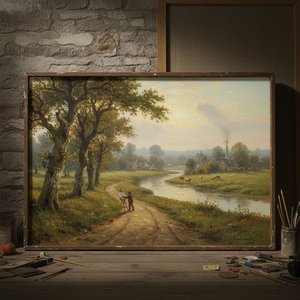
Charles Viaud: A Breton Painter of Light and Shadow
Born in Concarneau, Brittany, in 1920, Charles Viaud’s life and art were inextricably linked to the rugged beauty and shifting light of his homeland. His early years were steeped in the traditions of Breton painting – a legacy of meticulous detail, vibrant color palettes, and a deep connection to the natural world. However, Viaud quickly transcended mere imitation, forging a distinctly personal style that combined these inherited elements with an innovative use of technique and a profound exploration of mood and atmosphere.
Viaud’s artistic journey began in Nantes, where he studied at the École des Beaux-Arts. Initially drawn to figurative painting, particularly portraits and landscapes, he soon became captivated by the effects of light on water and stone – a fascination that would dominate his oeuvre for decades. He spent considerable time observing the coastline of Brittany, meticulously documenting the interplay of sunlight, shadow, and reflection on the turbulent waters of the Atlantic. This dedication culminated in a series of intensely evocative paintings depicting harbors, cliffs, and boats, rendered with an almost photographic precision but imbued with a palpable sense of drama and emotion.
The influence of Paul Gauguin is undeniable in Viaud’s early work, particularly his use of bold colors and simplified forms. However, unlike Gauguin's exoticized depictions of Tahiti, Viaud remained firmly rooted in the Breton landscape, offering a nuanced portrayal of his native region. He was also deeply affected by the works of J.-H. Fragonard, evident in his masterful handling of light and atmosphere, particularly during his later years when he began to explore more abstract compositions.
The Evolution of Style: From Realism to Abstraction
Throughout the 1950s and 60s, Viaud’s paintings remained largely rooted in realism, characterized by meticulous detail and a strong sense of observation. His subjects – primarily coastal scenes, harbors, and boats – were rendered with an almost obsessive attention to surface texture and color. Yet, even within this realistic framework, he began to subtly manipulate perspective and composition, creating a dynamic tension between foreground and background.
A pivotal shift occurred in the late 1960s as Viaud’s style underwent a dramatic transformation. He gradually moved away from direct representation, experimenting with fragmented forms, blurred edges, and increasingly abstract compositions. This evolution was not driven by a rejection of his previous work but rather by a desire to capture the *essence* of light and atmosphere – to convey the feeling of being immersed in a particular place and time. His later paintings became characterized by washes of color, layered textures, and an almost ethereal quality, reflecting the shifting moods of the Breton coast.
Key Themes and Techniques
At the heart of Viaud’s artistic vision lay a profound appreciation for the ephemeral nature of light and its transformative power. He sought to capture not just the visual appearance of a scene but also the emotional resonance it evoked. His paintings are imbued with a sense of melancholy, nostalgia, and a deep connection to the natural world.
Viaud’s technical mastery was equally remarkable. He employed a unique layering technique, applying thin washes of color over dry underpaintings to create a shimmering surface texture. This method allowed him to build up complex gradations of tone and hue, capturing the subtle nuances of light and shadow with astonishing accuracy. His use of complementary colors – particularly blues and oranges – created a vibrant and dynamic visual effect, while his careful attention to detail ensured that every brushstroke contributed to the overall composition.
Legacy and Recognition
Charles Viaud’s work received limited recognition during his lifetime, largely due to his reclusive nature and his refusal to actively promote his art. However, in recent decades, his paintings have gained increasing acclaim among collectors and critics. His distinctive style – characterized by its evocative use of light, atmosphere, and texture – has been compared to that of Turner and Monet, while his deep connection to the Breton landscape sets him apart as a truly unique artist.
Today, Viaud’s paintings are held in prominent collections around the world, including the Musée d'Art Moderne de Paris and the Bibliothèque Nationale de France. His work continues to inspire artists and viewers alike, offering a poignant reminder of the beauty and power of the natural world.
Q&A
Charles Viaud의 다른 이름이나 별칭에는 무엇이 있나요?
Charles Viaud은(는) Viaud라는 이름으로도 활동하고 있습니다.
Charles Viaud의 모든 작품을 어디에서 볼 수 있나요?
이 사이트에 등록된 Charles Viaud의 모든 작품은 작가의 전체 작품 보기 페이지에서 만나보실 수 있습니다.
Charles Viaud 작가의 작품을 감상할 수 있는 3D 가상 투어가 있나요?
Charles Viaud의 3D 갤러리는 작가의 작품들을 가상 3D 갤러리로 감상할 수 있는 페이지입니다.