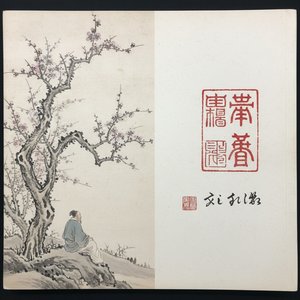
The Scholar's Quiet Vision
In the shifting landscape of the Yuan Dynasty, Cao Zhibai moved through the world as both a creator of images and a dedicated collector of books. Known by his courtesy names Youxuan and Zhensu, and often called by his sobriquet Yunxi, he belonged to a class of intellectuals who found solace in the written word and the brush. His life was defined by this dual devotion to the preservation of knowledge and the translation of nature onto silk. He was a man of deep learning, a bibliophile whose hands were as accustomed to turning delicate pages as they were to guiding a brush through ink and color.
His presence in history is felt through the quiet strength of his landscapes. He did not seek to reinvent the world, but rather to breathe life into the traditions of those who came before him. By looking backward, he found a way to move forward, capturing the essence of the mountains and mists that had long inspired the Chinese spirit.
The Language of Ink and Silk
The brushwork of Cao Zhibai tells a story of careful imitation and personal refinement. He drew much of his inspiration from the great traditions of the past, specifically the styles of Li Cheng and Guo Xi. His work sought to revitalize the landscape painting traditions of the Li-Guo school, bringing a renewed sense of structure and atmosphere to the medium. Through his hands, the ink and color on silk became a way to navigate the complexities of the natural world.
His technical approach was marked by several distinct characteristics:
- The use of ink and color on silk to create depth and texture.
- A stylistic lineage that echoed the monumental landscapes of earlier eras.
- A focus on the interplay between solid forms and ethereal atmosphere.
This method allowed him to create works that felt both grounded in history and uniquely his own. He worked with a precision that respected the weight of the mountains and the lightness of the clouds, ensuring that every stroke served the composition of the whole.
A Legacy in the Imperial Collection
The endurance of Cao Zhibai is evidenced by the survival of his works within the most prestigious repositories. His landscapes have been preserved through the centuries, finding a permanent home in the Palace Museum in Beijing. These surviving pieces offer a glimpse into the mind of a man who understood the permanence of art and the fleeting nature of the seasons. His ability to capture the spirit of the landscape ensured that his vision would remain long after his own time had passed.
He remains a significant figure for those who study the evolution of Chinese painting. His life reflects the intersection of scholarship and artistry, where the act of collecting books and the act of painting a mountain were parts of a single, unified pursuit of understanding the world.
Q&A
Cao Zhibai의 활동 시기는 어떻게 구분되어 있나요?
Cao Zhibai의 작품 세계를 시간순으로 정리한 기록은 아티스트 연대기 페이지에서 확인하실 수 있으며, 이곳에서는 각 시기별로 분류된 챕터를 따라 작품들을 제작 순서대로 만나보실 수 있습니다.
Cao Zhibai의 작품을 매체별로 찾아볼 수 있나요?
모든 매체별 페이지에서는 Cao Zhibai의 작품을 기법별로 모아볼 수 있습니다.
특정 색상 팔레트의 Cao Zhibai 작품은 어디에서 찾아볼 수 있나요?
컬러 팔레트별로 보기 페이지에서는 Cao Zhibai의 작품들을 색상 팔레트별로 모아볼 수 있습니다.
Cao Zhibai의 모든 작품은 어디에서 볼 수 있나요?
이 사이트에 등록된 Cao Zhibai의 모든 작품은 작가의 전체 작품 보기 페이지에서 만나보실 수 있습니다.