The Painter of Forlì
Born in Forlì around 1460, Baldassarre Carrari lived a life defined by the quiet rhythms of the Italian Renaissance. Known to history as Baldassarre Carrari il Giovane to distinguish him from his predecessor, he was a man of his era, deeply rooted in the artistic traditions of his native Emilia-Romagna. His career began in earnest around 1486, a period when the visual language of Italy was shifting toward a more structured, humanistic clarity. He did not work in isolation; rather, he was shaped by the hands of those who came before him, most notably through his apprenticeship under the painter Niccolò Rondinelli.
His development was a confluence of regional styles. While his training under Rondinelli provided a foundation, his brushwork and composition suggest a broader dialogue with the masters of the age. There is a discernible connection to the works of Melozzo da Forlì, a link perhaps forged through the influence of Marco Palmezzano. This lineage, combined with the stylistic touches of Lorenzo Costa, allowed Carrari to navigate the aesthetic demands of his time, blending the grace of his mentors with a distinct local sensibility.
A Life in Color and Shadow
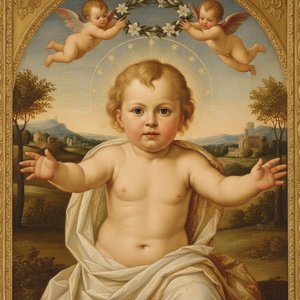
Carrari’s professional life was centered in the cities of Forlì and Ravenna. He remained active in these locales from his early years until his death in 1516. His work often focused on the sacred, capturing the quiet gravity of religious narratives. In pieces such as The Holy Family with an Angel, he approached the depiction of the divine with a specific, grounded focus. In this work, the infant Christ is portrayed with a maturity that belies his age, standing within the lap of his mother while the traditional witnesses—the ox and the ass—observe from the periphery. The composition extends beyond the immediate scene, using a procession in the background to hint at the arrival of the wise men, thereby connecting the intimate moment of birth to a larger theological event.
His technical approach was marked by a careful attention to the interplay of light and form. He did not seek to overwhelm the viewer but rather to present a scene of composed, devotional clarity. His presence in the art history of the Romagna region is defined by this steady, reliable hand, contributing to the visual landscape of the Renaissance through a commitment to the traditions of his training and the specific needs of his patrons in Forlì and Ravenna.
Q&A
Baldassarre Carrari의 작품을 연도순으로 어디에서 볼 수 있나요?
Baldassarre Carrari의 작품 연표를 확인해 보세요: 작품 연대기 페이지에서 작품들을 제작 날짜순으로 보실 수 있습니다.
Baldassarre Carrari의 연도별 활동 기록이 있나요?
Baldassarre Carrari의 연대기는 작가의 활동 시기별로 분류된 작품들을 연대순으로 보여주는 스크롤 방식의 타임라인입니다.
Baldassarre Carrari의 작품을 사조별로 둘러볼 수 있나요?
Baldassarre Carrari의 작품은 작가의 모든 미술 사조 페이지에서 사조별로 만나보실 수 있습니다.