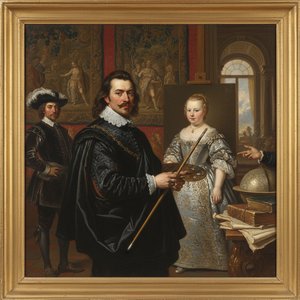
Antonio González Velázquez, I (1723 – 1793): The Painter of Light and Shadow
Antonio González Velázquez was a Spanish Baroque painter born in Madrid into a family steeped in artistic tradition. His father, Pablo González Velázquez, and brothers were all accomplished painters, fostering an environment that nurtured his innate talent from a young age. Recognizing his potential, the Real Academia de Bellas Artes awarded him a scholarship to study in Rome in 1747, where he honed his skills under the tutelage of Corrado Giaquinto – a formative experience that cemented his stylistic vision.- Early Career & Roman Influences: Velázquez’s time in Rome exposed him to Neoclassical ideals alongside Baroque grandeur, shaping his approach to composition and technique. He diligently studied classical sculpture and drawing, absorbing the principles of balance and proportion that would later characterize his monumental works.
- Return to Madrid & Court Patronage: Upon returning to Spain in 1752, Velázquez swiftly ascended the artistic ranks, securing commissions from influential patrons including King Ferdinand VI and Queen María Luisa Habsburg-Lorraine. His involvement in decorating the Royal Palace of Madrid – particularly the Antechamber ceiling – showcased his mastery of illusionistic painting and cemented his reputation as a court artist.
- Director of the Academy & Artistic Legacy: In 1765, Velázquez was appointed Director of the Real Academia de Bellas Artes de San Fernando, overseeing the training of aspiring artists and shaping the artistic landscape of Madrid for decades to come. He collaborated closely with Francisco Bayeu y Subías, establishing a tradition of excellence that endured through generations.
- Notable Works & Artistic Style: Velázquez’s oeuvre comprises an impressive collection of portraits, religious paintings, and historical scenes—each imbued with remarkable realism and psychological insight. His signature technique involved layering thin glazes of paint to achieve luminous effects – capturing the subtleties of light and shadow with unparalleled accuracy. Masterpieces like “Columbus” and “The Adoration of the Magi” exemplify his artistic genius and continue to inspire admiration worldwide.
Key Achievements & Recognition
Velázquez’s contributions to Spanish art history are undeniable. He elevated painting to new heights of expressive power, establishing a style that would become synonymous with Baroque grandeur. His meticulous observation of nature and his ability to convey emotion through subtle gestures earned him the admiration of contemporaries and cemented his place among Spain's greatest artistic figures. Furthermore, he fostered a vibrant artistic community at San Fernando Academy, nurturing talent and shaping the future of Spanish art.Influence & Legacy
Velázquez’s influence extended far beyond his own lifetime. He served as an inspiration for subsequent generations of painters—particularly Francisco Goya—who embraced his innovative approach to realism and psychological portraiture. His groundbreaking technique of chiaroscuro – manipulating light and dark – revolutionized painting practice and continues to inform artistic endeavors today. Antonio González Velázquez remains a pivotal figure in art history, celebrated for his unparalleled skill, profound vision, and enduring legacy as the painter of light and shadow.Q&A
Antonio González Velázquez은(는) 어느 시대의 작품을 남겼나요?
Antonio González Velázquez은(는) Early Modern 시대에 활동했습니다. 이 시기는 역사적 맥락 속에서 작가의 예술적 위치를 보여줍니다.
Antonio González Velázquez 작가의 작품에서 가장 자주 나타나는 색상은 무엇인가요?
Antonio González Velázquez의 팔레트 지놈에서는 작가의 작품 세계를 구성하는 컬러 프로필을 확인하실 수 있습니다.
Antonio González Velázquez의 작품은 얼마나 인기가 있나요?
이 사이트에서 Antonio González Velázquez의 작품에 관한 통계를 확인할 수 있는 방문 통계 페이지를 만나보세요.
Antonio González Velázquez 작가의 작품을 감상할 수 있는 3D 갤러리는 어디인가요?
Antonio González Velázquez의 작품은 작가의 3D 갤러리 페이지 내 3D 갤러리에서 감상하실 수 있습니다.