A Venetian Chronicler: The Life and Art of Antonio Ermolao Paoletti
Antonio Ermolao Paoletti, born in Venice on May 8th, 1834, and passing away in his beloved city on December 13th, 1912, was a painter deeply entwined with the spirit of Venice. He wasn’t merely *of* Venice; he chronicled it—its bustling piazzas, its quiet canals, the everyday lives unfolding within its ancient walls. Paoletti belonged to a lineage steeped in Venetian culture; his father, Ermolao Paoletti, was a renowned scholar and writer, authoring an exhaustive guide to the city’s architecture, art, and customs, as well as a dictionary of the local dialect. This upbringing undoubtedly instilled in Antonio a profound appreciation for Venice's unique character, which would become the defining subject of his artistic career.Early Training and Artistic Development
Paoletti received his formal training at the Accademia di Belle Arti in Venice, studying under Pompeo Marino Molmenti. He found himself amongst a vibrant circle of fellow artists, including sculptor Antonio Dal Zotto and Armenian painter Edgar Chahine. This period was formative, shaping his technical skills and solidifying his interest in genre painting—depicting scenes from everyday life. While the grand historical canvases were popular at the time, Paoletti gravitated towards capturing the fleeting moments of Venetian existence. His early works already hinted at a keen observational ability and a talent for portraying human interaction with warmth and detail. He wasn’t interested in idealized representations but rather in the authentic texture of life as it was lived by ordinary people.Themes and Style: Echoes of the Bamboccianti
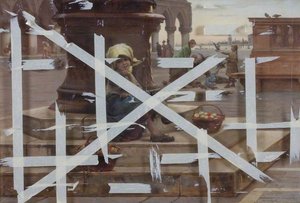
Paoletti's oeuvre is characterized by its charming depictions of Venetian genre scenes, often recalling the style of the *Bamboccianti*—a group of Dutch and Flemish painters who settled in Rome during the 17th century and focused on everyday Roman life. Like them, Paoletti found beauty in the commonplace: children playing in the streets, women engaged in domestic tasks, vendors hawking their wares. His paintings are filled with a sense of nostalgia, capturing a Venice that was both timeless and subtly changing. He frequently depicted scenes around Piazza San Marco, showcasing the lively interactions between locals and tourists. Feeding the Pigeons, one of his most recognizable works, exemplifies this—a vibrant snapshot of daily life unfolding against the backdrop of the iconic square. He also painted sacred frescoes for churches in the Veneto region, demonstrating a versatility beyond purely secular subjects. His brushwork is generally smooth and detailed, with a focus on capturing light and atmosphere.Exhibitions and Recognition
Throughout his career, Paoletti exhibited widely, gaining recognition for his evocative portrayals of Venetian life. He participated in exhibitions in Milan (1872), Turin (1884), and at the Promotrice Popolana Venicena. His submissions often featured scenes brimming with local color and character—such as Ecco come va il vino nelle messe, Flowers for the Holy Virgin, and Fa' caro al nonno!. These exhibitions provided a platform to showcase his talent to a wider audience, solidifying his reputation as a skilled genre painter. He also contributed significantly to the artistic landscape of Venice by becoming a professor at the Accademia di Belle Arti, passing on his knowledge and passion for painting to future generations.Legacy: A Preserver of Venetian Identity
Antonio Ermolao Paoletti’s historical significance lies in his dedication to documenting the everyday life of Venice during a period of transition. While not aiming for groundbreaking innovation, he excelled at capturing the essence of the city—its atmosphere, its people, and its unique cultural identity. His paintings offer valuable insights into 19th-century Venetian society, providing a glimpse into the lives of those often overlooked by grand historical narratives. He wasn’t simply painting pictures; he was preserving memories, celebrating the beauty of the commonplace, and ensuring that the spirit of Venice would endure through his art. His works continue to resonate with viewers today, offering a charming and evocative window into a bygone era.Q&A
Antonio Ermolao Paoletti은(는) 어느 시대의 작품을 남겼나요?
Antonio Ermolao Paoletti은(는) 19th Century 시대에 활동했습니다. 이 시기는 역사적 맥락 속에서 작가의 예술적 위치를 보여줍니다.
키워드로 Antonio Ermolao Paoletti의 작품을 찾아볼 수 있나요?
Antonio Ermolao Paoletti의 작품은 아티스트의 키워드별 탐색 페이지에서 키워드별로 찾아보실 수 있습니다. 각 키워드를 통해 관련 작품들을 모아 감상하실 수 있습니다.
Antonio Ermolao Paoletti가 그린 모든 주제를 한눈에 볼 수 있는 개요가 있나요?
Antonio Ermolao Paoletti의 작품은 작가의 주제별 작품 모음 페이지에서 주제별로 찾아보실 수 있습니다.