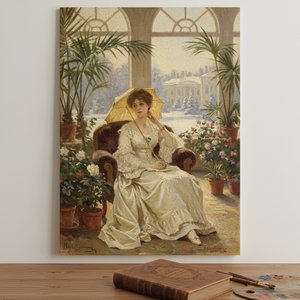
A Life Forged in Conflict and Color
Born into the quiet surroundings of Nietulisko Duże, near Kunów, Antoni Adam Piotrowski was the son of a man who worked with iron sheets. His early years in the Russian sector of partitioned Poland were marked by the shadows of unrest, specifically the January Uprising which he witnessed as a young boy. This early exposure to upheaval would later define his brushwork. After the loss of his father, the family moved to Radomsko, where the seeds of his artistic vocation began to take root alongside his first drawings of Gypsies and local life.
His path toward mastery led him through the great teaching studios of his era. In Warsaw, he learned under Wojciech Gerson, and later sought the rigorous training of Munich, studying with Wilhelm Lindenschmidt the Younger. He even sat at the feet of Jan Matejko in Kraków, though the young painter eventually found himself at odds with his mentor's direction. This independence drove him to open his own studio in Cracow, a space where he could explore a style that moved beyond mere historical instruction toward a more visceral realism.
The Eye of the Correspondent
It was not merely the studio, but the battlefield that truly shaped his vision. In 1879, Piotrowski traveled to the newly liberated Bulgaria, not as a tourist, but as a correspondent for prominent British and French weeklies like The Graphic and Le Monde Illustré. He did not just observe from afar; he lived through the tension of the era. His commitment to the cause became so profound that in 1885, he returned to Bulgaria as a volunteer in the Serbo-Bulgarian War.
This period of combat left an indelible mark on his repertoire. He captured the raw reality of military life, producing works such as the Battle of Slivnitsa and the storming of Tsaribrod. His sketches and paintings from these campaigns were sought after by European periodicals, bringing the grit of the Balkan struggles to a wide audience. The Bulgarian state recognized the weight of his observations, eventually purchasing nine of his historical battle scenes for their permanent collection.
A Versatile Hand
While the smoke of war provided much of his subject matter, Piotrowski possessed a range that extended into the quietest corners of human existence. He was a painter of many faces and moods. In his later years, he turned his attention to the psychological depth of portraiture, painting figures such as Prince Alexander of Battenberg and Prince Ferdinand of Saxe-Coburg-Gotha. His ability to capture the dignity of Bulgarian nobles sat alongside his more tender depictions of common folk.
His work often drifted into different aesthetic territories, showing a curiosity for various modes of expression:
- Realism and Genre Scenes: He depicted the daily rhythms of village life, such as in At the Fair or A Shepherd Girl.
- Symbolism: In works like Nymphs and Satyrs, he explored the realms of ancient mythology.
- Impressionistic Tendencies: Later pieces, such as Barns, revealed a fascination with light and atmosphere that leaned toward more modern aesthetics.
Even as he moved through Paris and eventually back to Warsaw, his work remained anchored in the tangible. Whether documenting the heavy atmosphere of the Batak Massacre or the snowy drifts of the Podolia region, he remained a chronicler of truth. He died in Warsaw, leaving behind a body of work that bridged the gap between the romanticized past and the stark, unvarnished reality of a changing Europe.
Q&A
Antoni Piotrowski 작가의 작품에서 가장 자주 나타나는 색상은 무엇인가요?
이 사이트에 등록된 작품 전반에 나타나는 Antoni Piotrowski의 색채 활용은 작가의 팔레트 지놈 페이지에서 자세히 살펴보실 수 있습니다.
Antoni Piotrowski의 모든 작품을 어디에서 볼 수 있나요?
이 사이트에 등록된 Antoni Piotrowski의 모든 작품은 작가의 전체 작품 보기 페이지에서 만나보실 수 있습니다.
Antoni Piotrowski 작가는 어떤 사조의 작품 활동을 했나요?
Antoni Piotrowski 작가의 작품을 예술 사조별로 모아둔 모든 미술 사조 페이지에서 해당 작가가 활동했던 사조를 확인하실 수 있습니다.
Antoni Piotrowski의 작품을 색상별로 모아둔 곳은 어디인가요?
Antoni Piotrowski의 작품은 작가의 컬러 인덱스 페이지에서 색상별로 감상하실 수 있습니다.