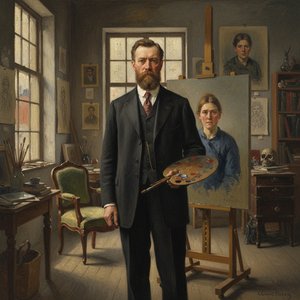
A Life Rooted in Norway
Andreas Bloch entered the world on 29 July 1860, born into the quiet surroundings of the Hellerud farm in Skedsmo, within Akershus county, Norway. He was the son of Jens Peter Blankenborg Bloch and Anne Julie Margrethe Schroeter. His early years were shaped by this Norwegian landscape, a setting that would later find its way into his sketches and historical interests. In 1878, he began formal training at the art school of Knud Bergslien, spending a year refining his initial skills before seeking broader horizons.
His pursuit of knowledge led him away from home to the Art Academy of Düsseldorf, where he studied under Johann Peter Theodor Janssen between 1880 and 1881. This period of academic rigor was supplemented by travels through Belgium, Paris, and Leipzig, allowing him to absorb the varied artistic currents of Europe. In 1890, he married Ingeborg Elise Tellefsen, and he remained in Kristiania until his death on 11 May 1917.
The Art of Illustration and Design
While he worked as a painter, Bloch is most frequently remembered for the precision of his drawings. He possessed a particular talent for capturing narrative through line, making him a sought-after illustrator for several satirical magazines, including Vikingen, Krydseren, and Korsaren. His hand was also found in the pages of many books, bringing stories to life for readers across Norway.
His versatility extended far beyond the printed page. He moved between different creative disciplines with ease:
- He designed theatrical costumes for both the Christiania Theater and Nationaltheatret.
- He created posters and portraits that captured the likenesses of his contemporaries.
- He contributed to civic identity by designing the Coat of arms of Lillehammer.
- He even designed the Holmenkollen Medal, an award for skiing established in 1895.
Historical Narratives and Legacy
Bloch had a deep interest in history, which manifested in both his paintings and his book illustrations. He illustrated works by authors such as Margrethe Aabel Munthe, Nordahl Rolfsen, Henrik August Angell, and Jacob Breda Bull. His drawings for Fridtjof Nansen’s expedition books, Paa ski over Grønland and Fram over Polhavet, provided a visual record of significant Norwegian explorations.
His paintings often focused on weighty historical moments. One notable work from 1906 depicts the coronation of King Haakon VII and Queen Maud in Nidaros Cathedral. Through these works, he documented the changing face of his nation. Today, his contributions to Norwegian visual culture are preserved in the collections of the National Gallery and the Oslo City Museum.
Q&A
Andreas Bloch의 모든 작품을 어디에서 볼 수 있나요?
이 사이트에 등록된 Andreas Bloch의 모든 작품은 작가의 전체 작품 보기 페이지에서 만나보실 수 있습니다.
Andreas Bloch의 활동 시기는 어떻게 구분되어 있나요?
Andreas Bloch의 예술적 여정은 연대기 페이지에서 시기별로 펼쳐집니다. 이곳에서는 작가의 활동 시기를 장(chapter)으로 나누어 작품들을 연대순 타임라인 형태로 한눈에 확인할 수 있습니다.
주제별로 Andreas Bloch의 작품을 찾아볼 수 있나요?
Andreas Bloch의 주제별 작품 모음는 작가의 작품들을 주제별로 찾아볼 수 있는 페이지입니다.
Andreas Bloch의 전 작품에 걸친 색채 활용을 살펴볼 수 있을까요?
Andreas Bloch 작가 작품의 컬러 프로필은 작가의 팔레트 지놈 페이지에서 확인하실 수 있습니다.