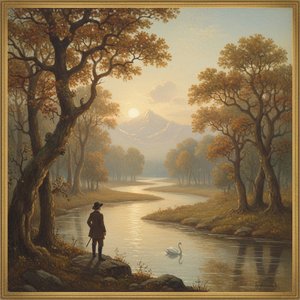
The Sacred Bloom: The Life and Vision of Amédée Masclef
In the twilight of the nineteenth century, as the rigid structures of academic realism began to dissolve into the ethereal mists of Symbolism, the work of Amédée Masclef emerged as a profound bridge between two worlds. Born on August 9, 1858, in Béthune, Masclef did not merely observe nature; he sought to interpret its divine architecture. His journey was one of unique dualities, shaped by his early theological studies at Amiens Cathedral and his eventual ordination as an abbé in 1885. This spiritual foundation infused his artistic practice with a sense of reverence, transforming the act of botanical illustration from a scientific endeavor into a meditative exploration of the sacred order hidden within the natural world.
Masclef’s artistic development was deeply rooted in the traditions of the Barbizon school, a movement that championed the direct, unadorned observation of nature. From this lineage, he inherited a commitment to authenticity and a profound respect for the en plein air spirit. However, Mascle and his contemporaries were increasingly drawn toward the burgeoning Symbolist movement, which sought to capture subjective experience and emotional resonance. In Masclef’s hands, a simple dandelion or a delicate sprig of chamomile became more than mere specimens; they were vessels of sentiment, imbued with a dreamlike quality that transcended their physical forms.
A Botanical Legacy in Watercolor
The pinnacle of Masclef’s contribution to the visual arts lies in his monumental achievement, the Atlas des Plantes de France. Published in 1891 and revised in 1893 in collaboration with Gaston Bonnier, this extraordinary work consists of four hundred meticulously rendered plates. This was not merely a catalog of flora but a triumph of watercolor technique, where precision met poetry. Each plate demonstrates a masterful command of layering and hatching, capturing the delicate textures, translucent petals, and intricate structures of French vegetation with scientific accuracy and an unmistakable artistic soul.
Beyond his famous atlas, Masclef’s oeuvre is characterized by several key achievements that solidified his place in botanical history:
- Scientific Authority: His role as a Professor of Natural Sciences at the Petit séminaire d'Arras and his membership in the Société botanique de France allowed him to blend rigorous academic knowledge with aesthetic grace.
- Thematic Depth: His ability to navigate the transition from the objective realism of the Barbizon masters to the evocative, often spiritualized imagery of Symbolism.
- Enduring Documentation: The publication of works such as Les plantes d'Europe, which ensured his botanical insights reached a wide European audience for decades.
The Intersection of Science and Spirit
To look upon a Masclef watercolor is to witness the intersection of the analytical mind and the searching soul. His work serves as a vital historical record of the French landscape, yet it remains eternally contemporary through its emotional depth. While he may be overshadowed in popular memory by the more flamboyant figures of the Symbolist movement, his legacy persists in the quiet, enduring beauty of his botanical portraits. He remains a pivotal figure who proved that the most minute details of the natural world—the curve of a leaf or the hue of a petal—could hold the weight of the infinite.
Q&A
Amédée Masclef의 작품을 매체별로 찾아볼 수 있나요?
특정 매체로 제작된 Amédée Masclef의 모든 작품을 확인하시려면, 작가의 모든 매체별 페이지를 이용해 주세요.
Amédée Masclef 작가의 작품 관련 통계 정보는 어디에서 확인할 수 있나요?
Amédée Masclef 작가의 작품 통계 정보는 방문 통계 페이지에서 확인하실 수 있습니다.
Amédée Masclef의 작품 중 몇 점을 둘러보실 수 있나요?
전체 작품 보기 페이지에서 Amédée Masclef의 작품 작품 94점점을 만나보실 수 있습니다.
Amédée Masclef의 연도별 활동 기록이 있나요?
Amédée Masclef의 작품 세계를 시간순으로 정리한 기록은 아티스트 연대기 페이지에서 확인하실 수 있으며, 이곳에서는 각 시기별로 분류된 챕터를 따라 작품들을 제작 순서대로 만나보실 수 있습니다.