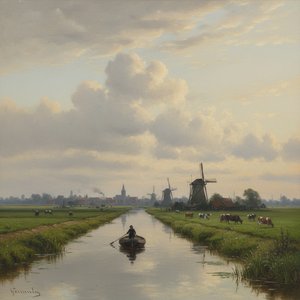
The Painter of Ghent
Albert Baertsoen lived his life within the borders of Ghent, a city defined by its textile mills and canal waters. Born into a family where his father worked as a miller and industrialist, he had the means to pursue the arts from an early age. He began his formal training at the Royal Academy of Fine Arts in Ghent, studying under Gustave Den Duyts and Jean Delvin. These early years were spent learning the weight of a line and the structure of the buildings that surrounded him.
His eyes often settled on the quiet moments of the day. He had a particular affinity for twilight, capturing the way light fades over the water and the stone of the city. In his work, one can see the Maison de Bateliers, the boatmen's hiring hall, with the Church of Saint-Michael standing in the background. He did not look for the most picturesque corners but instead focused on the atmosphere of the streets and the canals. His paintings often carry a sense of stillness, reflecting the transition of seasons or the approach of night.
Travels and Landscapes
While Ghent remained his anchor, his work moved through other landscapes. He traveled to Paris to study at the art school of Alfred Philippe Roll and later accompanied other Belgian painters to London in 1890. During the First World War, he found refuge in London, where he turned his attention to the Bankside and the Thames. He preferred the edges of the city, painting the area near the bridges in mist, rain, or dusk. These scenes often felt heavy, shaped by the grey weather and the unusual perspectives he chose.
His interests also extended to the water and the industrial reaches of Belgium. He spent time in the Scheldt estuary near Doel and worked in the Leie region. His subjects included:
- Winter scenes and frozen landscapes
- Industrial views of the Liège region
- The ports and towns of Zeeland, such as Terneuzen and Middelburg
- The architecture of Bruges and Diksmuide
He even built a houseboat, the Fafner, at the Jabon Frères shipyard in Amay. This allowed him to travel through the waterways of the Netherlands, visiting places like Dordrecht and Amsterdam while keeping his sketches close at hand.
Technique and Legacy
Baertsoen worked across several mediums, including oil, pastel, and etching. He was a meticulous observer who used drawing sheets to record motifs in pencil before moving to larger oil sketches. This habit of working out a scene through multiple versions allowed him to explore the same subject repeatedly. His graphic work, particularly his etchings, remains a significant part of what people recognize about his skill today.
His career saw him participating in major exhibitions, from the Brussels exhibition held by l'Essor in 1887 to the Venice Biennale and the Vienna Secession. In 1919, he was appointed a member of the Royal Academy of Belgium and received the title of Commander of the Order of the Crown. He died in Ghent in 1922, leaving behind a body of work that captures the changing face of his home city and the quiet, often somber, beauty of the landscapes he encountered.
Q&A
Albert Baertsoen가 그린 모든 주제를 한눈에 볼 수 있는 개요가 있나요?
주제별 작품 모음 페이지에서는 Albert Baertsoen의 작품들을 주제별로 확인하실 수 있습니다.
Albert Baertsoen 작가의 다른 활동명이나 알려진 이름이 있나요?
Albert Baertsoen은(는) Albert Baertson, アルベール・バールトソン, Альберт Бартсон(으)로도 알려져 있습니다.
Albert Baertsoen의 출생지와 출생 연도는 어떻게 되나요?
Albert Baertsoen은(는) 1866년 Ghent에서 태어났습니다.