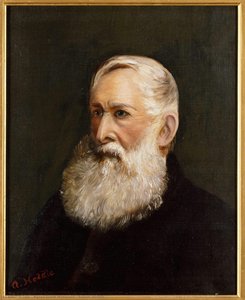
A Portrait of Victorian Spirit: Agnes Grant McDonald
Agnes Grant McDonald (1867–1941) remains a relatively obscure figure in the annals of British art history, yet her canvases hold a quiet beauty and capture the essence of the Victorian era with remarkable sensitivity. Born into a family steeped in Scottish heritage, her life was shaped by a lineage of intellectual curiosity and scientific exploration; her father, Robert Hoddle, was a celebrated surveyor instrumental in the establishment of Melbourne. This connection to the mapping of the natural world perhaps informed McDonald’s own artistic journey, as her oeuvre speaks volumes about a profound engagement with the environment and a masterful ability to translate direct observation into evocative visual representations. While biographical details regarding her formative years remain sparse, anecdotal evidence suggests she received a privileged education that fostered a deep appreciation for both art and scholarship, providing the foundation for her refined artistic sensibilities.The Impressionistic Lens and Artistic Technique
McDonald’s stylistic development was deeply informed by the burgeoning movements of her time, demonstrating a considerable influence from Impressionism. She drew particular inspiration from the works of Claude Monet and Pierre-Auguste Renoir, seeking to capture the ephemeral qualities of light and atmosphere. Rather than adhering to rigid academic structures, she skillfully employed loose brushstrokes and dappled light to convey fleeting moments of beauty—a technique that allowed her to breathe life into her subjects. Her paintings are characterized by a meticulous attention to detail combined with an expressive handling of color and texture, creating a bridge between the precision of traditional realism and the emotive freedom of the Impressionist movement.Themes of Landscape and Domesticity
The breadth of McDonald’s artistic output primarily consisted of landscapes and portraits, predominantly depicting the ruggedly beautiful Scottish scenery and her own familial members. In her work, one finds a rejection of grand narratives or dramatic, sweeping compositions in favor of scenes imbued with tranquility and understated emotion. This stylistic choice reflected the Victorian preoccupation with domesticity, moral contemplation, and the sanctity of the private sphere. Her landscapes often serve as more than mere topographical records; they are emotional spaces where the viewer can experience the stillness of the natural world.Legacy and Historical Significance
Though she may not have commanded the international fame of her contemporaries, McDonald’s significance lies in her ability to capture a specific cultural zeitgeist. Her work serves as a poignant window into the Victorian spirit, documenting a period of transition between traditional values and the modernizing influences of the early twentieth century. Through her portraits—notably her depiction of Robert Hoddle which exemplifies her talent for capturing personality—and her atmospheric landscapes, she preserved the quiet dignity of her era. Her legacy is found in the subtle textures of her brushwork and the enduring, peaceful resonance of her compositions, marking her as a true treasure of British art history.Q&A
키워드별로 분류된 Agnes Grant Mcdonald의 작품은 어디에서 볼 수 있나요?
Agnes Grant Mcdonald의 키워드별 탐색 페이지에서는 작가의 작품들을 키워드별로 모아볼 수 있습니다.
Agnes Grant Mcdonald의 활동 시기는 어떻게 구분되어 있나요?
Agnes Grant Mcdonald의 작품 세계를 시간순으로 정리한 기록은 아티스트 연대기 페이지에서 확인하실 수 있으며, 이곳에서는 각 시기별로 분류된 챕터를 따라 작품들을 제작 순서대로 만나보실 수 있습니다.
Agnes Grant Mcdonald의 작품 중 몇 점을 둘러보실 수 있나요?
전체 작품 보기 페이지에서 Agnes Grant Mcdonald의 작품 작품 1점점을 만나보실 수 있습니다.