
 미리보기
미리보기
 공유하기
공유하기 공유하기
공유하기
 상세 정보
상세 정보

 다운로드
다운로드
 유사 작품
유사 작품 X-레이
X-레이 슬라이드 쇼
 통계 정보
통계 정보Uneven
 Watercolor
- WallArt
- Surrealism
 1924
1924- Modern
 19.0 x 24.0 cm
 더 보기
더 보기
온라인 미리보기보다 훨씬 뛰어난 품질의 고해상도 디지털 이미지를 구매해 보세요.
각 파일은 사내 전문가가 고급 도구와 숙련된 수동 리터칭 기술을 사용하여 세심하게 준비합니다. 우리는 모든 이미지가 탁월한 선명도, 정확한 색상 재현력, 그리고 미세한 디테일까지 완벽하게 갖추도록 보장합니다.
최종 파일은 전문적인 편집 및 인쇄 환경에서 즉시 사용할 수 있도록 최적화되어 72시간 이내에 이메일로 발송됩니다. 이는 세계적인 디자인 스튜디오, 출판사 및 갤러리가 신뢰하는 것과 동일한 품질입니다.
디지털 이미지
개인 소장 및 전시, 인쇄, 창작 프로젝트를 위한 고해상도 파일을 다운로드하세요. ( 프린트 판매로 전환 손으로 그린 그림 구매)
모든 디지털 이미지 주문에 포함된 혜택
전문적인 디지털 이미지 전송 보장
OriginalUniqueArt.com를 선택하시면 단순히 이미지를 받는 것을 넘어, 정밀한 보정 과정을 거친 전문적인 디지털 예술 작품을 만나보실 수 있습니다. 모든 작품에는 만족 보장 서비스가 함께 제공되며, 주문 시 다음과 같은 사항들이 자동으로 포함됩니다:

빠른 이메일 전송
주문 후 72시간 이내에 고해상도 디지털 이미지 파일이 이메일로 발송되며, 즉시 사용하실 수 있습니다.

AI 기술로 향상된 디지털 파일
귀하의 작품은 고급 AI 도구와 수동 편집 과정을 거쳐 전문적으로 최적화되며, 이를 통해 디테일과 선명도, 색상의 정확도를 극대화합니다.

평생 무료 재전송 서비스
파일을 실수로 삭제하거나 분실하셨나요? 걱정 마세요. 언제든 무료로 다시 보내드립니다.

추가 수입 비용 없음 - 언제나
관세나 부가세, 배송비 부담 없이 작품을 즉시 감상하세요 - 디지털 다운로드는 언제나 면세 혜택이 적용됩니다.

정확한 색상 보장
전문적인 도구와 색상 관리 시스템을 통해 디지털 이미지가 원본의 색상을 최대한 정확하게 구현하도록 보장합니다.

100일 안심 보장제
구매하신 디지털 이미지에 만족하지 못하실 경우, 100일 이내에 별도의 조건 없이 수정 또는 100% 환불을 진행해 드립니다.

100% 환불 보장
만족스럽지 않으신가요? 디지털 파일을 받으신 후 100일 이내에 어떠한 조건 없이 전액 환불해 드립니다.

대량 주문 할인
이미지 3매 구매 시 10% 할인 - 5매 구매 시 15% 할인 - 10매 이상 구매 시 20% 할인. 크리에이티브 프로젝트, 갤러리, 에이전시에 매우 유용합니다.
A Visionary Fragment of the Avant-Garde
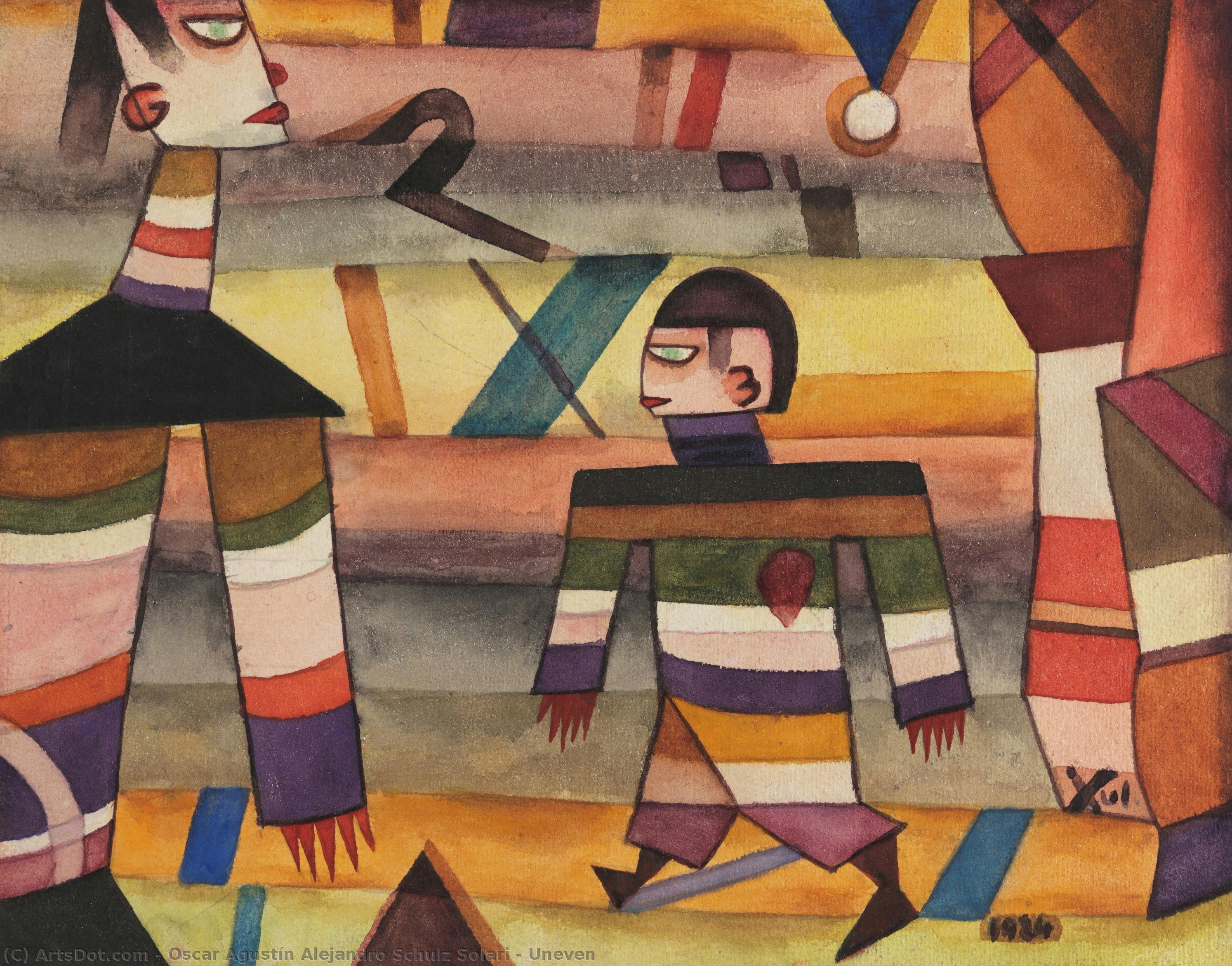
In the ephemeral landscape of early twentieth-century modernism, few works capture the fragmented, dreamlike essence of the era quite like Uneven. Created in 1924 by the enigmatic Argentine master Xul Solar, this watercolor serves as a hauntingly beautiful window into a lost moment of art history. The painting belongs to a period of profound mystery; of the sixty-two works presented in Solar's landmark 1929 exhibition in Buenos Aires, many have vanished into the shadows of time, leaving only a handful of certainties. This piece stands as one of those precious survivors, a delicate testament to an artist who sought to bridge the gap between the terrestrial and the spiritual.
The composition is a captivating dance of figures and forms that defies traditional perspective. At its heart, three individuals stand in a rhythmic arrangement, their presence defined by bold, contrasting patterns. One figure commands attention with a large, expressive head and a shirt adorned in vibrant red and blue stripes, while others follow in a sequence of black, white, and verdant tones. This play of stripes creates a visual vibration, an "unevenness" that mirrors the title itself. Interspersed within this human tableau are the silent observers of the scene—dogs that drift through the composition, some anchored near the figures and others appearing as spectral presences in the periphery, adding a layer of surrealist whimsy and domestic mystery to the arrangement.
Symbolism and the Surrealist Spirit
To gaze upon Uneven is to enter the esoteric mind of Xul Solar. As an artist deeply immersed in occult symbolism, geometric abstraction, and linguistic innovation, Solar used his medium to explore dimensions beyond the visible. The technique of watercolor allows for a translucent, ethereal quality, where colors bleed into one another just enough to suggest that the boundaries between people, animals, and space are permeable. The use of stripes is not merely decorative; it acts as a rhythmic device, breaking up the solidity of the figures and integrating them into the atmospheric background.
The emotional impact of the work lies in its profound sense of curiosity and slight disorientation. There is a quiet tension in the way the characters face one another, a silent dialogue captured in pigment. For the collector or the lover of fine art, this piece offers more than just aesthetic pleasure; it provides an invitation to contemplate the unseen connections that bind all living things. It is a work that rewards deep looking, revealing new layers of meaning with every encounter—a perfect centerpiece for those who appreciate art that challenges the intellect while soothing the soul.
An Elegant Addition to Sophisticated Interiors
For interior designers and connoisseurs of high-quality reproductions, Uneven represents a sophisticated choice for creating a focal point of cultural depth. Its intimate scale of 19 x 24 cm makes it an ideal selection for curated gallery walls or as a standalone accent in a study or library. The vibrant yet balanced palette of primary colors and earthy greens can breathe life into a minimalist modern space or add a layer of historical intrigue to a classic setting.
Owning a reproduction of such a significant piece from the Argentine avant-garde allows one to bring the spirit of 1920s Buenos Aires into the contemporary home. It is an investment in atmosphere, offering a conversation starter that speaks of travel, mysticism, and the enduring power of the human imagination. Whether displayed in a sunlit salon or a quiet reading nook, this work by Xul Solar remains a timeless masterpiece of rhythmic abstraction.
작가 소개
A Luminary of the Avant-Garde: The Enigmatic World of Xul Solar
Oscar Agustín Alejandro Schulz Solari, known to the world as Xul Solar, was a figure who defied easy categorization. Born in San Fernando, Argentina, in 1887, his life and art were a vibrant tapestry woven with threads of cosmopolitan upbringing, esoteric exploration, and an unwavering dedication to artistic innovation. His parents—a Baltic German father and an Italian mother—instilled in him a sensibility open to diverse cultural currents, a foundation that would profoundly shape his artistic journey. Though initially educated as both a musician and architect, it was during extensive travels through Europe – London, Paris, Turin, Genoa, Milan – that Schulz Solari discovered his true calling: painting. He began with watercolor, later embracing tempera and occasionally oils, each medium serving as a vehicle for increasingly complex visions. The adoption of the name “Xul Solar” itself is deeply revealing; derived from the Latin "lux" (light) and "solar," it embodies the artist’s fascination with illumination, energy, and the universal forces that underpin existence. It wasn't merely a pseudonym but an invocation of his artistic philosophy.Influences and Artistic Development
Xul Solar’s early work reflected the prevailing European avant-garde movements, yet he quickly transcended imitation to forge a uniquely personal style. His encounter with British occultist Aleister Crowley in 1924, though brief, left an indelible mark, sparking an interest in mysticism and symbolism that would permeate his art. Upon returning to Buenos Aires, Xul Solar became a central figure in the “Florida Group” (also known as the "Martín Fierro group"), a hub of intellectual and artistic ferment. Here, he forged close friendships with literary giants Jorge Luis Borges and Leopoldo Marechal, relationships that fostered a cross-pollination of ideas and profoundly influenced his creative output. This association wasn’t merely social; it was an exchange of philosophical inquiries, linguistic experimentation, and shared explorations of the subconscious. His paintings began to incorporate invented alphabets, geometric abstractions infused with occult symbolism, and dreamlike landscapes populated by enigmatic figures. He didn't simply depict reality; he constructed alternate realities governed by his own internal logic.A Universe of Symbols and Languages
The core of Xul Solar’s artistic practice lay in the creation of a personal mythology—a universe brimming with invented languages, symbolic systems, and fantastical creatures. He developed two complete artificial languages: “Neocriollo,” a poetic blend of Portuguese and Spanish intended for spoken communication, and “Panlengua,” an ambitious attempt at a universal language linking mathematics, music, astrology, and the visual arts. These linguistic endeavors weren’t merely intellectual exercises; they were integral to his artistic vision, informing the intricate patterns and coded messages embedded within his paintings. He believed that language held the key to unlocking deeper truths about the universe, and he sought to create a system of communication that transcended cultural boundaries. This fascination extended to other areas: he designed musical instruments based on esoteric principles and even invented a complex board game called “Panajedrez,” governed by rules derived from his semiotic experiments.Legacy and Lasting Impact
Despite achieving recognition during his lifetime, with a significant exposition at the Musée National d'Art Moderne in Paris in 1962, Xul Solar remained somewhat of an enigmatic figure until after his death in Tigre, Argentina, in 1963. Emilio Pettoruti’s biography published five years later helped to solidify his place within the canon of Argentine art and beyond. Today, Xul Solar is celebrated as a pivotal figure of the Latin American avant-garde—an artist whose work anticipated many of the concerns that would come to define Surrealism and other 20th-century movements. His paintings, with their vibrant colors, intricate symbolism, and otherworldly atmosphere, continue to captivate audiences worldwide. Naná Watzin, Leader of Snakes, and Four Indian Women are just a few examples of his masterpieces that showcase his unique artistic vision. Xul Solar’s legacy extends beyond the realm of painting; he was a visionary thinker, an inventor, and a cultural innovator who dared to imagine alternative realities and challenge conventional modes of thought. His work remains a testament to the power of art to transcend boundaries, explore the mysteries of existence, and illuminate the hidden dimensions of the human experience.
Xul Solar
1887 - 1963 , Argentina
주요 정보
- Artistic Movement Or Style: Avant-garde, Surrealism
- Artists Or Movements Influenced By This Artist:
- Jorge Luis Borges
- Leopoldo Marechal
- Artists Who Influenced This Artist:
- Emilio Pettoruti
- Arturo Martini
- Date Of Birth: December 14, 1887
- Date Of Death: April 9, 1963
- Full Name: Oscar Agustin Schulz Solari
- Nationality: Argentine
- Notable Artworks:
- Naná Watzin
- Leader of Snakes
- Four Indian Women
- Colonial House
- Holy Dance
- Place Of Birth: San Fernando, Argentina