유화 원작 구매
 Molnar에 관한 모든 것







































 가로 또는 세로 중 어느 한 면이라도 105cm(약 41인치)를 초과하는 작품이나 복제화의 경우, 프레임은 분해된 키트 형태로 배송됩니다. 이는 안전한 배송을 보장하고 운송 중 발생할 수 있는 손상을 방지하기 위함입니다.


A Symphony of Circles: Unveiling Victor Vasarely’s “Molnar”
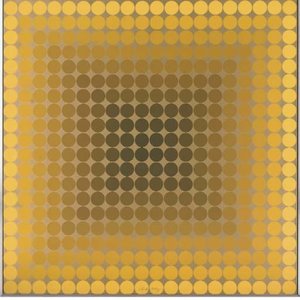
Victor Vasarely's "Molnar" is more than just a painting; it’s an invitation into the mesmerizing world of Op Art, a realm where perception itself becomes the subject. This striking composition – a dominant red circle enveloped by a constellation of smaller circles in vibrant hues – immediately captivates with its dynamic energy and illusionistic depth. The work, echoing Vasarely's pioneering explorations of optical art, demonstrates a masterful manipulation of color and form to create an experience that transcends simple visual representation.
The Genesis of Optical Illusions
Born in 1906 in Pécs, Croatia (then part of Austria-Hungary), Károly Vaszary – later known as Victor Vasarely – initially pursued a medical career before dedicating himself to the burgeoning field of visual art. His formative years were deeply influenced by the Bauhaus movement and Sándor Bortnyik’s “Műhely” workshop, where he absorbed the principles of functional design and geometric abstraction. This training provided the foundation for his revolutionary approach: to explore how the human eye perceives and interprets shapes and colors. "Molnar" exemplifies this philosophy perfectly, drawing upon techniques developed by Vasarely and other pioneers of Op Art – artists who sought to challenge traditional notions of representation by directly engaging with the viewer’s visual system.
Decoding the Composition
The painting's intricate arrangement is a deliberate exercise in controlled chaos. The large, red circle acts as an anchor, drawing the eye inward while simultaneously creating a sense of space and depth. The smaller circles, rendered in a spectrum of colors – green, yellow, pink, brown, and blue – are not randomly scattered; they’re meticulously positioned to create a dynamic interplay of light and shadow, further enhancing the illusion of three-dimensional form. This technique, characteristic of Vasarely's work, relies on the principles of optical mixing, where adjacent colors appear to blend together due to the way our eyes perceive them. The overall effect is one of constant movement and shifting perspective, a testament to the artist’s understanding of visual perception.
Symbolism and Emotional Resonance
"Molnar" transcends mere aesthetic appeal; it speaks to fundamental questions about reality and perception. Vasarely's work often explored themes of order and chaos, suggesting that these two forces are inextricably linked within the human experience. The circles themselves can be interpreted as representing wholeness, unity, or even the infinite – concepts frequently explored in geometric abstraction. Beyond its intellectual depth, "Molnar" evokes a powerful emotional response, inviting viewers to lose themselves in its mesmerizing patterns and contemplate the nature of visual reality. It’s a piece that demands attention, stimulating the senses and challenging our assumptions about how we see the world.
질의응답
Molnar은(는) 수작업으로 그린 작품인가요, 아니면 프린트된 작품인가요?
수작업 제작: 숙련된 화가가 Molnar을(를) 리넨 캔버스 위에 유화로 재현합니다.
Molnar의 사이즈는 어떤 것을 선택해야 하나요?
사이즈는 31.6 x 31.7 cm (₩268034)부터 239.2 x 240.1 cm (₩2775489)까지 있으며, 이 페이지의 표에 주요 단계별 가격이 안내되어 있습니다.
배송은 얼마나 걸리나요?
배송은 전 세계 무료 특송으로 4~5주가 소요되며, 본 페이지에서 긴급 제작 옵션을 선택하실 수 있습니다. 제품은 조건 없이 100일 이내에 반품하여 전액 환불받으실 수 있습니다.
빅토르 바사렐리 작가는 Molnar 작품에 어떤 재료를 사용했나요?
Acrylic On Canvas
 미리보기

 공유하기
 공유하기
 상세 정보
 학습용 요약본


 다운로드
 유사 작품 더 보기
 X-레이
 슬라이드 쇼 보기
 질의응답

 통계 정보