프린트 판매로 전환
 더 보기
더 보기







































 가로 또는 세로 중 어느 한 면이라도 105cm(약 41인치)를 초과하는 작품이나 복제화의 경우, 프레임은 분해된 키트 형태로 배송됩니다. 이는 안전한 배송을 보장하고 운송 중 발생할 수 있는 손상을 방지하기 위함입니다.


A Quad (c.1900): A Monumental Vision of British Landscape
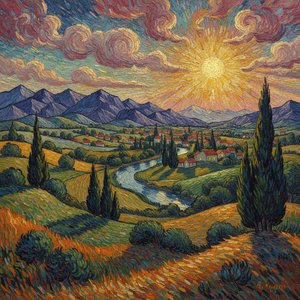
Sir William Nicholson’s “A Quad” stands as an arresting testament to the burgeoning landscape movement of early 20th century Britain, capturing a dramatic vista of Dartmoor National Park with breathtaking precision and emotional resonance. Painted around 1900, this monumental canvas exemplifies Nicholson's masterful command of Impressionistic principles blended seamlessly with Symbolist influences—a stylistic fusion that distinguishes it from its contemporaries.
The painting depicts a vast expanse of moorland under a turbulent sky ablaze with hues of crimson and ochre. Nicholson skillfully employs loose brushstrokes to convey the dynamism of the weather, mirroring the rugged beauty of Dartmoor’s terrain. Foreground elements—rolling hillsides dotted with heather—are rendered in muted tones, creating depth and perspective that draws the viewer into the scene. However, it is the sky itself – dominated by swirling clouds – which commands attention, conveying a palpable sense of atmospheric drama.
- Style: Impressionistic Landscape
- Technique: Oil on Canvas; Impasto Texture
- Historical Context: Dartmoor landscape painting gained prominence during the Aesthetic Movement, reflecting a fascination with untamed nature and Romantic ideals.
Beyond its aesthetic merits, “A Quad” resonates with deeper symbolic significance. Nicholson’s deliberate use of color—particularly the fiery reds—suggests passion and energy, mirroring the primal forces shaping Dartmoor's environment. The composition itself emphasizes grandeur and solitude, inviting contemplation on humanity’s relationship with the natural world. It speaks to a yearning for escape from urban pressures and an appreciation for the sublime beauty found in untouched wilderness.
Nicholson’s artistic partnership with Mabel Pryde profoundly shaped his creative vision. Together they established the Pryde Studio, fostering innovation and experimentation within British art circles. This collaborative spirit is evident in “A Quad,” where Nicholson's meticulous observation of Dartmoor combined with Pryde’s encouragement to push boundaries resulted in a truly unforgettable artwork.
About Sir William Nicholson
Born in Newark-on-Trent in 1872, Sir William Nicholson (1872–1949) was a British painter whose career spanned diverse mediums and styles. His father, an engineer and Conservative MP, instilled discipline alongside an appreciation for artistic pursuits—a duality that profoundly influenced his artistic development.
Early training under Hubert von Herkomer honed Nicholson’s technical skills while introducing him to Mabel Pryde, whom he married and with whom he formed a lifelong creative partnership. This collaboration propelled them to establish the Pryde Studio, nurturing innovation and fostering dialogue within British art.
Nicholson's artistic output encompassed portraits, landscapes, woodcuts, and decorative murals—each reflecting his unwavering commitment to exploring themes of emotion, memory, and human experience. His enduring legacy resides in his ability to capture the essence of his subjects with remarkable sensitivity and stylistic brilliance.
Connections to Other Artists
Nicholson’s artistic trajectory intersected with that of fellow British painters who championed landscape painting during the Aesthetic Movement. Notably, John Kyffin Williams—a Welsh artist celebrated for capturing Dartmoor's ethereal beauty—shared Nicholson’s fascination with portraying untamed landscapes using bold impasto technique.
Furthermore, Frank Brangwyn’s monumental murals and dramatic depictions of exotic locales mirrored Nicholson’s ambition to convey grandeur and emotional intensity. These artists collectively contributed to shaping the artistic landscape of their time, reflecting a shared desire to engage viewers on both an aesthetic and intellectual level.
Further Exploration
The Sir William Dunn School of Pathology—a pioneering institution dedicated to immunology research—represents a contrasting facet of Nicholson’s cultural milieu. Founded in Oxford, it exemplifies the scientific advancements that underpinned Victorian society and fostered dialogue between art and science.
Similarly, “A Quad” embodies the spirit of artistic experimentation championed by figures like Sir William Blake Richmond—a Pre-Raphaelite painter who sought to infuse his canvases with symbolic meaning. These artists’ endeavors underscore the multifaceted nature of British culture during the Edwardian era.
질의응답
윌리엄 니콜슨의 "A Quad (c.1900)"을(를) 활용하기에 가장 좋은 용도와 공간은 무엇인가요?
윌리엄 니콜슨의 "A Quad (c.1900)"은(는) Accent(을)를 위해 추천되며, Living Room에 배치하기에 가장 이상적입니다. 용도와 공간 정보를 참고하여 작품의 최적의 위치를 찾아보세요.
1900년에 "A Quad (c.1900)"을(를) 제작할 당시 윌리엄 니콜슨의 나이는 몇 세였나요?
1900년에 "A Quad (c.1900)"이(가) 제작되었을 당시, 1872년에 태어난 윌리엄 니콜슨의 나이는 28세였습니다.
윌리엄 니콜슨의 "A Quad (c.1900)"의 수작업 복제화를 판매하는 곳이 어디인가요?
"A Quad (c.1900)" 작품은 리넨 캔버스에 손으로 직접 그린 유화 복제화로 만나보실 수 있습니다. 주문은 수작업 유화 복제화 페이지에서 가능하며, 다양한 사이즈를 선택하실 수 있습니다.
이 작품에 대해 더 알아보기
 미리보기
미리보기
 공유하기
공유하기 공유하기
공유하기
 상세 정보
상세 정보 가이드 보기

 다운로드
다운로드
 유사 작품 더 보기
 X-레이
X-레이 슬라이드 쇼 보기
 질의응답
질의응답 통계 정보
통계 정보