프린트 판매로 전환
 상세 보기
상세 보기







































 가로 또는 세로 중 어느 한 면이라도 105cm(약 41인치)를 초과하는 작품이나 복제화의 경우, 프레임은 분해된 키트 형태로 배송됩니다. 이는 안전한 배송을 보장하고 운송 중 발생할 수 있는 손상을 방지하기 위함입니다.


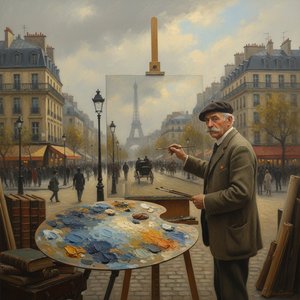
Cais da Farinha, carry us on the banks of the Seine, in Paris, the capital where the artist meets for the second time, now for a period of five years (1921-1926), and already with a path marked by the influence of his master of the School of Fine Arts of Lisbon and a naturalistic tradition, incorporated by Malhoa and Columbano. Technically, ready to develop new paths and to emancipate himself from the academic demands, Dórdio Gomes has joined the pictorial movement which will mark the history of European painting and open himself to the new constructive and formal concerns developed by Paul Cézanne, the postmodernist. This painting is an exercise of landscaping, in which the author paints outdoors, like the Impressionists did, in front of the motif, providing the chromatic changes of nature, at the precise moment of a day of charged atmospheric environment, in a scenario of distant perspective, making the outline of the horizon stand out, the silhouette of Notre-Dame. The right bank of the river, on rolling, winding earth, occupies the foreground of the observer, in search of the objects present, such as the car and boats moored in the waters of the Seine.
질의응답
시망 세자르 도르지우 고메스의 "Cais da Farinha, Paris"의 재료와 제작 연도는 무엇인가요?
"Cais da Farinha, Paris"은(는) 1923년에 Oil 기법으로 제작되었습니다. 재료와 제작 연도는 원작이 어떤 방식으로 언제 만들어졌는지를 설명합니다.
"Cais da Farinha, Paris"의 조회수는 얼마인가요?
"Cais da Farinha, Paris"에 대한 통계 페이지가 존재합니다. 이 페이지에는 해당 작품과 작가의 다른 작품들에 대한 월별 방문자 수가 국가 및 언어별로 상세히 표시됩니다.
시망 세자르 도르지우 고메스의 "Cais da Farinha, Paris"은 어떤 사조와 시대에 속하나요?
시망 세자르 도르지우 고메스의 "Cais da Farinha, Paris"은(는) 작가의 근대 미술 시대 중 Modernism 사조에 속합니다.
More about this painting
 실제 크기로 보기
 보내기
보내기 공유하기
공유하기
 상세 보기
상세 보기 가이드 보기

 이미지 다운로드
 유사 작품 더 보기
 X-레이
X-레이 슬라이드 쇼 보기
 Q&A
Q&A 통계 정보
통계 정보