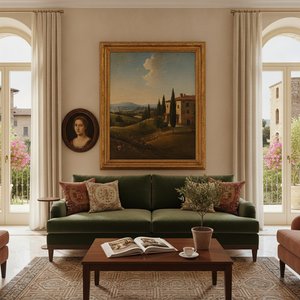
프린트 판매로 전환
 더 보기
더 보기







































 가로 또는 세로 중 어느 한 면이라도 105cm(약 41인치)를 초과하는 작품이나 복제화의 경우, 프레임은 분해된 키트 형태로 배송됩니다. 이는 안전한 배송을 보장하고 운송 중 발생할 수 있는 손상을 방지하기 위함입니다.


A Moment Frozen in Tuscan Tranquility
In the quiet corners of art history, few works capture the essence of peaceful companionship as tenderly as Silvestro Lega’s 1880 masterpiece, “In the Villa.” The painting invites the viewer into a serene tableau, where a man and a woman sit closely together on a bench, nestled beneath the dappled shade of mature, protective trees. This is not merely a depiction of a garden scene; it is an intimate study of connection. Lega meticulously arranges his subjects against a lush backdrop of foliage, creating a harmonious balance that draws the eye inward, toward the silent, shared language between the two figures. The atmosphere is one of profound stillness, as if the very air of the Tuscan landscape has paused to honor this private moment of togetherness.
The technical brilliance of the piece lies in Lega’s mastery of the Macchiaioli technique. Moving away from the polished, often artificial perfection of academic idealism, Lega embraced the concept of “macchia”—the use of distinct spots or patches of color to build form and light. Rather than relying on smooth, seamless transitions, he applied pigment in irregular, textured strokes that capture the flickering interplay of sunlight and shadow. This method lends an incredible immediacy to the work, making the textures of the leaves and the soft light filtering through the canopy feel palpable. For the discerning collector or interior designer, this technique provides a rich, tactile quality that brings a sense of organic life and movement to any space.
Symbolism and the Spirit of the Belle Époque
Beyond its surface beauty, “In the Villa” is layered with subtle symbolic resonances that elevate it from a simple genre painting to a work of deep contemplation. The sturdy trees framing the couple serve as metaphors for stability and longevity, mirroring the enduring nature of the bond they share. Even a small detail, such as a bird soaring in the distant sky, adds a layer of poetic aspiration and freedom to the composition. Through a palette of muted greens, earthy browns, and soft ochres, Lega achieves a tonal harmony that evokes a sense of timelessness, grounding the fleeting moment in something much more permanent.
Historically, this work emerged during the Belle Époque, a period of significant cultural and political transformation in Italy. As a leading figure of the Macchiaioli movement, Lega’s art was deeply rooted in social realism and a commitment to observing the truth of everyday life. His involvement in the political currents of his era—including his support for Italian unification—infused his landscapes with a sense of grounded reality and emotional honesty. To possess a reproduction of this work is to hold a piece of Italian heritage, capturing a period where art sought to find beauty in the authentic, unadorned moments of human existence.
For those looking to infuse their homes or galleries with a sense of calm and sophistication, “In the Villa” offers an unparalleled emotional impact. It is a painting that does not demand attention through loud colors or dramatic action, but rather earns it through its quiet, soulful presence. Whether placed in a sunlit study or a contemporary living space, this work serves as a window into a world of grace, reminding us of the beauty found in simplicity and the enduring strength of human connection.
질의응답
"In the villa"은(는) 언제 제작되었나요?
"In the villa"은(는) 1880년에 제작되었습니다. 이 시기는 실베스트로 레가의 예술적 경력과 당시의 시대상을 잘 보여줍니다.
원작 실베스트로 레가의 "In the villa"의 크기는 어떻게 되나요?
실베스트로 레가의 "In the villa"의 원작 크기는 48 x 68 cm입니다. 복제화는 동일한 비율을 유지하면서 다른 크기로도 주문 가능합니다.
"In the villa"의 색상들이 서로 어떻게 조화를 이루고 있나요?
실베스트로 레가의 "In the villa"의 색채는 Strong Color Unity 조화를 보여줍니다. 여기서 조화란 색상들이 서로 어떻게 어우러지는지를 의미합니다.
이 작품에 대해 더 알아보기
 미리보기
미리보기
 공유하기
공유하기 공유하기
공유하기
 상세 정보
상세 정보 가이드 보기

 다운로드
다운로드
 유사 작품 더 보기
 X-레이
X-레이 슬라이드 쇼 보기
 질의응답
질의응답 통계 정보
통계 정보