Neo-Dada · 1955
Monogram (로버트 라우션버그, 1955)
로버트 라우션버그 (1925–2008) 작가의 Monogram 1955년에 제작되었습니다. Neo-Dada 운동에 속합니다.
- 1955

 미리보기

 수작업 유화 작품
 공유하기
 공유하기
 학습용 요약본


 다운로드
 유사 작품 더 보기
 X-레이
 슬라이드 쇼 보기
 질의응답

 통계 정보
Monogram 요약
Monogram은(는) 무엇을 묘사하고 있나요?
A Fusion of Nature and Industry: Robert Rauschenberg's "Monogram"
Robert Rauschenberg’s 1955 “Monogram” is a seminal work from his groundbreaking “Combines” series, a pivotal moment in art history that blurred the lines between painting, sculpture, and assemblage. This iconic piece transcends simple categorization, offering a complex visual narrative rich with symbolism and challenging traditional artistic boundaries. It's a powerful statement about post-war American culture, consumerism, and the evolving role of the artist.
Subject & Style: Neo-Dada Meets Pop Art
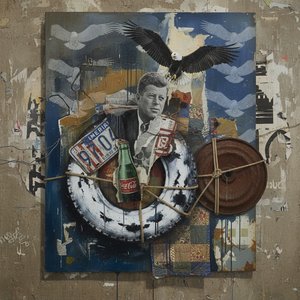
At its core, "Monogram" presents a striking juxtaposition of organic and industrial elements. The central image is the head of a ram, instantly recognizable through its long, curving horns. However, Rauschenberg doesn't present this animal in a naturalistic way. Instead, he obscures the face with painted markings, transforming it into an almost abstract form. Behind the ram’s head looms a large tire – a ubiquitous symbol of American transportation and industrial progress. This unexpected pairing is characteristic of the Neo-Dada movement, which Rauschenberg helped pioneer. Neo-Dada rejected the seriousness of Abstract Expressionism, embracing humor, irony, and found objects to critique societal norms. The work foreshadows elements of Pop Art, anticipating its embrace of everyday imagery and mass culture.
Technique & Materials: The "Combine" Process
“Monogram” exemplifies Rauschenberg’s innovative “Combines.” This term, coined by the artist himself, describes works that incorporate a variety of materials beyond traditional paint on canvas. Here, he utilizes a tire, fabric scraps, paper fragments, and painted surfaces to create a layered and textured composition. The base upon which the ram's head rests is covered in a collage-like arrangement of these disparate elements – torn papers, crumpled fabrics—adding to the work’s chaotic yet compelling visual energy. Rauschenberg’s technique involved a process of intuitive layering and assemblage, often incorporating materials he found or collected, further emphasizing the element of chance and spontaneity within his creative practice.
Symbolism & Historical Context
The symbolism in "Monogram" is open to interpretation, contributing to its enduring appeal. The ram itself can be seen as a symbol of power, virility, and even aggression. Its painted-over face suggests a loss of identity or a questioning of traditional representations. The tire, representing industrialization and mobility, introduces a contrasting element of modernity and perhaps even environmental concern. Created in 1955, the work reflects the post-war American landscape – a period of rapid economic growth, consumerism, and technological advancement. The piece can be viewed as a commentary on this era's complex relationship with nature and industry, questioning the impact of human progress on the natural world.
Emotional Impact & Legacy
"Monogram" evokes a range of emotions – from curiosity and intrigue to unease and even a sense of playful absurdity. The unexpected combination of elements challenges viewers to reconsider their perceptions of art and its relationship to everyday life. The work’s impact on subsequent generations of artists is undeniable, influencing the development of assemblage art, Pop Art, and contemporary sculpture. Owning a reproduction of "Monogram" allows you to bring this iconic piece into your space—a conversation starter and a testament to Rauschenberg's revolutionary vision.
Monogram의 고해상도 이미지
로버트 라우션버그, Monogram (1955).
Monogram에 관한 질문과 답변
로버트 라우션버그의 "Monogram"에는 어떤 모습이 담겨 있나요?
로버트 라우션버그의 "Monogram"은(는) 퍼블릭 도메인인가요?
저작권과 관련하여, "Monogram"은(는) 저작권 보호 대상입니다 상태입니다.
로버트 라우션버그의 "Monogram"은(는) 어떤 미술 사조에 속하나요?
"Monogram"은(는) 로버트 라우션버그의 예술적 발전 단계 중 어느 시기를 나타냅니까?
1955년에 "Monogram"을(를) 제작할 당시 로버트 라우션버그의 나이는 몇 세였나요?
로버트 라우션버그의 "Monogram"의 저작권 상태는 어떻게 되나요?
"Monogram"은(는) 로버트 라우션버그의 작품 세계와 화풍을 어떻게 반영하고 있나요?
"Monogram"은(는) 로버트 라우션버그의 Neo-Dada 시기 작품으로, 작가의 주요 주제로는 dadaism & surrealism, assemblage art techniques, pop art sensibilities, representative of 'combines' style, exploration of found object art, key work in rauschenberg’s oeuvre, demonstrates his experimental approach, juxtaposition of nature/industry 등이 있습니다.
아티스트 로버트 라우션버그 소개

1925–2008, 미국
로버트 라우션버그
A Life Forged in Transition 로버트 라우셕버그(Robert Rauschenberg), 본명 밀턴 어니스트 라우셕버그는 1925년 미국 텍사스주 포트 아서의 석유가 풍부한 지역에서 태어났습니다. 그의 삶은 역동적인 에너지와 변화 정신을 반영하는 듯했습니다. 어린 시절은 정착된 곳 없이 아버지의 직업 때문에 여러 지역을 떠돌아다니며 보냈고, 이러한 유목 생활은 다양한 시각적 자극에 대한 수용성과 변화를 포용하려는 의지를 그의 내면에 은연중에 심어주었습니다. 이러한 초기 경험은 미국인의 삶의 질감과 리듬에 대한 감수성을 키워주었고, 이는 그의 예술 탐구에 깊이 영향을 미쳤습니다.
로버트 라우션버그의 다른 작품들
 재산 (Estate)1963
 신호들1970
 Barge1963
 Odalisk1958
Monogram 관련 에세이
 Francis Picabia: Dada's Provocateur – Reassessing Mechanical Forms & Mystical UndercurrentsExplore the revolutionary art of Francis Picabia – Dada's enigmatic provocateur. Discover his mechanical forms, hidden symbolism & lasting …
 Robert Rauschenberg: Bridging Painting & Life – A Comprehensive Exploration of Combines, Silkscreens, and the Erasure of BoundariesExplore the revolutionary art of Robert Rauschenberg – Combines, silkscreens & more. Discover his impact on Pop Art, investment potential &…
 Spontaneity and Matter: Distinguishing CoBrA from Art InformelMaster the differences between CoBrA and Art Informel with our expert guide. Learn to identify these post-war movements today.