

 실제 크기로 보기
 보내기
보내기 공유하기
공유하기
 상세 보기
상세 보기 가이드 보기

 이미지 다운로드
 유사 작품 더 보기
 X-레이
X-레이 슬라이드 쇼 보기
 통계 정보
통계 정보Caesar Dictates His Commentaries
 Oil On Canvas
- WallArt
- Neoclassical Revival
 1812
1812- 19th Century
 270.0 x 450.0 cm
 퀴리날레 궁전
 상세 보기
상세 보기
Get a print-ready file that goes far beyond the web preview. Every digital image we sell comes from a high-resolution master in our stock database — usually 5,000 to 15,000 pixels wide — so you can print large, crop tightly, or reproduce fine detail with confidence.
No file leaves our studio untouched. A digital expert checks the colors against the original painting and corrects them if needed, then improves clarity and detail with professional retouching tools — always staying faithful to the artist's brushwork and style. The result is an image that looks like the painting, not like a filtered scan.
You approve before you're done: our expert sends the image by e-mail within 72 hours for your review. Not satisfied? Ask for improvements or corrections, or request a refund if the quality falls short.
This is the quality relied on by publishers, design studios, galleries and print shops.
디지털 이미지
개인 소장 및 전시, 인쇄, 창작 프로젝트를 위한 고해상도 파일을 다운로드하세요. ( 프린트 판매로 전환 수작업 채색 복제본 주문하기)
모든 디지털 이미지 주문 시 제공되는 혜택
전문적인 디지털 이미지 전송 보장
OriginalUniqueArt.com를 선택하시면 단순히 이미지를 받는 것을 넘어, 정밀한 보정 과정을 거쳐 완성된 전문적인 디지털 예술 작품을 만나보실 수 있습니다. 모든 작품에는 만족 보장 서비스가 함께 제공되며, 주문 시 다음과 같은 사항들이 자동으로 포함됩니다:

빠른 이메일 수령
주문 후 72시간 이내에 고해상도 디지털 이미지 파일이 이메일로 발송되며, 즉시 사용하실 수 있습니다.

AI 기술로 최적화된 디지털 파일
귀하의 작품은 고급 AI 기술과 정교한 수동 편집 과정을 거쳐 전문적으로 최적화되며, 이를 통해 디테일과 선명도, 색상의 정확도를 극대화합니다.

평생 무료 재전송 서비스
파일을 실수로 삭제하거나 분실하셨나요? 걱정 마세요. 언제든 무료로 다시 보내드립니다.

추가 수입 비용 없음 - 언제나
관세나 부가세, 배송비 부담 없이 작품을 즉시 소장하세요 - 디지털 다운로드는 언제나 면세 혜택이 적용됩니다.

정확한 색상 보장
전문적인 도구와 색상 관리 시스템을 통해 디지털 이미지가 원본의 색상을 최대한 정확하게 구현하도록 보장합니다.

100일 만족 보장제
구매하신 디지털 이미지에 만족하지 못하실 경우, 100일 이내에 별도의 조건 없이 수정 또는 100% 환불을 진행해 드립니다.

100% 환불 보장
만족스럽지 않으신가요? 디지털 파일을 받으신 후 100일 이내에 조건 없이 전액 환불해 드립니다.

대량 주문 할인
이미지 3매 구매 시 10% 할인 - 5매 구매 시 15% 할인 - 10매 이상 구매 시 20% 할인. 크리에이티브 프로젝트, 갤러리, 에이전시에 매우 유용합니다.
The Grandeur of Empire: Caesar Dictates His Commentaries
To stand before this monumental canvas is to be transported across the centuries, into the very heart of Roman intellectual power. Depicting the scene inspired by Plutarch’s biography, Caesar Dictates His Commentaries captures a moment of profound historical weight—the mind of Julius Caesar at work. The setting itself speaks volumes; confined within the intimate yet grand space of a tent that opens dramatically onto the bustling energy of the military camp beyond. This contrast between focused scholarly endeavor and martial might is palpable, drawing the viewer into the gravity of empire-building thought.
A Study in Classical Authority and Technique
The composition centers on Caesar himself, rendered with an unmistakable air of luminous authority as he sits near a tripod adorned with zoomorphic legs. Clad in a brilliant white cloak, his posture suggests both deep contemplation and absolute command. He is surrounded by scribes, their bent forms illustrating the meticulous act of recording history onto tablets, while Caesar holds the stylus—the instrument through which immortal words are shaped. The artist masterfully employs oil on canvas to achieve rich textures, from the sumptuous folds of drapery to the polished wood of the furniture and the sheen of the parchment. The sheer scale of this work, measuring 270 x 450 cm, demands attention, allowing every detail—from scattered books suggesting vast libraries of knowledge to the distant boat visible in the background—to contribute to a tapestry of ancient Roman life.
Echoes of Power: Historical Context and Symbolism
The painting is more than just a portrait; it is an allegory of historical legacy. The likeness given to Caesar evokes parallels with Napoleon, suggesting that the themes of military genius intertwined with literary record have echoed through epochs. This connection subtly nods toward Giorgio Vasari’s earlier depiction in Florence, grounding the piece within a lineage of artistic commemoration of great leaders. Symbolically, the act of dictation itself represents the eternal struggle to document and interpret human action—the moment history is fixed into permanence by genius. The presence of the scribes underscores that even the greatest minds require diligent hands to translate vision into tangible record.
An Interior Statement for the Connoisseur
For the collector or designer whose taste leans toward narratives of enduring power and classical sophistication, this reproduction offers an unparalleled focal point. Its dramatic scale ensures it will anchor any grand hall or library, lending an air of cultivated erudition to the space. It is a piece that does not merely decorate; it narrates. Owning this work means embracing a dialogue with antiquity—a celebration of intellect, military prowess, and the enduring power of the written word.
질의응답
Pelagio Palagi의 "Caesar Dictates His Commentaries"은 강렬한 대비를 사용하나요, 아니면 부드러운 조화를 이루고 있나요?
Pelagio Palagi의 "Caesar Dictates His Commentaries"의 색채 분석은 Balanced한 대비와 Unified Palette한 조화를 보여줍니다.
Pelagio Palagi의 "Caesar Dictates His Commentaries" 작품에 권장되는 인쇄 설정은 무엇인가요?
Large 크기, Landscape 방향: 이는 Pelagio Palagi의 "Caesar Dictates His Commentaries" 작품에 권장되는 인쇄 설정입니다.
Pelagio Palagi의 "Caesar Dictates His Commentaries"에는 어떤 색상 팔레트가 사용되었나요?
Pelagio Palagi의 "Caesar Dictates His Commentaries"의 색채 구성은 Earthy로 설명됩니다. 이는 작품에 사용된 색상들을 간결하게 묘사한 것입니다.
아티스트 프로필
Early Life and Artistic Foundations
Pelagio Palagi, born in Bologna in 1775, embarked on an artistic journey nurtured from a remarkably young age. His formative years were profoundly shaped by Count Carlo Filippo Aldrovandi, a discerning patron who recognized and fostered the budding talent within the boy. Aldrovandi’s home was not merely a residence but a veritable academy, brimming with an extensive collection of prints and offering rigorous life drawing classes at the esteemed Accademia Clementina. This environment instilled in Palagi a deep appreciation for classical forms and techniques, providing him with a solid foundation in perspective, architecture, figurative painting, portraiture, and the art of collecting itself. It was a period of intense study and observation, laying the groundwork for his future versatility as an artist. Interestingly, these early artistic explorations coincided with the tumultuous arrival of Napoleon’s forces in Bologna, leading to unexpected commissions – designs for uniforms, medals, and emblems emblazoned with the revolutionary ideals of “Liberté, Égalité, Fraternité.” These initial projects demonstrated Palagi's adaptability and willingness to engage with the political currents of his time.From Roman Grandeur to Milanese Society
Palagi’s artistic development took a significant turn in 1806 when he journeyed to Rome, seeking further refinement at the Accademia di San Luca. It is believed that he may have studied under the tutelage of Vincenzo Camuccini, whose emphasis on historical accuracy and meticulous detail would leave an indelible mark on Palagi’s style. This Roman period proved pivotal, yielding notable works such as “Portrait of Giuseppe Guizzardi in Antique Costume” (1807) and the allegorical "Marriage of Amore and Psyche" (1808). He also undertook ambitious historical paintings like “Mario a Minturno,” showcasing his growing mastery of narrative composition. Beyond easel painting, Palagi’s talents were sought for large-scale decorative projects, including frescoes at the Palazzo del Quirinale and Palazzo Torlonia, demonstrating his ability to seamlessly blend artistic vision with architectural space. In 1815, Palagi relocated to Milan, establishing a private school that directly challenged the established authority of the Accademia di Brera. This bold move underscored his confidence in his pedagogical approach and his commitment to fostering independent artistic expression. During this Milanese chapter, he focused primarily on portraiture, capturing the likenesses of prominent figures like Giuseppe Bossi and Andrea Appiani, solidifying his reputation as a sought-after artist within elite social circles.Royal Patronage and Artistic Maturity
A new era dawned in 1832 when Palagi secured the patronage of King Carlo Alberto of Sardinia. This royal endorsement opened doors to significant commissions for various royal residences, transforming his career trajectory. He became deeply involved in ambitious enlargement projects at the Castle of Racconigi and modernization initiatives at the Palazzo Reale in Turin, showcasing not only his painting skills but also his aptitude for architectural design and interior decoration. His contributions were formally recognized with appointments as head of pictorial and decorative restoration projects and to the chair of decoration (cattedra di ornato) at the Accademia Albertina, cementing his position as a leading figure in the Italian art world. Perhaps the most magnificent testament to his artistic prowess during this period is “The Dance of the Hours,” a breathtaking ceiling painting commissioned for the ballroom at the Palazzo Reale in Turin. This work exemplifies Palagi’s ability to synthesize classical principles with a burgeoning Romantic sensibility, creating a dynamic and emotionally resonant composition that continues to captivate viewers today.A Synthesis of Styles and Enduring Legacy
Pelagio Palagi's artistic style represents a fascinating synthesis of Neoclassical rigor and emerging Romantic tendencies. His early training instilled in him a profound respect for clarity, order, and adherence to classical forms – qualities evident in his meticulously rendered portraits and historical paintings. However, influenced by artists like Francesco Hayez, he gradually incorporated elements of dramatic composition and emotional expression into his work, resulting in pieces such as “Gian Galeazzo Sforza” and “Ratto delle Sabine.” This willingness to embrace new artistic currents while remaining grounded in classical principles defines the unique character of his oeuvre. Beyond his accomplishments as a painter and sculptor, Palagi was an avid collector, amassing an impressive assemblage of Greek, Egyptian, Etruscan, and Roman sculpture, objects, and coins. Upon his death in 1860, he generously bequeathed this remarkable collection, along with his library, archive, and drawings, to the Comune di Bologna. Today, these treasures are housed at the Museo Civico Archeologico, Museo Civico Medievale, and Biblioteca Comunale dell'Archiginnasio, ensuring that Palagi’s legacy as a versatile artist, discerning collector, and influential figure in 19th-century Italian art endures for generations to come. His contributions extended beyond the canvas and chisel; he was a true polymath who left an indelible mark on the cultural landscape of his time.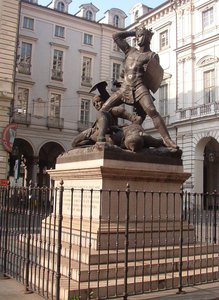
Pelagio Palagi
1775 - 1860 , Italy
핵심 정보
- Artistic Movement Or Style: Neoclassical, Romanticism
- Artists Who Influenced This Artist:
- Carlo Aldrovandi
- Vincenzo Camuccini
- Francesco Hayez
- Date Of Birth: 1775
- Date Of Death: 1860
- Full Name: Pelagio Palagi
- Nationality: Italian
- Notable Artworks:
- Portrait of Conte Lucini
- Self-portrait w/ friends
- The Dance of the Hours
- Mario a Minturno
- Marriage of Amore & Psyche
- Place Of Birth: Bologna, Italy