프린트 판매로 전환
 더 보기
더 보기







































 가로 또는 세로 중 어느 한 면이라도 105cm(약 41인치)를 초과하는 작품이나 복제화의 경우, 프레임은 분해된 키트 형태로 배송됩니다. 이는 안전한 배송을 보장하고 운송 중 발생할 수 있는 손상을 방지하기 위함입니다.


A Celestial Symphony in Watercolor
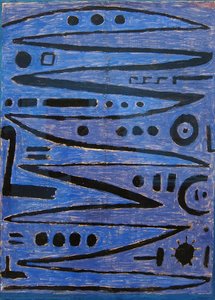
In the quiet, transformative era of the early 1920s, Paul Klee breathed life into a vision that transcended the boundaries of the physical world. His masterpiece, "The Firmament Above the Temple," is not merely a painting but a profound meditation on the spiritual connection between the earthly and the cosmic. Through a delicate dance of watercolor, pen, and ink, Klee invites us to gaze upward into a fragmented sky that feels both ancient and eternal. The work captures a stylized temple, yet it avoids the heavy weight of architectural realism, opting instead for a luminous, ethereal atmosphere where stone walls seem to dissolve into the very light they inhabit.
The composition is a masterclass in geometric abstraction, a hallmark of Klee’s unique ability to find rhythm within structure. Circles drift across the canvas like wandering planets or distant constellations, suggesting a universal harmony that resonates far beyond the frame. These celestial bodies act as anchors for the eye, guiding the viewer through a landscape where organic forms and mathematical precision coexist in perfect equilibrium. For the discerning collector or interior designer, this piece offers a sophisticated focal point—a window into a realm where geometry possesses a soul and color breathes with its own internal pulse.
Technique and the Language of Light
Klee’s technical execution in this 1922 watercolor is nothing short of miraculous. He utilizes the inherent transparency of the medium to create delicate washes that blend seamlessly, producing a sense of depth and luminosity that mimics the shifting light of a twilight sky. By employing a subtle grid system, Klee provides a structural foundation that prevents the abstraction from becoming chaotic; instead, it fosters a sense of controlled spontaneity. This deliberate juxtaposition of order and freedom reflects his deep-seated belief in art as a vehicle for exploring both rational thought and emotional intuition.
The color palette is vibrant yet balanced, utilizing varied tones to create a textured, multidimensional experience. Each patch of pigment feels like a sudden, bright chord in a visual symphony, much like the musicality that Klee—the son of a music teacher—infused into every stroke. This rhythmic approach to color ensures that the painting remains dynamic, capturing the viewer's attention through its intricate layers and the subtle tonal variations that emerge upon closer inspection.
Historical Resonance and Emotional Depth
To understand "The Firmament Above the Temple," one must consider the turbulent landscape of the Weimar Republic in which it was conceived. Amidst a period of profound political instability, Klee sought refuge in the exploration of inner states and universal truths. His work aligns with the broader Expressionist movement, standing alongside contemporaries like Kandinsky and Mondrian, yet it maintains a uniquely humanist vision rooted in folklore and myth. He does not seek to imitate the world, but to reveal its hidden rhythms.
For those seeking to bring inspiration into a living space, this artwork offers a sense of profound tranquility paired with intellectual stimulation. It is a piece that rewards contemplation, offering new layers of meaning with every viewing. Whether placed in a modern gallery setting or as a centerpiece in a curated home collection, Klee’s vision serves as a reminder of the interconnectedness of all things—a celestial dance captured forever on paper, inviting us to look upward and dream.
질의응답
"The Firmament Above the Temple"의 저작권 상태가 왜 이렇게 지정되어 있나요?
폴 클레의 "The Firmament Above the Temple"은(는) 퍼블릭 도메인 - 저작권 보호 기간이 만료되었습니다 상태입니다. 저작권 보호 기간은 작가가 사망한 1940년부터 기산됩니다.
Expressionism 내에서 "The Firmament Above the Temple"의 위상은 어느 정도인가요?
폴 클레의 "The Firmament Above the Temple"은(는) Iconic 수준의 인지도를 지닌 Expressionism 사조의 작품입니다.
폴 클레의 "The Firmament Above the Temple"의 수작업 복제화는 어디에서 구매할 수 있나요?
"The Firmament Above the Temple" 작품은 리넨 캔버스에 손으로 직접 그린 유화 복제화로 만나보실 수 있습니다. 주문은 수작업 유화 복제화 페이지에서 가능하며, 다양한 사이즈를 선택하실 수 있습니다.
이 작품에 대해 더 알아보기
 미리보기
미리보기
 공유하기
공유하기 공유하기
공유하기
 상세 정보
상세 정보 가이드 보기

 다운로드
다운로드
 유사 작품 더 보기
 X-레이
X-레이 슬라이드 쇼 보기
 질의응답
질의응답 통계 정보
통계 정보