프린트 판매로 전환
 더 보기
더 보기







































 가로 또는 세로 중 어느 한 면이라도 105cm(약 41인치)를 초과하는 작품이나 복제화의 경우, 프레임은 분해된 키트 형태로 배송됩니다. 이는 안전한 배송을 보장하고 운송 중 발생할 수 있는 손상을 방지하기 위함입니다.


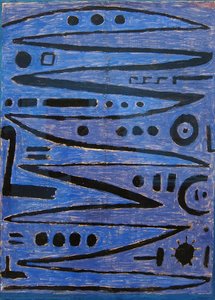
A Universe in Miniature: Paul Klee’s ‘Structural I’
Paul Klee's “Structural I,” painted in 1924, isn’t merely a depiction of stars; it’s an invitation to contemplate the very architecture of perception. Created during a period of intense experimentation within his oeuvre, this gouache on cardboard piece exemplifies Klee’s masterful synthesis of musical and visual ideas – a core tenet of his artistic philosophy. The painting immediately draws the eye with its vibrant constellation of shapes, each meticulously rendered in a palette of black, red, green, yellow, and blue. These aren't random splashes; they are carefully constructed elements, echoing the principles of musical composition where individual notes contribute to a larger harmonic whole.
The Language of Geometry and Emotion
Klee’s approach during this period was deeply rooted in geometric abstraction, influenced by movements like Cubism, yet infused with his uniquely personal sensibility. “Structural I” showcases this brilliantly. The overlapping circles, squares, and triangles aren't simply decorative; they represent a deliberate exploration of spatial relationships – mirroring the way musical intervals create depth and resonance. Notice how the varying sizes and orientations of these forms generate a dynamic tension, suggesting movement and energy within the seemingly static composition. This technique reflects Klee’s belief that art should be both intellectually stimulating and emotionally resonant.
Historical Context: A Moment of Artistic Revolution
1924 was a pivotal year for Klee, coinciding with his work on the mural for the Bauhaus Dessau, a project that profoundly shaped his artistic trajectory. The Bauhaus, with its emphasis on functional design and universal principles, encouraged artists to explore abstraction as a means of communicating fundamental truths. “Structural I” embodies this spirit – it’s a distillation of these ideas, stripped down to their essential components. The painting also reflects the broader European fascination with mythology and symbolism during the early 20th century, particularly the exploration of celestial imagery.
Decoding the Symbolism: Stars as Building Blocks
While abstract in its overall design, “Structural I” is rich with symbolic meaning. The stars themselves are not simply representations of distant suns; they function as building blocks – fundamental units within Klee’s visual language. Their arrangement suggests a network, a complex system of interconnectedness, reflecting the artist's interest in exploring order and chaos simultaneously. Some scholars interpret the varying sizes and colors of the stars as representing different musical notes or harmonies, further reinforcing Klee’s belief in the inherent connection between art forms.
A Timeless Appeal: For Collector and Interior Designer
"Structural I" remains a captivating work, offering a glimpse into the mind of one of 20th-century's most innovative artists. Its vibrant colors, intricate composition, and profound symbolism make it an ideal addition to any art collection or interior space. A hand-painted reproduction captures the essence of this masterpiece, allowing you to bring its contemplative beauty into your home – a reminder that even in abstraction, there is a universe waiting to be discovered.
질의응답
폴 클레의 "Structural I"은 강렬한 대비를 사용하나요, 아니면 부드러운 조화를 이루고 있나요?
폴 클레의 "Structural I"의 색채 구성은 Balanced한 대비와 Softly Mixed Palette한 조화가 어우러져 있습니다.
폴 클레의 "Structural I"은 미술사에서 어떤 위치를 차지하나요?
폴 클레의 "Structural I"의 미술사적 분류는 Modern 시대의 Abstract Expressionism입니다.
"Structural I"은(는) 어떤 화풍에 속하나요?
"Structural I"은(는) Abstract Expressionism 양식의 작품입니다. 이 사조는 해당 작품이 속한 예술적 전통을 나타냅니다.
이 작품에 대해 더 알아보기
 미리보기
미리보기
 공유하기
공유하기 공유하기
공유하기
 상세 정보
상세 정보 가이드 보기

 다운로드
다운로드
 유사 작품 더 보기
 X-레이
X-레이 슬라이드 쇼 보기
 질의응답
질의응답 통계 정보
통계 정보