프린트 판매로 전환
 상세 보기
상세 보기







































 가로 또는 세로 중 어느 한 면이라도 105cm(약 41인치)를 초과하는 작품이나 복제화의 경우, 프레임은 분해된 키트 형태로 배송됩니다. 이는 안전한 배송을 보장하고 운송 중 발생할 수 있는 손상을 방지하기 위함입니다.


A Figure Forged in Turmoil: Exploring Pollock’s ‘Untitled (Naked Man)’
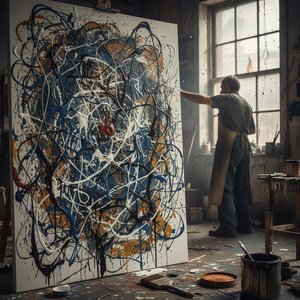
This powerful painting by Jackson Pollock plunges the viewer into a vortex of emotion and raw energy. Depicting a nude male figure seemingly erupting from a chaotic, fiery landscape, it's a prime example of his groundbreaking contribution to Abstract Expressionism. While often referred to simply as ‘Untitled (Naked Man)’, this work exists alongside a closely related version titled ‘Untitled (Naked Man with Knife)’ – both created around 1950-53, and sharing similar compositional elements and emotional weight.Style & Technique: The Birth of Action Painting
Jackson Pollock’s revolutionary technique is immediately apparent. Abandoning traditional easel painting, he placed the canvas on the floor and employed a radical “drip” method. Liquid paint – often industrial house paints thinned with turpentine – was poured, splashed, and flung onto the surface, creating a dense network of lines and textures. This wasn’t merely about applying paint; it was *performance*, an ‘action painting’ where the physical act of creation became integral to the artwork itself. The resulting composition is characterized by its loose brushwork (or lack thereof!), intense color application, and flattened perspective – all hallmarks of his mature style. The heavy impasto creates a tactile surface, inviting close inspection of the layers and gestures.Subject & Symbolism: Rebirth or Destruction?
The central figure, though abstracted, is undeniably present—a muscular male form struggling upwards amidst swirling chaos. The dominant warm tones – oranges, reds, and yellows – evoke heat, danger, and perhaps even suffering. These fiery hues contrast with subtle cooler blues and greens in the background, adding depth without resolving the overall sense of unrest. What does this figure *mean*? Interpretations are open-ended, but themes of rebirth, psychological turmoil, or emergence from destruction resonate strongly. The absence of a clear narrative allows viewers to project their own emotions and experiences onto the work. Is it a depiction of primal struggle, a symbolic representation of inner demons, or a testament to the resilience of the human spirit?Historical Context: A Post-War Vision
Pollock’s artistic breakthrough occurred in the aftermath of World War II, a period marked by profound anxiety and existential questioning. Abstract Expressionism emerged as an attempt to grapple with these feelings, rejecting representational art in favor of subjective expression. Pollock's work, in particular, reflected a desire to break free from convention and explore the subconscious mind. His drip paintings were not intended to depict specific objects or scenes but rather to convey raw emotion and energy directly onto the canvas. He became a leading figure in the New York School, shifting the center of the art world away from Paris.Emotional Impact & Legacy
‘Untitled (Naked Man)’ is not a painting for passive observation; it demands engagement. The turbulent composition and intense colors create a visceral experience, evoking feelings of unease, excitement, or even catharsis. Pollock’s work continues to captivate audiences today, influencing generations of artists and inspiring collectors and interior designers alike. Its bold energy and unconventional beauty make it a striking focal point for any space – a testament to the enduring power of abstract art. The painting serves as a reminder that art can be both deeply personal and universally resonant, offering a glimpse into the complexities of the human condition.질의응답
폴 잭슨 폴록의 "Untitled (Naked Man)"은 어떤 분위기와 감정을 전달하나요?
"Untitled (Naked Man)"에서는 Dramatic 분위기와 함께 Dramatic 감정이 느껴집니다.
폴 잭슨 폴록의 "Untitled (Naked Man)"의 색채는 작품의 감정과 어떻게 연결되나요?
폴 잭슨 폴록의 "Untitled (Naked Man)"은(는) Earthy 색조의 팔레트와 Dramatic 분위기가 조화를 이룹니다.
"Untitled (Naked Man)"의 색감은 얼마나 강렬한가요?
폴 잭슨 폴록의 "Untitled (Naked Man)"의 색채는 Balanced Soft의 채도와 Vivid의 강도를 보여줍니다.
More about this painting
 실제 크기로 보기
 보내기
보내기 공유하기
공유하기
 상세 보기
상세 보기 가이드 보기

 이미지 다운로드
 유사 작품 더 보기
 X-레이
X-레이 슬라이드 쇼 보기
 Q&A
Q&A 통계 정보
통계 정보