프린트 판매로 전환
 더 보기
더 보기







































 가로 또는 세로 중 어느 한 면이라도 105cm(약 41인치)를 초과하는 작품이나 복제화의 경우, 프레임은 분해된 키트 형태로 배송됩니다. 이는 안전한 배송을 보장하고 운송 중 발생할 수 있는 손상을 방지하기 위함입니다.


Annunciation by Paris Bordone: A Renaissance Reverie
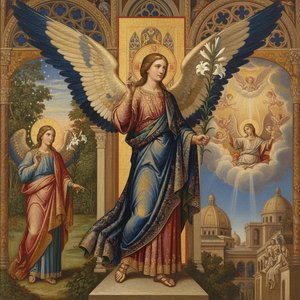
Paris Bordone’s “Annunciation” stands as a testament to the artistic fervor of the Venetian Renaissance, capturing not merely an iconic biblical narrative but also the very spirit of humanist inquiry and meticulous craftsmanship. Executed in 1555, this oil on canvas masterpiece—measuring 99 x 134 cm—currently resides within the Pinacoteca Nazionale di Siena, Italy, offering visitors a rare glimpse into a pivotal moment in Christian art history.
- Composition & Perspective: Bordone skillfully employs linear perspective to create a dramatic spatial illusion, anchoring the viewer’s gaze within the grandeur of a richly decorated chamber. The arched windows and columns contribute to a sense of solemnity, mirroring the spiritual significance of the depicted scene.
- Symbolism Richness: Beyond its narrative core, “Annunciation” overflows with symbolic imagery. Gabriel’s lily—a traditional emblem of purity—represents Mary's sanctity, while the open book symbolizes her devotion to prayer and scholarly contemplation. The cherub perched above the window reinforces this theme of divine grace and spiritual illumination.
- Technique & Style: Bordone’s masterful brushwork demonstrates a hallmark of Mannerist art – an emphasis on detail and expressive handling of paint—resulting in textures that convey both solidity and luminosity. The muted earth tones—ochre, umber, and Sienna—lend the painting a contemplative mood, reflecting the Renaissance preoccupation with humanist ideals.
- Historical Context: Created during a period marked by papal patronage and artistic experimentation, “Annunciation” embodies Venice’s position as a cultural epicenter. It reflects the broader Renaissance fascination with classical antiquity and its influence on artistic conventions—particularly in architectural design and spatial organization.
The painting's impact transcends mere visual beauty; it speaks to fundamental questions of faith, femininity, and divine providence. Bordone’s meticulous attention to detail ensures that every element contributes to the overall narrative and emotional resonance – a legacy preserved in this enduring masterpiece.
Exploring Bordone’s Venetian Legacy
Paris Bordone's artistic journey began under the tutelage of Titian, arguably Venice’s most celebrated painter. Despite tensions surrounding their relationship—fueled by differing stylistic ambitions—Bordone forged his own distinctive path, prioritizing independent creativity and establishing himself as a master of Mannerist art.
- Influence of Titian: Bordone's apprenticeship with Titian exposed him to the monumental scale and vibrant color palettes characteristic of Venetian painting. However, Bordone subtly diverged from his mentor’s style, favoring a more restrained aesthetic that nonetheless retained remarkable expressive power.
- Provincial Vitality: Unlike many artists of his time who sought inspiration in Rome—the seat of papal patronage—Bordone remained firmly rooted in Venice, capturing the spirit of his city's artistic milieu. This blend of Venetian tradition and personal vision distinguishes Bordone’s oeuvre from that of his contemporaries.
Further enriching our understanding of Bordone’s artistic sensibilities is his engagement with mythological subjects—a genre favored by Venetian artists during the Renaissance. These works demonstrate Bordone's command of classical techniques and his ability to infuse narrative storytelling with humanist ideals.
A Window into Renaissance Siena
“Annunciation” finds its home in the Pinacoteca Nazionale di Siena, Italy – a museum dedicated to showcasing Sienese art from the Medieval period through the Baroque era. The museum’s collection offers invaluable insight into the artistic traditions of Tuscany during the Renaissance—a time marked by intellectual ferment and artistic innovation.
- Museum Context: Situated in Siena’s historic center, the Pinacoteca Nazionale embodies the city's commitment to preserving its cultural heritage. Visitors can admire masterpieces from Sienese artists spanning centuries – a testament to the enduring power of art to inspire and educate.
Consider commissioning a high-quality reproduction of “Annunciation” by Paris Bordone—a captivating piece of Renaissance art that will grace your home or office with its timeless beauty and profound symbolism.
질의응답
파리스 보르도네의 "성모 마리아의 선언"에는 어떤 색상 팔레트가 사용되었나요?
"성모 마리아의 선언"의 색상은 어스톤 팔레트를 이룹니다. 이 분류는 작품을 지배하는 주요 색상군을 나타냅니다.
파리스 보르도네의 "성모 마리아의 선언"은 어떤 미술 사조와 시대에 속하나요?
파리스 보르도네의 "성모 마리아의 선언"은(는) 작가의 르네상스 시대 중 Renaissance Mannerism 사조에 속합니다.
"성모 마리아의 선언" 작품을 파인 아트 프린트로 구매할 수 있나요?
"성모 마리아의 선언" 작품은 코튼 캔버스 또는 아카이브용 캔버스지에 인쇄된 파인 아트 프린트를 통해 만나보실 수 있습니다. 주문은 파인 아트 프린트 페이지에서 원하시는 사이즈를 선택하여 진행하실 수 있습니다.
이 작품에 대해 더 알아보기
 미리보기
미리보기
 공유하기
공유하기 공유하기
공유하기
 상세 정보
상세 정보 가이드 보기

 다운로드
다운로드
 유사 작품 더 보기
 X-레이
X-레이 슬라이드 쇼 보기
 질의응답
질의응답 통계 정보
통계 정보