프린트 판매로 전환
 더 보기
더 보기







































 가로 또는 세로 중 어느 한 면이라도 105cm(약 41인치)를 초과하는 작품이나 복제화의 경우, 프레임은 분해된 키트 형태로 배송됩니다. 이는 안전한 배송을 보장하고 운송 중 발생할 수 있는 손상을 방지하기 위함입니다.


A Study in Distortion: Unpacking Pablo Picasso’s “Woman”
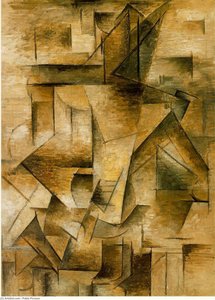
Pablo Picasso's "Woman," a work shrouded in intriguing ambiguity, stands as a compelling example of the artist’s evolving approach during the early years of his Cubist experimentation. More than simply a portrait, it’s a fragmented exploration of form and perception, inviting viewers to actively participate in reconstructing the image. The painting, though its exact dimensions remain unknown, presents a figure dominated by a head positioned slightly off-center within the composition, while her body extends downwards into the lower right quadrant of the canvas. This deliberate asymmetry immediately establishes a sense of unease and challenges traditional notions of balanced representation – a hallmark of Picasso’s revolutionary style.
The most striking element is undoubtedly the woman's face, rendered with a pronounced distortion that borders on abstraction. Her features are not depicted in a realistic manner; instead, they are broken down into geometric shapes and planes, suggesting multiple viewpoints simultaneously. This technique, central to Cubism’s development, aimed to capture the subject’s essence by representing it as an intellectual construct rather than a purely visual one. The simplification of her face, coupled with the yellowish hue dominating the background – a color often associated with decay and introspection – creates a mood that is both melancholic and enigmatic. It's a deliberate departure from the idealized beauty prevalent in earlier portraiture, reflecting Picasso’s growing interest in exploring psychological states and challenging established artistic conventions.
The Seeds of Cubism: Form and Perspective
Picasso was deeply influenced by the work of Paul Cézanne, particularly his emphasis on geometric forms and multiple perspectives. Cézanne's paintings, with their flattened planes and fragmented compositions, paved the way for Picasso’s own explorations in Cubism. “Woman” exemplifies this influence; the figure is not presented from a single vantage point but rather as if viewed from several angles at once. This simultaneous representation of different viewpoints was a radical departure from traditional Western art, which typically aimed to create an illusion of three-dimensional space on a two-dimensional surface.
The painting’s technique further underscores this Cubist approach. Picasso employs thick, layered brushstrokes and a limited palette – primarily yellows, browns, and blacks – to build up the forms. The use of black outlines is particularly significant, acting as structural elements that define the figure's contours and create a sense of solidity amidst the fragmented composition. This deliberate layering adds depth and texture to the painting, inviting closer examination and encouraging viewers to consider the various ways in which the woman’s form is being presented.
Symbolism and Emotional Resonance
While Picasso himself often resisted assigning definitive meanings to his works, “Woman” undoubtedly carries a potent emotional charge. The distorted features of the face suggest vulnerability and perhaps even suffering. The yellowish background evokes feelings of sadness, isolation, or introspection – potentially reflecting the artist’s own personal experiences during this period of experimentation and upheaval. Some art historians have linked the color to Picasso's grief following the death of his sister, Conchita, a tragedy that profoundly impacted his artistic development.
Furthermore, the painting’s composition—with the head elevated and the body descending—can be interpreted as a metaphor for power dynamics or perhaps even a representation of the artist’s own relationship with his subject. The woman's passive stance, combined with Picasso’s assertive control over the image, suggests a complex interplay between creator and creation. The necklace she wears adds another layer of intrigue, hinting at adornment, status, or perhaps even a symbolic connection to the past.
A Legacy in Reproduction
OriginalUniqueArt offers meticulously crafted hand-painted reproductions of Picasso’s “Woman,” allowing art enthusiasts to experience the depth and complexity of this iconic work firsthand. Our skilled artists faithfully recreate the painting's distinctive style, capturing its fragmented forms, rich colors, and emotional resonance with exceptional detail. Whether you are a seasoned collector or simply seeking to bring a touch of artistic brilliance into your home, our reproductions provide an authentic and affordable way to own a piece of Picasso’s revolutionary legacy. Explore the available sizes and canvas options on our website today – and immerse yourself in the captivating world of “Woman.”
질의응답
파블로 피카소의 "Woman"의 색감은 선명한가요, 아니면 차분한가요?
파블로 피카소의 "Woman"은(는) Balanced Soft의 채도와 Vivid의 색채 강도를 보여줍니다.
파블로 피카소의 "Woman"은(는) Cubist Exploration를 작가의 모국과 어떻게 연결하고 있나요?
"Woman"은 작가의 탄생지를 통해 Cubist Exploration 사조와 스페인를 연결합니다.
파블로 피카소의 "Woman"은(는) 퍼블릭 도메인인가요?
저작권과 관련하여, "Woman"은(는) 저작권 보호 대상입니다 상태입니다.
이 작품에 대해 더 알아보기
 미리보기
미리보기
 공유하기
공유하기 공유하기
공유하기
 상세 정보
상세 정보 가이드 보기

 다운로드
다운로드
 유사 작품 더 보기
 X-레이
X-레이 슬라이드 쇼 보기
 질의응답
질의응답 통계 정보
통계 정보