프린트 판매로 전환
 더 보기







































 가로 또는 세로 중 어느 한 면이라도 105cm(약 41인치)를 초과하는 작품이나 복제화의 경우, 프레임은 분해된 키트 형태로 배송됩니다. 이는 안전한 배송을 보장하고 운송 중 발생할 수 있는 손상을 방지하기 위함입니다.


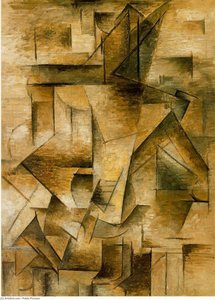
A Study in Geometric Fragmentation: Picasso’s ‘Les Pains’
The painting “Les Pains” – French for “The Breads” – stands as a pivotal moment in Pablo Picasso's artistic evolution, marking the genesis of Cubism and demonstrating his burgeoning fascination with deconstructing visual perception. Executed in 1909, this monochrome composition isn’t merely a depiction of everyday objects; it’s an experiment in formal language that would fundamentally reshape modern art. Initially conceived as a response to Cézanne's influence – Picasso sought to emulate Cézanne’s ability to convey volume and spatial depth – the artwork swiftly transcended imitation, forging its own distinctive path toward abstraction.The Composition: A Dialogue Between Still Life and Geometric Precision
At first glance, “Les Pains” presents a seemingly simple tableau: a bottle perched atop a rocky outcrop alongside four pears and a loaf of baguette bread resting on a stark white tablecloth. However, Picasso abandons traditional perspective altogether, opting instead for a radical approach where planes overlap and intersect without adhering to conventional spatial conventions. This deliberate disregard for illusion is mirrored in the treatment of each element – the bottle, the pears, and particularly the bread – which are dissected into geometric fragments that simultaneously exist in multiple viewpoints. The artist meticulously applies fine striations with a brush, capturing not just the appearance of these objects but also their underlying structure, conveying a palpable sense of volume through textural detail.Color and Movement: Spiraling Towards Synthesis
Despite its monochrome palette—primarily shades of gray—the painting pulsates with subtle chromatic nuances. The dominant color is undeniably white, representing both the tablecloth and providing an essential backdrop for highlighting the textures and contours of the objects. However, it’s the central baguette and crown of bread that command immediate attention. Picasso orchestrates a mesmerizing spiral movement around these elements, drawing the viewer's eye into a dynamic interplay of shapes and colors. This spiraling gesture isn’t merely decorative; it embodies Picasso’s ambition to synthesize disparate visual information into a unified whole—a hallmark of Cubist aesthetics.Historical Context: Cézanne’s Influence and the Birth of Cubism
Picasso's exploration of geometric fragmentation directly responds to the artistic legacy of Paul Cézanne, whose work championed the idea that objects exist in multiple perspectives simultaneously. Cézanne famously stated, “Treat nature as you find it, but depict it as you see it,” a dictum that profoundly impacted Picasso’s thinking about representation. "Les Pains" represents an early step toward realizing this vision, foreshadowing the groundbreaking innovations of Cubism—a movement spearheaded by Picasso and Georges Braque—which would revolutionize painting in the years following 1909.Symbolic Resonance: Beyond Representation – Exploring Perception
“Les Pains” transcends mere visual depiction; it delves into the realm of psychological exploration. The choice of bread, a symbol of sustenance and tradition, juxtaposed against the bottle—representing containment and perhaps fragility—suggests a contemplation on fundamental human concerns. Picasso’s masterful manipulation of form and color isn't simply about capturing what is seen but about conveying how perception itself shapes our understanding of reality. This artwork invites viewers to consider not just what they observe but also how their own gaze interprets the visual world.질의응답
파블로 피카소의 "Les Pains"의 프린트 제품은 어디에서 구매할 수 있나요?
파블로 피카소의 "Les Pains"의 프린트는 해당 작품의 파인 아트 프린트 페이지에서 간편하게 주문하실 수 있습니다: 코튼 캔버스 또는 아카이브용 캔버스지에 인쇄된 파인 아트 프린트.
파블로 피카소의 "Les Pains"의 구성을 주도하는 색상은 무엇인가요?
"Les Pains"에서 가장 돋보이는 색상은 Celadon (#c2beb2)입니다. 작품의 주된 색상을 활용하면 인테리어와 더욱 조화롭게 연출할 수 있습니다.
파블로 피카소의 "Les Pains"의 디지털 파일을 어디에서 구매할 수 있나요?
파블로 피카소의 "Les Pains"의 디지털 파일을 소장하시려면, 디지털 이미지 파일 페이지에서 고해상도 디지털 이미지 다운로드을(를) 주문해 주세요.
이 작품에 대해 더 알아보기
 미리보기

 공유하기
 공유하기
 상세 정보
 가이드 보기


 다운로드
 유사 작품 더 보기
 X-레이
 슬라이드 쇼 보기
 질의응답
 통계 정보