프린트 판매로 전환
 더 보기
더 보기







































 가로 또는 세로 중 어느 한 면이라도 105cm(약 41인치)를 초과하는 작품이나 복제화의 경우, 프레임은 분해된 키트 형태로 배송됩니다. 이는 안전한 배송을 보장하고 운송 중 발생할 수 있는 손상을 방지하기 위함입니다.


The Intimate Portrait of Family Life: Moritz Daniel Oppenheim’s “The Examination”
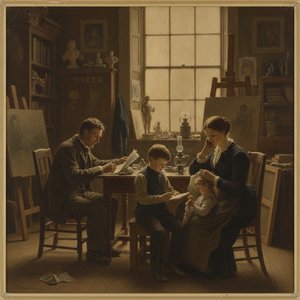
Moritz Daniel Oppenheim's "The Examination," painted in 1868, is more than just a domestic scene; it’s a poignant window into the heart of 19th-century Jewish family life. This intimate portrait, rendered with remarkable sensitivity and detail, captures a moment of quiet contemplation within a warmly lit living space – a space that speaks volumes about tradition, education, and familial bonds. The painting immediately draws the viewer in, not with grand gestures or dramatic action, but through the subtle interplay of glances, postures, and the palpable sense of connection between father and daughters.
Oppenheim’s style leans heavily towards Realism, yet it transcends mere representation. He masterfully employs a muted color palette – predominantly browns, creams, and ochres – to create an atmosphere of understated elegance and domestic tranquility. The lighting is particularly noteworthy; it's diffused and natural, casting gentle shadows that enhance the three-dimensionality of the figures and their surroundings. The artist’s brushwork is deliberate and controlled, meticulously building up layers of paint to achieve a rich texture and a sense of depth. Notice how he subtly captures the textures of the fabrics – the worn velvet chair, the simple wooden table, the folds in the women's dresses – adding an incredible level of realism and grounding the scene.
A Glimpse into Jewish Life and Education
The painting’s subject matter is deeply rooted in the social and cultural context of its time. “The Examination” depicts a father, presumably a scholar or religious leader, seated with his two daughters. He's absorbed in reading a book, while they attentively observe him, suggesting a scene of learning and guidance. This wasn’t simply a casual family gathering; it represented a crucial element of Jewish upbringing – the transmission of knowledge and tradition from one generation to the next. The presence of the books scattered around the room reinforces this theme, hinting at a home filled with intellectual pursuits and a commitment to education.
Oppenheim’s decision to portray a family scene within a Jewish context was groundbreaking for its time. While many artists were depicting Jewish subjects, Oppenheim's work focused on portraying everyday life, familial relationships, and religious practices – offering a more nuanced and intimate representation of the Jewish community than previously seen in Western art. This focus aligns with the burgeoning “Wissenschaft des Judentums” (Jewish knowledge) movement, which sought to study Judaism as an academic discipline, documenting its history, culture, and traditions.
Symbolism and Emotional Resonance
Beyond its straightforward depiction of a family moment, "The Examination" is rich in symbolic detail. The vase positioned centrally on the table – holding fresh fruit – can be interpreted as representing knowledge, wisdom, or even reward. The gesture of the father pointing to the book, combined with the daughters’ attentive expressions, suggests a process of learning and understanding. The overall mood is one of quiet dignity and affection, conveying a sense of warmth and familial harmony.
Furthermore, the painting subtly alludes to the importance of Jewish tradition and heritage. The setting itself – a comfortable home filled with books – speaks to a commitment to intellectual pursuits and the preservation of cultural values. The scene evokes a feeling of stability, continuity, and the enduring strength of family bonds. It’s a testament to Oppenheim's ability to capture not just a visual likeness but also the emotional essence of his subjects.
A Timeless Masterpiece – Reproduction Considerations
Reproductions of “The Examination” offer a remarkable opportunity to bring this evocative artwork into your home or office. When selecting a reproduction, consider the quality of the print and the canvas or paper used. A high-resolution digital print on archival-quality canvas will ensure that the colors and details are faithfully reproduced, capturing the painting’s subtle nuances and rich textures. The original's muted palette translates beautifully to a wide range of interior design styles – from traditional to contemporary – adding a touch of understated elegance and intellectual warmth.
As an investment piece, a high-quality reproduction of “The Examination” is more than just a decorative item; it’s a window into the past, a celebration of family life, and a testament to the artistic vision of Moritz Daniel Oppenheim. It's a reminder that even in quiet moments, profound beauty and enduring values can be found.
질의응답
모리츠 다니엘 오펜하임의 "The Examination (Das Verhören)" 작품은 작가의 본국에 보관되어 있나요?
아니요 - 해당 작품은 해외에 보관되어 있습니다. "The Examination (Das Verhören)"은(는) 미국에 소장되어 있는 반면, 모리츠 다니엘 오펜하임의 출생지는 독일입니다.
모리츠 다니엘 오펜하임의 "The Examination (Das Verhören)"의 구성을 주도하는 색상은 무엇인가요?
모리츠 다니엘 오펜하임의 "The Examination (Das Verhören)"의 주요 색상은 Phthalo Green (#1c1b27)입니다.
모리츠 다니엘 오펜하임의 "The Examination (Das Verhören)"의 재료와 크기는 어떻게 되나요?
"The Examination (Das Verhören)"은(는) Oil On Canvas 기법으로 제작되었으며, 원작의 크기는 66 x 54 cm입니다.
이 작품에 대해 더 알아보기
 미리보기
미리보기
 공유하기
공유하기 공유하기
공유하기
 상세 정보
상세 정보 가이드 보기

 다운로드
다운로드
 유사 작품 더 보기
 X-레이
X-레이 슬라이드 쇼 보기
 질의응답
질의응답 통계 정보
통계 정보