유화 원작 구매
 The Forest에 관한 모든 것







































 가로 또는 세로 중 어느 한 면이라도 105cm(약 41인치)를 초과하는 작품이나 복제화의 경우, 프레임은 분해된 키트 형태로 배송됩니다. 이는 안전한 배송을 보장하고 운송 중 발생할 수 있는 손상을 방지하기 위함입니다.


A Nocturne of Dreams: Max Ernst’s “The Forest”
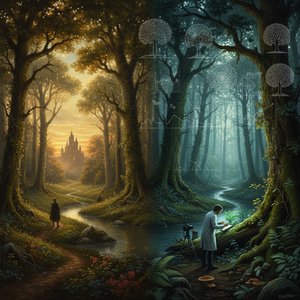
Max Ernst's "The Forest," painted in 1927, isn’t merely a depiction of a landscape; it’s an immersion into the subconscious, a carefully constructed dreamscape rendered with the unsettling beauty characteristic of the artist’s early Surrealist explorations. This intimate canvas – measuring just 25 x 36 cm – holds within its borders a potent collision of natural and urban elements, inviting viewers to contemplate the anxieties and aspirations simmering beneath the surface of modern life. The painting immediately draws the eye upward to a luminous moon dominating the sky, casting an ethereal glow upon the sprawling cityscape below. Buildings rise from the darkness, not as symbols of progress or order, but as strangely distorted monoliths, hinting at a world both familiar and profoundly alien.
Ernst’s technique is deliberately evocative, employing a layered approach that anticipates techniques he would later refine in his collage work. He utilizes loose, expressive brushstrokes, building up the forms of trees and buildings with a sense of urgency and movement. The color palette leans heavily into cool blues and greens, punctuated by the stark white of the moon and the muted tones of the city lights – colors that contribute to the painting’s nocturnal atmosphere and imbue it with a feeling of quiet mystery. Notice how he doesn't meticulously render detail; instead, he favors suggestion and mood, allowing the viewer’s imagination to fill in the gaps.
The Seeds of Surrealism: Ernst’s Intellectual Landscape
Understanding “The Forest” requires acknowledging Max Ernst’s unique artistic trajectory. Born in Brühl, Germany, in 1891, Ernst wasn't a traditional painter; his path was forged through rigorous academic study – philosophy, art history, literature, psychology, and psychiatry at the University of Bonn. This intellectual grounding profoundly shaped his approach to art, moving him beyond mere representation towards exploring the realm of dreams, memory, and the irrational. His father, a teacher of the deaf, instilled in him a sensitivity to the world and a rebellious spirit – qualities that would become central to Ernst’s artistic vision. He was deeply influenced by thinkers like Freud and Jung, particularly their theories on the unconscious mind, which he sought to translate into visual form.
The year 1927 is crucial within this context. It represents a pivotal moment in Ernst's development as a Surrealist, a period marked by experimentation with automatism – a technique of spontaneous creation designed to bypass conscious control and tap directly into the subconscious. "The Forest," therefore, can be seen as a product of this process, a visual manifestation of his inner world.
Symbolic Echoes: Nature Versus Urbanity
The juxtaposition of the forest and the city is laden with symbolic weight. The forest, traditionally associated with nature, instinct, and the primal, stands in stark contrast to the rigid geometry and artificial light of the urban landscape. This isn’t a harmonious blend; rather, it's a tension – a suggestion that the encroachment of modernity threatens to overwhelm the natural world. The moon itself is a potent symbol, often linked to cycles, intuition, and the hidden realms of the unconscious. Its presence elevates the scene beyond a simple cityscape, transforming it into a dreamlike tableau.
Furthermore, consider the distorted forms of the buildings. They aren’t simply architectural structures; they seem to lean inward, almost collapsing under their own weight, mirroring perhaps a sense of unease or anxiety about the future. The trees, though present, are somewhat obscured by the city's glow, hinting at a diminishing connection with nature.
A Timeless Resonance: Reproduction and Artistic Legacy
"The Forest" continues to resonate with viewers today because it taps into fundamental human experiences – the longing for escape, the anxieties of urban life, and the enduring power of the subconscious. OriginalUniqueArt’s meticulously crafted hand-painted reproductions capture not only the visual details of Ernst's original but also its emotional depth and atmospheric quality. Each reproduction is created with the same attention to texture and color as the original, ensuring a faithful representation of this iconic Surrealist masterpiece. Whether you are an art collector seeking to expand your collection or an interior designer searching for a unique piece to elevate a space, a OriginalUniqueArt reproduction of “The Forest” offers a captivating glimpse into the mind of one of 20th-century’s most visionary artists.
질의응답
The Forest은(는) 수작업으로 그린 작품인가요, 아니면 프린트된 작품인가요?
수작업 제작: 숙련된 화가가 The Forest을(를) 리넨 캔버스 위에 유화로 재현합니다.
The Forest의 사이즈는 어떤 것을 선택해야 하나요?
원작의 크기는 25 x 36 cm입니다. 사이즈는 26.1 x 38.4 cm (₩272310)부터 166.2 x 244.7 cm (₩2069554)까지 있으며, 이 페이지의 표에 주요 단계별 가격이 안내되어 있습니다.
배송은 얼마나 걸리나요?
배송은 전 세계 무료 특송으로 4~5주가 소요되며, 본 페이지에서 긴급 제작 옵션을 선택하실 수 있습니다. 제품은 조건 없이 100일 이내에 반품하여 전액 환불받으실 수 있습니다.
The Forest 원본은 어디에 있나요?
원본은 텔아비브에 위치한 Tel Aviv Museum of Art 소장품입니다.
막스 에른스트 작가는 The Forest 작품에 어떤 재료를 사용했나요?
Acrylic On Canvas
 미리보기

 공유하기
 공유하기
 상세 정보
 학습용 요약본


 다운로드
 유사 작품 더 보기
 X-레이
 슬라이드 쇼 보기
 질의응답

 통계 정보