프린트 판매로 전환
 더 보기
더 보기







































 가로 또는 세로 중 어느 한 면이라도 105cm(약 41인치)를 초과하는 작품이나 복제화의 경우, 프레임은 분해된 키트 형태로 배송됩니다. 이는 안전한 배송을 보장하고 운송 중 발생할 수 있는 손상을 방지하기 위함입니다.


A Symphony in Crimson: Decoding Mark Rothko's ‘Black on Maroon’
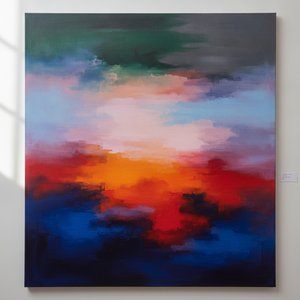
To stand before Mark Rothko’s Black on Maroon is to enter a realm where the boundaries of the physical world begin to dissolve. Painted in 1958, this masterpiece serves as a cornerstone of Abstract Expressionism, offering far more than a mere arrangement of pigment on canvas. It is a deliberate distillation of human intention—a profound quest to capture the intangible, the ephemeral, and the deeply felt. In this work, Rothko eschews all recognizable forms, choosing instead to present three rectangular blocks of color that seem to hover within a state of perpetual transition. The palette, dominated by deep maroons and somber blacks, creates a visual weight that pulls the viewer into a meditative trance, inviting a level of contemplation rarely achieved in modern art.
The technical brilliance of this piece lies in its quiet complexity. As a pioneer of the color field painting movement, Rothko utilized a revolutionary method of layering thin, translucent washes of oil paint, often mixed with glue tempera and pigment. This meticulous process creates a velvety, textured surface that does not merely reflect light but seems to absorb it, generating an internal luminosity. The edges of his rectangular forms are never sharp; instead, they are softly blurred, creating a hazy, atmospheric effect where colors bleed into one another like shadows at dusk. For the discerning collector or interior designer, this technique provides a sense of depth and movement that breathes life into a space, offering a focal point that changes character depending on the light and the angle of observation.
The Weight of History and the Language of Emotion
To fully appreciate the gravity of Black on Maroon, one must consider the turbulent era from which it emerged. Rothko was working within a cultural milieu gripped by the existential anxieties of the post-World War II period. His art became a visual response to a world grappling with loss, trauma, and the search for meaning amidst chaos. The starkness of the black against the warmth of the maroon can be seen as a dialogue between life and void, or passion and mourning. Rothko himself famously viewed his canvases as "windows onto eternity," intending for the viewer to bypass rational thought and connect directly with primal emotional responses.
The symbolism within the work is intentionally open-ended, allowing each observer to find their own truth. While the deep maroon hues may evoke feelings of warmth, vulnerability, or even a grounded sense of earthiness, the encroaching blackness introduces an element of mystery and the unknown. This tension between light and dark, presence and absence, makes the painting an incredibly versatile piece for high-end decor. Whether placed in a quiet study to foster introspection or as a commanding statement in a contemporary living space, a high-quality reproduction of this work brings with it an aura of sophisticated stillness. It is not merely a decoration; it is an invitation to experience the sublime.
질의응답
마크 로스코의 "Black on Maroon"은 미술사에서 어떤 위치를 차지하나요?
마크 로스코의 "Black on Maroon"은(는) Modern 시대의 Color Field 사조에 속하며, 이러한 요소들이 어우러져 미술사에서 이 작품이 갖는 위상을 완성합니다.
마크 로스코의 "Black on Maroon"의 복제화가 공간에 어떤 분위기를 선사할까요?
마크 로스코의 "Black on Maroon"은(는) Dramatic 분위기를 자아내며, Restaurant에 추천하는 작품입니다. 무드란 작품이 주변 공간에 선사하는 정취를 의미합니다.
1958년에 "Black on Maroon"을(를) 제작할 당시 마크 로스코의 나이는 몇 세였나요?
마크 로스코은(는) 55세에 "Black on Maroon"을(를) 제작했습니다. 작가는 1903년에 태어났으며, 이 작품의 제작 연도는 1958년입니다.
이 작품에 대해 더 알아보기
 미리보기
미리보기
 공유하기
공유하기 공유하기
공유하기
 상세 정보
상세 정보 가이드 보기

 다운로드
다운로드
 유사 작품 더 보기
 X-레이
X-레이 슬라이드 쇼 보기
 질의응답
질의응답 통계 정보
통계 정보