프린트 판매로 전환
 더 보기
더 보기







































 가로 또는 세로 중 어느 한 면이라도 105cm(약 41인치)를 초과하는 작품이나 복제화의 경우, 프레임은 분해된 키트 형태로 배송됩니다. 이는 안전한 배송을 보장하고 운송 중 발생할 수 있는 손상을 방지하기 위함입니다.


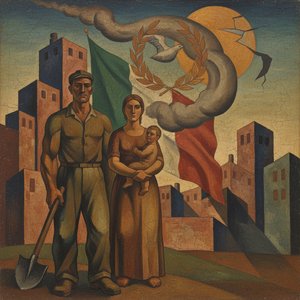
A Monumental Vision of Labor and Solitude
In the profound depths of Mario Sironi’s Il Lavoratore, we encounter more than a mere preparatory study; we witness a monumental dialogue between the individual and the weight of history. Created as a preparatory cartoon for the massive mosaic commissioned for the 1936 Milan Triennial, this work serves as a powerful window into the socio-political soul of Fascist Italy. Yet, beneath the surface-level nod to Mussolini’s vision of a disciplined, industrious citizenry, lies a much more intimate and haunting exploration of the human condition. The painting captures a solitary figure, rendered with a gravity that transcends its original political intent, embodying a sense of profound isolation and the quiet, enduring struggle for meaning amidst the relentless march of industrial progress.
The composition is masterfully structured to command the viewer's attention, utilizing a verticality that emphasizes the weight of the subject. A single figure dominates the space, positioned in a posture that oscillates between humble submission and defiant endurance. Through Sironi’s lens, the act of labor is stripped of its romanticized glory and instead presented as an existential state—a moment of stillness within a world of shifting shadows. For the discerning collector or interior designer, this piece offers a commanding presence, bringing a sense of historical weight and intellectual depth to any curated space.
The Alchemy of Shadow and Form
Technically, Il Lavoratore is a triumph of early Modernist expression, showcasing Sironi’s departure from the luminous, fragmented light of his Divisionist roots toward something far more substantial and somber. The artist employs a palette dominated by earthy ochres, deep blacks, and rich golds, creating a chiaroscuro effect that breathes life into the geometric forms. There is a palpable sense of impasto here; the visible, thick brushstrokes suggest a tactile reality, as if the paint itself were labored over with the same intensity as the subject it depicts.
The style leans heavily into the metaphysical and the expressionistic, where shapes are simplified into powerful, architectural blocks. The lines defining the figure and the surrounding environment are not sharp or clinical but possess a smoky, blurred quality that contributes to a claustrophobic, almost dreamlike atmosphere. This lack of traditional linear perspective flattens the space, forcing the viewer to confront the emotional volume of the figure rather than getting lost in a receding landscape. The interplay of light, appearing to descend from above, casts dramatic shadows that carve out the musculature and the heavy folds of the composition, lending the work an almost sculptural permanence.
Symbolism and the Emotional Resonance
To gaze upon Il Lavoratore is to engage with a complex tapestry of symbolism. The outstretched arms of the figure can be interpreted as a gesture of both vulnerability and strength—a reaching out toward a connection that remains perpetually out of grasp. Sironi, influenced by the psychological depth of Giorgio de Chirico, uses these massive, immobile forms to evoke a sense of timelessness and melancholy. The geometric rigidity of the background elements contrasts sharply with the organic, albeit stylized, form of the human body, mirroring the tension between the individual spirit and the cold, industrial structures of modern society.
For those seeking to incorporate art into a sophisticated interior, this reproduction offers an unparalleled emotional impact. It is a piece that invites contemplation, acting as a focal point that stimulates conversation about identity, resilience, and the passage of time. Whether placed in a quiet study or a grand gallery, Il Lavoratore radiates a somber elegance, making it an exquisite choice for those who appreciate art that speaks to the complexities of the human experience through a lens of monumental beauty.
질의응답
"Il lavoratore"의 색감을 고려했을 때, 어느 공간에 전시하는 것이 가장 좋을까요?
Earthy 색조를 담은 마리오 시로니의 "Il lavoratore"는 Living Room에 배치하시길 추천드립니다. 이 작품의 색감이 이러한 제안의 이유이기도 합니다.
마리오 시로니의 "Il lavoratore"의 수작업 복제화는 어디에서 구매할 수 있나요?
"Il lavoratore" 작품은 리넨 캔버스에 손으로 직접 그린 유화 복제화로 만나보실 수 있습니다. 주문은 수작업 유화 복제화 페이지에서 가능하며, 다양한 사이즈를 선택하실 수 있습니다.
"Il lavoratore"은(는) 저작권으로부터 자유로운가요?
저작권과 관련하여, "Il lavoratore"은(는) 저작권 보호 대상입니다 상태입니다.
이 작품에 대해 더 알아보기
 미리보기
미리보기
 공유하기
공유하기 공유하기
공유하기
 상세 정보
상세 정보 가이드 보기

 다운로드
다운로드
 유사 작품 더 보기
 X-레이
X-레이 슬라이드 쇼 보기
 질의응답
질의응답 통계 정보
통계 정보