 유화 원작 구매
 Blue Landscape에 관한 모든 것







































 가로 또는 세로 중 어느 한 면이라도 105cm(약 41인치)를 초과하는 작품이나 복제화의 경우, 프레임은 분해된 키트 형태로 배송됩니다. 이는 안전한 배송을 보장하고 운송 중 발생할 수 있는 손상을 방지하기 위함입니다.


Identification of Blue Landscape by Marc Chagall
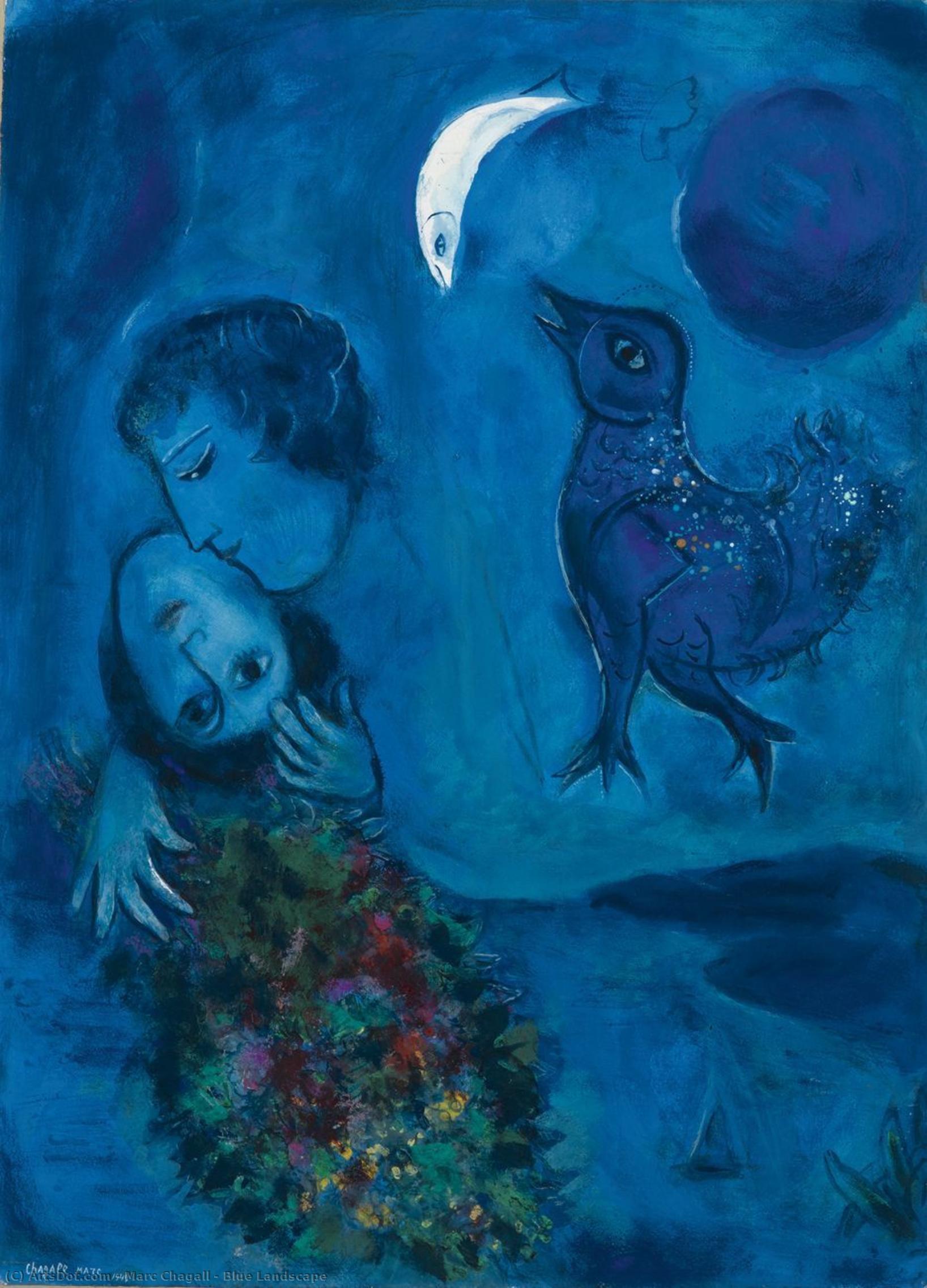
The gaze meets Blue Landscape, a work where the boundaries between reality and a dreamlike vision begin to dissolve. Created by Marc Chagall in 1949, this piece exists as a profound meditation on memory and the enduring weight of human connection. It is a gouache work that captures a specific, quiet moment of intimacy, suspended within a vast and celestial atmosphere.
In this scene, the artist uses the medium of gouache to build a world that feels both deeply personal and strangely universal. The work invites a sense of wonder, as if we are peering into a private memory held by the soul. Every stroke contributes to a vision that prioritizes the pulse of emotion over the rigid rules of the physical world. It is a quiet, blue-hued space where the echoes of love and remembrance seem to linger in the air.
Composition and Visual Elements of the Work
In the foreground, a man and a woman are locked in a tender embrace. They share a quiet, intimate moment, their bodies positioned as if caught in the middle of a slow dance. The woman reaches up, her arms encircling the man's neck, while he gazes down into her face. This central tableau anchors the scene, radiating a profound sense of love and connection that pulls the viewer into their private world.
Above this couple, the sky opens up into a vast, nocturnal expanse. Two birds soar through the air, one drifting toward the left and the other toward the right, their wings cutting through the stillness. The heavens are crowded with stars that dot the darkness, creating a deep, celestial atmosphere. A moon hangs in the upper reaches of the frame, casting a gentle luminescence that washes over the landscape below. This soft light settles upon the earth, bathing the entire scene in a quiet, dreamlike glow.
Technique and Artistic Style of the Artist
The gouache on paper breathes with a soft, matte texture, allowing the colors to settle into the fibers of the page. Chagall moves away from the rigid constraints of academic tradition, leaning instead into the raw, direct expression of Primitivism. There is a sense that the artist is not merely painting a scene, but is instead sketching a memory as it floats through the mind. The lines do not seek to define the world with clinical precision; instead, they flow with a lyrical, unstudied grace that feels deeply personal.
In this space, realism and dreamlike distortions exist in a delicate, constant dance. The figures do not obey the strict laws of anatomy or gravity. Instead, they bend and sway, caught in a moment of emotional weight that transcends physical form. This choice prioritizes the resonance of feeling over the accuracy of the human frame. The artist seeks to capture the essence of a kiss or the weight of an embrace, allowing the shapes to shift and drift as if seen through the haze of a half-remembered dream.
Color Palette and Symbolic Meaning
The scene unfolds within a world dominated by shades of blue. This color does not merely describe the night; it breathes through every corner of the composition. Deep indigo shadows pool in the depths of the landscape, while pale cerulean washes across the sky, creating a sense of infinite space. These tones do not simply represent the atmosphere of a nighttime setting. Instead, the blue carries a weight of meaning, embodying peace, contemplation, and the quiet essence of love. The color acts as a vessel for the emotions shared between the embracing figures.
Every hue works to translate a feeling rather than a literal sight. The moonlight, which casts a gentle luminescence upon the landscape, works in harmony with the celestial blues to foster an atmosphere of serenity and tranquility. This use of color moves beyond the descriptive, turning the sky and the earth into a symbolic realm where memory and emotion reside. The blue is a language of the soul, speaking of the profound connections that endure even when the physical world fades into a dreamlike state.
Historical Context and Themes
The world feels heavy in the wake of World War II, a time when the shadows of devastation linger over the landscape. In this era of reconstruction and loss, the work emerges as a quiet whisper of resilience. It speaks to the capacity for hope even when the surroundings feel fractured. There is a profound sense of survival here, a refusal to let the darkness of the age extinguish the light of human connection.
A certain melancholy drifts through the scene, rooted in the artist's own history of displacement. The memory of exile from Soviet Russia leaves a trace upon the soul of the work. This personal history of wandering and searching informs the emotional weight of the embrace. It is a meditation on the things we carry with us—the memories of home, the ache of loss, and the enduring power of emotion. The piece reaches into the depths of human experience to find what remains when everything else is stripped away.
질의응답
Blue Landscape은(는) 수작업으로 그린 작품인가요, 아니면 프린트된 작품인가요?
수작업 제작: 숙련된 화가가 Blue Landscape을(를) 리넨 캔버스 위에 유화로 재현합니다.
Blue Landscape의 사이즈는 어떤 것을 선택해야 하나요?
원작의 크기는 77 x 56 cm입니다. 사이즈는 37.3 x 26.8 cm (₩269539)부터 248.2 x 178.6 cm (₩2210220)까지 있으며, 이 페이지의 표에 주요 단계별 가격이 안내되어 있습니다.
배송은 얼마나 걸리나요?
배송은 전 세계 무료 특송으로 4~5주가 소요되며, 본 페이지에서 긴급 제작 옵션을 선택하실 수 있습니다. 제품은 조건 없이 100일 이내에 반품하여 전액 환불받으실 수 있습니다.
Blue Landscape 원본은 어디에 있나요?
원본은 부퍼탈에 위치한 Von der Heydt Museum 소장품입니다.
마르크 샤갈 작가는 Blue Landscape 작품에 어떤 재료를 사용했나요?
Gouache
 미리보기

 공유하기
 공유하기
 상세 정보
 학습용 요약본


 다운로드
 유사 작품 더 보기
 X-레이
 슬라이드 쇼 보기
 질의응답

 통계 정보