
 실제 크기로 보기
 보내기
보내기 공유하기
공유하기
 상세 보기
상세 보기 가이드 보기

 이미지 다운로드
 유사 작품 더 보기
 X-레이
X-레이 슬라이드 쇼 보기
 통계 정보
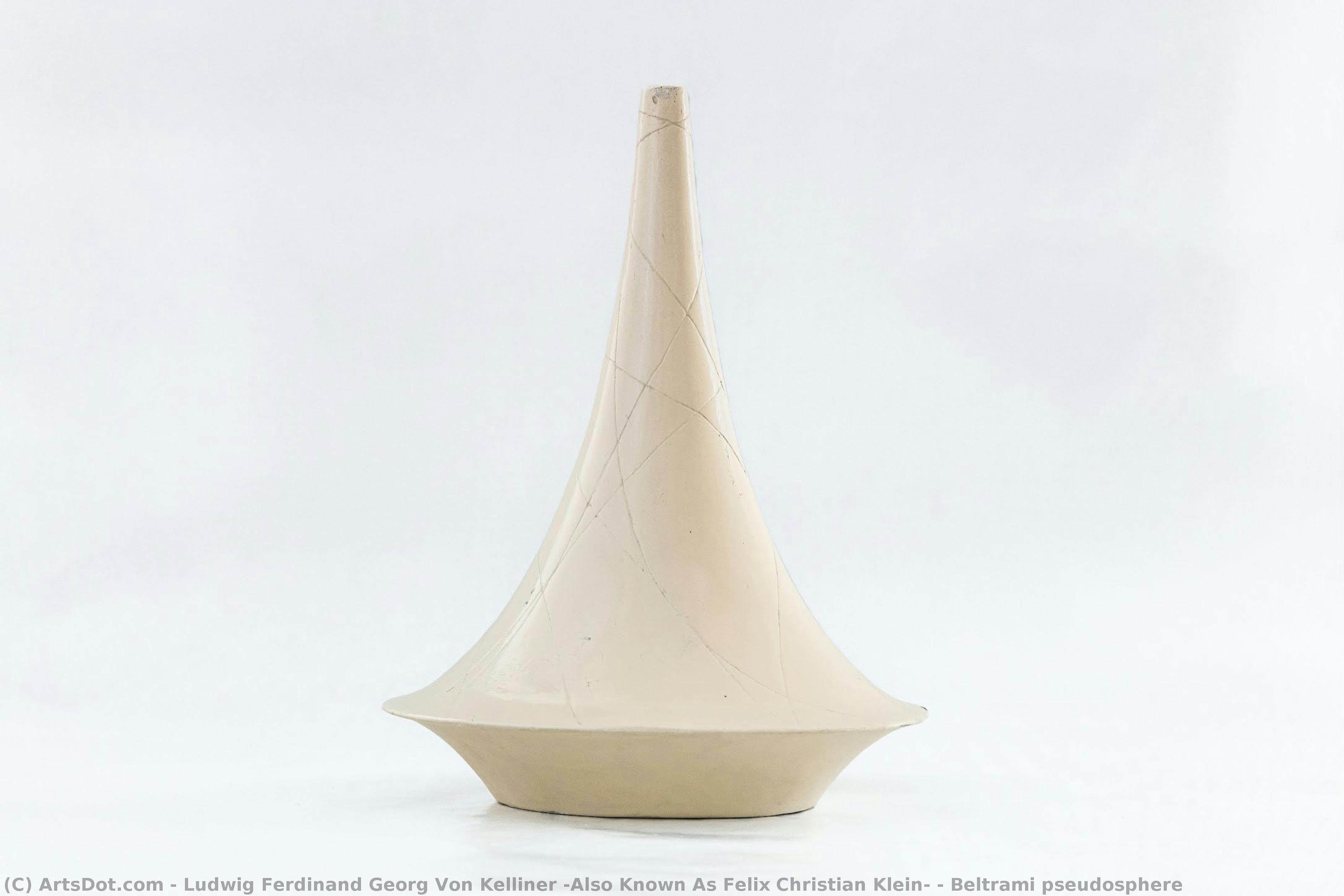
통계 정보Beltrami pseudosphere

 상세 보기
상세 보기
온라인 미리보기보다 훨씬 뛰어난 품질의 고해상도 디지털 이미지를 구매해 보세요.
각 파일은 사내 전문가가 고급 도구와 숙련된 수동 리터칭 기술을 사용하여 세심하게 준비합니다. 우리는 모든 이미지가 탁월한 선명도, 정확한 색상 재현력, 그리고 미세한 디테일까지 완벽하게 갖추도록 보장합니다.
최종 파일은 전문적인 편집 및 인쇄 환경에서 즉시 사용할 수 있도록 최적화되어 72시간 이내에 이메일로 발송됩니다. 이는 세계적인 디자인 스튜디오, 출판사 및 갤러리가 신뢰하는 것과 동일한 품질입니다.
디지털 이미지
개인 소장 및 전시, 인쇄, 창작 프로젝트를 위한 고해상도 파일을 다운로드하세요. ( 프린트 판매로 전환 수작업 채색 복제본 주문하기)
모든 디지털 이미지 주문 시 제공되는 혜택
전문적인 디지털 이미지 전송 보장
OriginalUniqueArt.com를 선택하시면 단순히 이미지를 받는 것을 넘어, 정밀한 보정 과정을 거쳐 완성된 전문적인 디지털 예술 작품을 만나보실 수 있습니다. 모든 작품에는 만족 보장 서비스가 함께 제공되며, 주문 시 다음과 같은 사항들이 자동으로 포함됩니다:

빠른 이메일 수령
주문 후 72시간 이내에 고해상도 디지털 이미지 파일이 이메일로 발송되며, 즉시 사용하실 수 있습니다.

AI 기술로 최적화된 디지털 파일
귀하의 작품은 고급 AI 기술과 정교한 수동 편집 과정을 거쳐 전문적으로 최적화되며, 이를 통해 디테일과 선명도, 색상의 정확도를 극대화합니다.

평생 무료 재전송 서비스
파일을 실수로 삭제하거나 분실하셨나요? 걱정 마세요. 언제든 무료로 다시 보내드립니다.

추가 수입 비용 없음 - 언제나
관세나 부가세, 배송비 부담 없이 작품을 즉시 소장하세요 - 디지털 다운로드는 언제나 면세 혜택이 적용됩니다.

정확한 색상 보장
전문적인 도구와 색상 관리 시스템을 통해 디지털 이미지가 원본의 색상을 최대한 정확하게 구현하도록 보장합니다.

100일 만족 보장제
구매하신 디지털 이미지에 만족하지 못하실 경우, 100일 이내에 별도의 조건 없이 수정 또는 100% 환불을 진행해 드립니다.

100% 환불 보장
만족스럽지 않으신가요? 디지털 파일을 받으신 후 100일 이내에 조건 없이 전액 환불해 드립니다.

대량 주문 할인
이미지 3매 구매 시 10% 할인 - 5매 구매 시 15% 할인 - 10매 이상 구매 시 20% 할인. 크리에이티브 프로젝트, 갤러리, 에이전시에 매우 유용합니다.
아티스트 프로필
The Mathematical Vision of Felix Klein
Felix Klein, born in Düsseldorf, Germany, in 1849 and passing away in Göttingen in 1925, was far more than a mathematician; he was a visionary who reshaped our understanding of geometry and its relationship to art and the physical world. While not a painter himself, his profound theoretical work provided a framework for visualizing complex forms that deeply resonated with artists exploring abstraction and non-Euclidean spaces in the late 19th and early 20th centuries. His life was dedicated to unifying disparate branches of mathematics under elegant, overarching principles, a quest that ultimately led to breakthroughs impacting fields far beyond academia. Klein’s initial studies at the University of Bonn were followed by doctoral work focusing on non-Euclidean geometry – a radical departure from traditional mathematical thought. This early fascination with geometries that challenged Euclid's axioms would become a defining characteristic of his career. He wasn’t simply interested in proving these new systems existed, but in understanding their inherent properties and how they related to the familiar Euclidean world.Erlangen Program and Geometric Transformation
Klein is most celebrated for his *Erlangen Program*, presented as his habilitation thesis in 1872. This groundbreaking work proposed a revolutionary way of classifying geometries not by their specific metric properties (like distance or angles), but by the types of transformations that leave them invariant. Imagine, for instance, a shape remaining unchanged when rotated, reflected, or scaled – these are geometric transformations. Klein argued that each geometry is defined by its unique group of symmetries. Euclidean geometry, he explained, is characterized by transformations preserving distances and angles; projective geometry by those preserving straight lines; hyperbolic geometry by those preserving cross-ratios. This abstract approach provided a powerful unifying language for the entire field. The implications were enormous. It wasn’t about choosing *the* correct geometry, but recognizing that all geometries are equally valid, each possessing its own internal logic and aesthetic qualities. This concept of transformation would later prove crucial in understanding concepts like perspective in art and the warping of space-time in physics.Impact on Visual Representation
Although Klein didn’t directly create artworks, his mathematical models—particularly those illustrating non-Euclidean geometries and surfaces—had a significant impact on visual culture. His visualizations of complex forms, such as the *Kummer surface* (with both 4 and 16 real singular points) and the *Beltrami pseudosphere*, offered artists new ways to conceptualize space and challenge traditional notions of perspective and representation. These weren’t merely abstract diagrams; they were explorations of previously unseen worlds. Artists like M.C. Escher, though not directly influenced by Klein's work in a documented way, intuitively grasped the principles of geometric transformation that Klein formalized. The distortions, impossible constructions, and tessellations found in Escher’s art can be seen as visual manifestations of the ideas explored within the Erlangen Program. Furthermore, his work laid the groundwork for understanding fractal geometry, which would become central to computer-generated imagery and digital art decades later.Later Life and Legacy
Klein's influence extended beyond pure mathematics. He became a leading figure in German education, advocating for a more intuitive and visual approach to teaching mathematical concepts. He served as director of the Mathematical Institute at Göttingen, attracting some of the brightest minds of his generation and fostering a collaborative environment that propelled mathematical research forward. His textbooks were widely adopted and helped shape generations of mathematicians. He also made significant contributions to other areas of mathematics including group theory, number theory, and function theory.- Kummer Surface Studies: Klein’s detailed investigations into the Kummer surface provided a visual and mathematical framework for understanding complex algebraic surfaces.
- Group Theory Research: His work on group theory had profound implications for crystallography, physics, and other scientific disciplines.
- Felix Christian Klein's Influence on Art: While not an artist himself, his mathematical models inspired new ways of visualizing space and challenging traditional representation.
Historical Significance
Felix Klein’s legacy is one of unification and abstraction. He didn’t just solve problems; he fundamentally changed the way mathematicians *thought* about geometry. The Erlangen Program remains a cornerstone of modern mathematical thought, providing a powerful framework for understanding the relationships between different geometric systems. His emphasis on visualization and intuitive understanding made mathematics more accessible and inspired generations of researchers to explore new frontiers. His work continues to resonate today, bridging the gap between abstract theory and concrete visual experience, reminding us that mathematics is not merely a collection of formulas but a powerful language for describing and interpreting the world around us.
ludwig ferdinand georg von kelliner (also known as felix christian klein)
1849 - 1925 , Germany
핵심 정보
- Artistic Movement Or Style: Geometry, Group Theory
- Date Of Birth: 1849
- Date Of Death: 1925
- Full Name: Felix Klein
- Nationality: German
- Notable Artworks:
- Kummer Surface (4 pts)
- Kummer Surface (16 pts)
- Beltrami Pseudosphere
- Place Of Birth: Dusseldorf, Germany