
 미리보기
미리보기
 프린트 구매
 공유하기
공유하기 공유하기
공유하기
 상세 정보
상세 정보

 다운로드
다운로드
 유사 작품
유사 작품 X-레이
X-레이 슬라이드 쇼
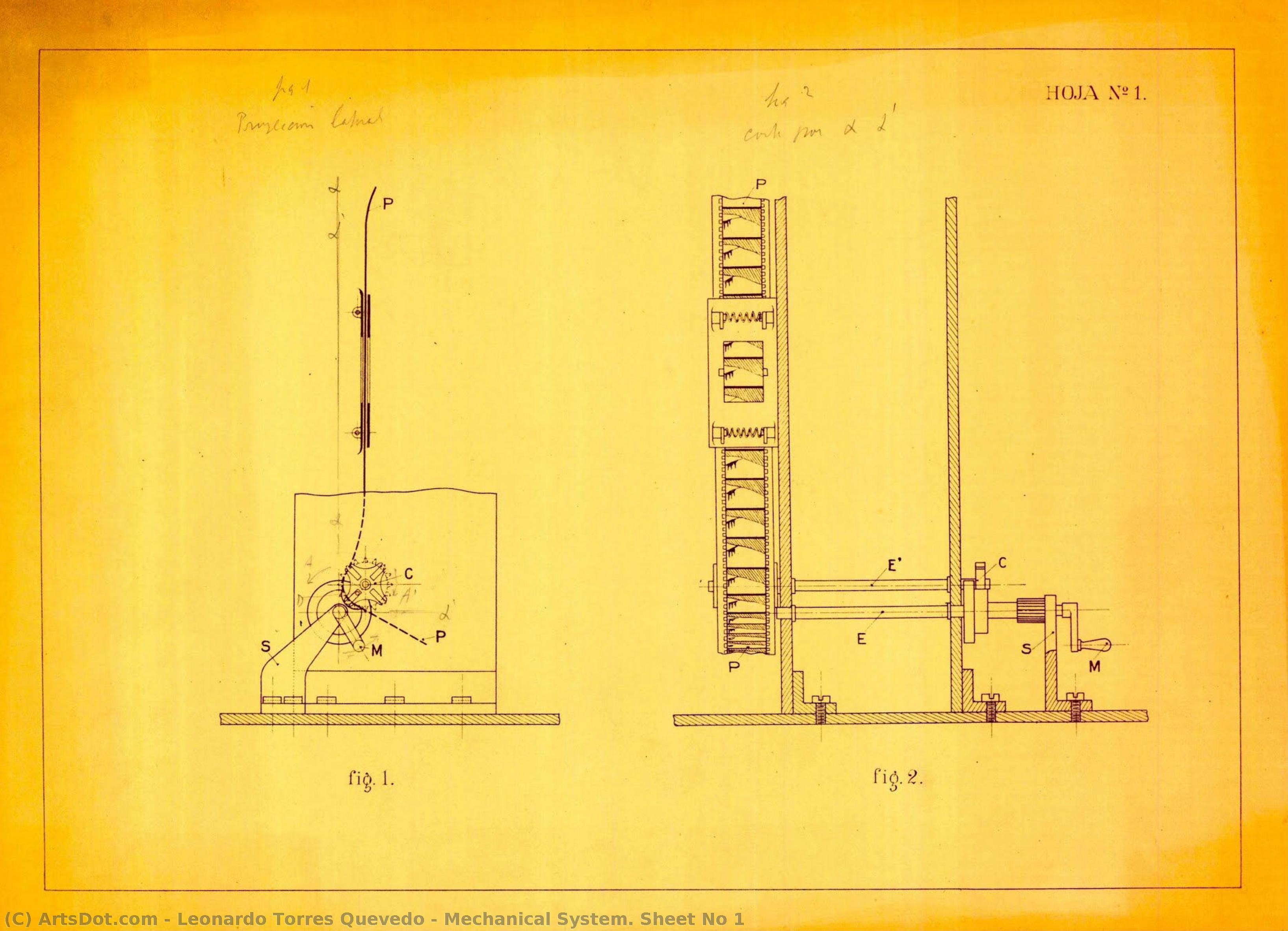
Mechanical System. Sheet No 1

 더 보기
더 보기




































작품의 원본 비율을 유지하는 미리 설정된 크기 중에서 선택하세요.

특정 프레임이나 공간에 맞도록 직접 크기를 입력할 수 있습니다. 선택하신 크기가 원본 이미지의 비율과 일치하지 않는 경우, 작품을 자르거나 추가적인 손으로 그린 요소를 사용하여 그림을 확장합니다. 제작 시작 전 승인을 위해 디지털 목업을 보내드립니다.
화면 미리 보기는 실제 자르기 또는 확장을 반영하지 않습니다. 최종 구성은 목업을 통해서만 정확하게 확인하실 수 있습니다.
맞춤 크기 제작도 가능하지만, 원본 비율을 유지하기 위해 사전 정의된 목록에서 크기를 선택하시는 것을 권장합니다.
주문 후 OriginalUniqueArt.com 팀에서 상세 안내를 위해 고객님께 이메일을 보내드리며, 미리보기 시안을 제공해 드립니다.


 유리 옵션은 110cm 미만 크기에서만 선택 가능합니다.

Mechanical System. Sheet No 1
재현 기법
복제본 크기
-


최종 결제 금액
$ 300
작가 약력
Leonardo Torres Quevedo: A Pioneer of Automation
Early Life and Education
- Born: December 28, 1852, in Spain.
- Leonardo Torres Quevedo was a remarkably versatile individual, excelling as a civil engineer, mathematician, and inventor.
- Details regarding his formal education are somewhat scarce, but he demonstrated an early aptitude for technical subjects and problem-solving.
Engineering Innovations and Early Career
- Torres Quevedo’s initial work focused on practical engineering solutions. He quickly gained recognition for his innovative designs.
- Aerial Trams: One of his first groundbreaking inventions was a cable car system patented in 1887, designed for safe and efficient transportation. This culminated in the Niagara Falls Aero Car in 1916.
- He also made significant contributions to naval architecture, designing innovative vessels like the *buque campamento* (camp-vessel) – a balloon carrier.
Pioneering Work in Computing and Automation
- In the 1890s, Torres Quevedo turned his attention to analog computation. He published influential papers like *Sur les machines algébriques* (1895) and *Machines à calculer* (1901).
- El Ajedrecista (The Chess Player): Created in 1912, this electromagnetic device was capable of playing a limited form of chess. It’s considered an early example of artificial intelligence and programmable machines.
- Essays on Automatics (1914): This work speculated about thinking machines and introduced concepts like floating-point arithmetic, anticipating modern computing principles.
Remote Control and Aeronautics
- Torres Quevedo was a pioneer in remote control technology. He developed the Telekino (1901-1905), laying down the principles of modern wireless remote operation.
- Astra-Torres Airships: During World War I, he invented non-rigid airships that aided British and French forces in countering German submarine warfare. These trilobed structures were a significant aeronautical achievement.
Later Life and Legacy
- Torres Quevedo held important positions, including seat N of the Real Academia Española (1920-1936) and presidency of the Spanish Royal Academy of Sciences (1928-1934).
- He retired in 1930 and passed away on December 18, 1936.
- Historical Significance: Torres Quevedo’s work foreshadowed many developments in robotics, artificial intelligence, and automation. He is now recognized as a visionary inventor whose ideas were far ahead of his time.
Influences and Impact
- Influenced By: While specific influences are not extensively documented, Torres Quevedo’s work demonstrates an understanding of 19th-century mechanical engineering principles and mathematical theory.
- Influenced: His inventions and theoretical contributions influenced subsequent generations of engineers and computer scientists. He laid the groundwork for many technologies we rely on today.

Leonardo Torres Quevedo
1852 - 1936 , Spain
주요 정보
- Birth Date: December 28, 1852
- Birth Place: Spain
- Death Date: December 18, 1936
- Name: Leonardo Torres Quevedo
- Nationality: Spanish
- Notable Works:
- Telekino
- El Ajedrecista
- Astra-Torres airships
- Aerial trams

