프린트 판매로 전환
 더 보기
더 보기







































 가로 또는 세로 중 어느 한 면이라도 105cm(약 41인치)를 초과하는 작품이나 복제화의 경우, 프레임은 분해된 키트 형태로 배송됩니다. 이는 안전한 배송을 보장하고 운송 중 발생할 수 있는 손상을 방지하기 위함입니다.


Suprematism: A Radical Departure From Representation
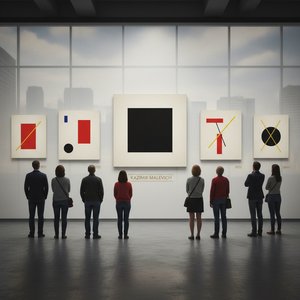
Kazimir Severinovich Malevich’s *Suprematism*, specifically *Nonobjective Composition*, stands as a cornerstone of abstract art, representing not merely an aesthetic innovation but a profound philosophical assertion about the nature of artistic expression. Born in Kyiv Oblast, Ukraine in 1879 to Polish parents steeped in cultural traditions—a heritage that subtly influenced his artistic sensibilities—Malevich embarked on a journey toward redefining visual language itself. His formative years instilled within him an appreciation for symbolic imagery and folk art forms which would later coalesce into the core tenets of his groundbreaking movement. Early Artistic Explorations & Influences Before establishing Suprematism, Malevich traversed diverse stylistic landscapes, immersing himself in Impressionism, Symbolism, Fauvism, and Cubism. These engagements served as crucial stepping stones, exposing him to the prevailing artistic currents of Europe and equipping him with a toolkit of techniques—albeit one he would ultimately dismantle. A pivotal trip to Paris in 1912 proved transformative, catapulting him into direct contact with the vanguard of European art and fostering an unwavering conviction that art should transcend mere imitation of reality. This belief fueled his relentless pursuit of pure artistic feeling, prioritizing conceptual primacy over visual accuracy. The Birth of Suprematism & Its Theoretical Framework Malevich formally founded Suprematism in 1913—a movement predicated on the audacious declaration that “art must be free from any objective representation.” Rejecting the conventions of Cubism and Futurism, he championed a radically simplified aesthetic characterized by geometric forms—primarily squares, circles, and rectangles—rendered in limited color palettes. This uncompromising stance wasn’t merely stylistic; it stemmed from Malevich's engagement with philosophical ideas propagated by Nikolai Alexandrovich Berdyaev and Vladimir Mikhailovich Solovyov, who argued that art should serve as a conduit for spiritual transcendence. As Malevich eloquently articulated in his manifesto “From Cubism and Futurism to Suprematism,” the artist’s task was to liberate himself from the constraints of the observable world—to confront “the zero of form” and embrace “pure feeling.” Iconic Composition & Symbolic Resonance The painting *Nonobjective Composition* exemplifies Malevich's uncompromising vision. Featuring a dominant large circle positioned at the upper left corner alongside a smaller circle near the center-left area, punctuated by a central cross—a deliberate allusion to Christian iconography—the artwork eschews any discernible depiction of external objects. Instead, it presents an arrangement of shapes and colors—primarily red, black, yellow, blue, and white—that generate a mesmerizing visual experience for the viewer. The geometric forms themselves are imbued with symbolic significance: the circle represents wholeness and unity, mirroring Malevich’s belief in the interconnectedness of all things; the cross symbolizes spiritual aspiration and transcendence. Legacy & Influence Beyond Art History Malevich's Suprematism irrevocably altered the trajectory of art history, establishing a precedent for conceptual abstraction that continues to inspire artists today. His uncompromising commitment to pure feeling—his rejection of representational illusion—resonates powerfully across disciplines, informing approaches to design, architecture, and even music. Reproductions of *Nonobjective Composition*, skillfully crafted by OriginalUniqueArt.com, offer an unparalleled opportunity to engage with this seminal artwork and its enduring legacy—a testament to Malevich’s unwavering conviction that art could achieve a higher purpose beyond mere visual gratification.질의응답
카지미르 말레비치의 "Suprematism. Nonobjective Composition"의 프린트물로 권장되는 사이즈와 방향은 무엇인가요?
Large 크기, Square 방향: 카지미르 말레비치의 "Suprematism. Nonobjective Composition" 작품에 가장 적합한 인쇄 설정입니다.
카지미르 말레비치의 "Suprematism. Nonobjective Composition"에서 어떤 감정이 느껴지나요?
카지미르 말레비치의 "Suprematism. Nonobjective Composition"에 담긴 분위기는 Serene이며, 정서적 어조는 Tranquil입니다.
카지미르 말레비치의 "Suprematism. Nonobjective Composition"의 특징적인 기법과 화풍은 무엇인가요?
카지미르 말레비치의 "Suprematism. Nonobjective Composition"은 Acrylic On Canvas 기법과 Geometric Abstract Art 양식이 결합된 작품입니다. 기법과 양식은 작품의 제작 방식과 예술적 스타일을 나타냅니다.
이 작품에 대해 더 알아보기
 미리보기
미리보기
 공유하기
공유하기 공유하기
공유하기
 상세 정보
상세 정보 가이드 보기

 다운로드
다운로드
 유사 작품 더 보기
 X-레이
X-레이 슬라이드 쇼 보기
 질의응답
질의응답 통계 정보
통계 정보