프린트 판매로 전환
 더 보기
더 보기







































 가로 또는 세로 중 어느 한 면이라도 105cm(약 41인치)를 초과하는 작품이나 복제화의 경우, 프레임은 분해된 키트 형태로 배송됩니다. 이는 안전한 배송을 보장하고 운송 중 발생할 수 있는 손상을 방지하기 위함입니다.


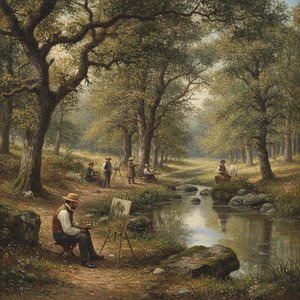
A Tempestuous Soul Captured: Jules Dupré’s “Soleil Couchant Après l'Orage”
Jules Dupré’s “Soleil Couchant Après l’Orage” (Setting Sun After the Storm) isn’t merely a landscape painting; it’s an immersion into the raw, untamed heart of nature. Painted in 1851, during his pivotal years within the Barbizon School, this work transcends simple representation to become a profound meditation on light, shadow, and the melancholic beauty born from elemental forces. It's a scene that whispers of resilience, solitude, and the humbling power of the natural world – an experience readily accessible through high-quality reproductions like those offered by OriginalUniqueArt.com.
The composition immediately draws the eye to a solitary tree dominating the foreground, its branches reaching skyward as if battling the lingering remnants of the storm. Below, a small stream cascades over rocks into a pool, reflecting the bruised hues of the twilight sky. In the distance, a hazy horizon line suggests an expansive vista, hinting at both the vastness and the isolation of the landscape. Dupré masterfully employs a pyramidal structure – a technique borrowed from classical art but imbued with his own intensely personal vision – to guide our gaze towards this central anchor point, creating a sense of stability amidst the apparent chaos.
The Barbizon School: Embracing Nature’s Drama
To fully appreciate “Soleil Couchant Après l’Orage,” it's crucial to understand the context within which Dupré worked – the Barbizon School. Rejecting the idealized landscapes favored by earlier generations, the Barbizon artists sought to capture nature as they *actually* saw it: weathered, dramatic, and often imbued with a sense of melancholy. Unlike Corot, who focused on lyrical beauty, or Rousseau, who emphasized epic grandeur, Dupré wrestled with the darker aspects of the natural world – the fury of storms, the poignant stillness after a tempest. This is evident in the painting’s palpable atmosphere; it doesn't celebrate nature’s splendor but rather acknowledges its power and potential for destruction.
Dupré’s connection to Constable, an English landscape painter known for his atmospheric effects and use of light, profoundly influenced his approach. Constable demonstrated how to capture the fleeting qualities of light and shadow, a skill Dupré expertly translates into this work. The diffused lighting, suggestive of either an overcast sky or the soft glow of twilight, contributes significantly to the painting’s mood – a blend of serenity and underlying tension.
Technique and Materials: A Masterful Impression
The painting is executed in oil paint on wood panel, utilizing broad brushstrokes that create a wonderfully textured surface. Dupré's technique isn't about meticulous detail; instead, he prioritizes capturing the *impression* of light and atmosphere. The loose, expressive lines, particularly evident in the depiction of foliage and water movement, convey a sense of dynamism and immediacy. Notice how the brushstrokes themselves seem to mimic the swirling patterns of the storm clouds – a testament to Dupré’s ability to translate visual experience onto canvas.
The color palette is dominated by cool blues and grays, punctuated by flashes of warm ochre and amber in the setting sun. These contrasting hues create a dramatic interplay of light and shadow, further enhancing the painting's emotional impact. The subtle use of atmospheric perspective – where distant objects appear paler and less distinct – adds depth to the composition without sacrificing its overall sense of immediacy.
Symbolism and Emotional Resonance
The solitary tree in “Soleil Couchant Après l’Orage” is more than just a compositional element; it functions as a potent symbol. Standing resilient against the forces of nature, it embodies themes of endurance, strength, and perhaps even isolation. The storm itself can be interpreted as a metaphor for life's challenges – periods of hardship and uncertainty that ultimately give way to renewal and tranquility. The painting’s overall mood is one of quiet contemplation, inviting viewers to reflect on their own experiences with the natural world and the enduring power of the human spirit.
Reproductions of “Soleil Couchant Après l’Orage” offer a remarkable opportunity to bring this evocative artwork into your home or office. OriginalUniqueArt.com provides high-quality reproductions that faithfully capture Dupré's masterful technique and emotional depth, allowing you to experience the painting’s beauty and symbolism firsthand.
질의응답
"SOLEIL COUCHANT APRES L'ORAGE"은(는) 어느 작가의 작품인가요?
"SOLEIL COUCHANT APRES L'ORAGE"의 작가는 쥘 뒤프레입니다.
"SOLEIL COUCHANT APRES L'ORAGE" 프린트의 권장 용도는 무엇인가요?
쥘 뒤프레의 "SOLEIL COUCHANT APRES L'ORAGE"은(는) Statement(으)로 활용하시기에 가장 좋습니다. 그 외에도 다양한 용도로 사용하실 수 있습니다.
"SOLEIL COUCHANT APRES L'ORAGE"과(와) 유사한 작품이 더 있을까요?
쥘 뒤프레의 "SOLEIL COUCHANT APRES L'ORAGE"과(와) 유사한 작품들은 해당 작품의 유사한 작품들 페이지에서 모아 보실 수 있습니다.
이 작품에 대해 더 알아보기
 미리보기
미리보기
 공유하기
공유하기 공유하기
공유하기
 상세 정보
상세 정보 가이드 보기

 다운로드
다운로드
 유사 작품 더 보기
 X-레이
X-레이 슬라이드 쇼 보기
 질의응답
질의응답 통계 정보
통계 정보